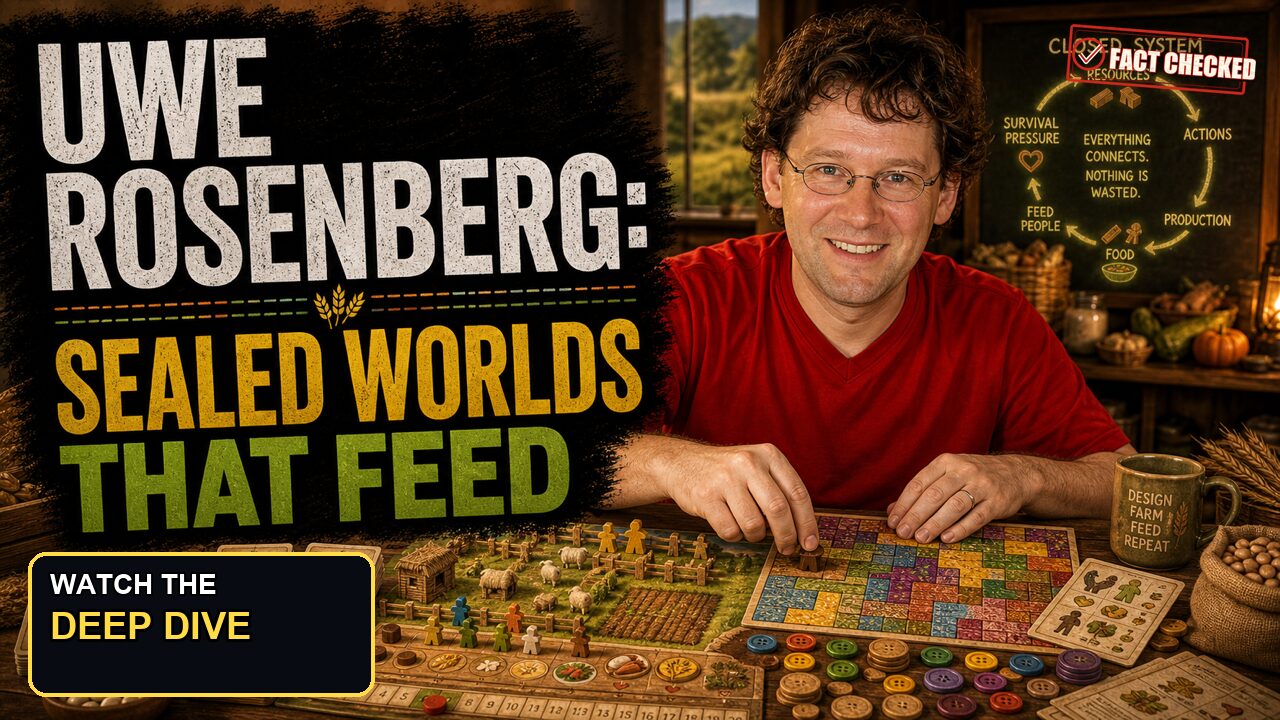
Uwe Rosenberg designs games that feel like rooms with no loose boards.
That is the best way into him.
His games are not loose collections of clever mechanisms. They close. A rule creates pressure, that pressure creates behavior, that behavior reveals the theme, and the theme makes the pressure feel inevitable. In Bohnanza, the order of cards in your hand traps you into negotiation. In Agricola, the family you grow becomes the family you must feed. In Patchwork, every pretty tile is also money, time, income, and an awkward shape.
Nothing is just decoration.
That is why Rosenberg can design a bean-trading card game, a hungry farm, a harbor economy, a cave civilization, a quilt, a Viking household, and a fishing village, and still have all of them feel unmistakably his.
The scale changes.
The seal remains.
The Beans
Before the farms, there were beans.
Bohnanza is one of those games that sounds silly until the rule clicks. You are planting and trading beans. The art is goofy. The table is noisy. Then the central constraint lands: you cannot rearrange the cards in your hand.
That one rule does the work.
It turns a card game into a negotiation engine. The card you do not want yet is coming whether you like it or not. The bean you need may be in someone else’s hand, and their hand has its own awful future. The rules do not merely permit trading. They make trading feel necessary.
That is a Rosenberg signature: a constraint so specific that the game starts generating behavior on its own.
Bohnanza also matters because it shows Rosenberg’s early strength before the heavy boxes arrived. He was already interested in friction. Not random friction, not punishment for its own sake, but a small designed discomfort that makes players talk, plan, bargain, and reveal what they need.
The beans were funny.
The design was serious.
THE TAX
Agricola changed Rosenberg’s public identity.
Worker placement existed before Agricola. Rosenberg did not invent the idea of placing workers on spaces to take actions. What he did was make the mechanism feel biological.
You are not only taking actions. You are growing a household.
That is where the pressure enters. More family members give you more actions, but they also demand more food. Every expansion of power increases the cost of survival. The harvest waits on the calendar. You can see it coming. You know the food bill will arrive. You still want one more room, one more field, one more worker, one more plan.
That tension is the heart of Agricola.
It made worker placement feel less like abstract action selection and more like a life being squeezed by seasons. The personal farm board helped too. Your choices did not vanish into an abstract total. They became fields, fences, rooms, animals, ovens, vegetables, and a household that could either endure or collapse.
Agricola’s influence is not that every later worker-placement game copied its exact structure. The influence is deeper and broader: players came to expect that worker placement could be intimate, thematic, pressured, and personally visible.
You could look down and see the life you had built.
Or failed to build.
The Harbor, The Cave, The Wheel
Rosenberg did not stop at Agricola because the farm had not exhausted the problem.
Le Havre shifted the action into buildings, ships, goods, loans, and an economic harbor. Ora et Labora replaced some accumulation habits with a resource wheel, turning production into a rotating system you could read at a glance. Caverna opened the farm into a larger sandbox of dwarves, caves, rooms, expeditions, animals, and development paths.
These games are not simple sequels.
They are arguments with prior solutions.
Agricola uses card-driven asymmetry and tight survival. Caverna relaxes some of that asymmetry into open information and abundance. Le Havre compresses the worker concept into one central worker and a growing building economy. Ora et Labora asks whether production can be made more elegant through rotation rather than piles.
That iterative habit is part of Rosenberg’s craft. He does not only release a mechanism and move on. He worries it from another angle. If the first version creates pressure through hunger, the next may create pressure through buildings, resource timing, spatial arrangement, or the sheer impossibility of doing everything well.
Each new box talks to the last one.
The Quilt
Patchwork looks like the opposite of Agricola.
It is small. It is short. It is for two players. It is about sewing a quilt. No farmyard sprawl, no giant harvest cycle, no table full of cards. Just buttons, time, and pieces that never quite fit the way you want.
But the design mind is the same.
Every tile is a decision with several costs at once. How many buttons does it cost? How much time does it spend? Does it increase income? Does the shape solve the hole you have now, or create a worse hole later? The time track creates tempo. The button income creates economy. The grid creates spatial pressure.
Patchwork is Rosenberg in miniature.
A closed system. A friendly theme. A real knife under the cloth.
The game also helped push polyomino placement deeper into modern hobby gaming. Polyominoes existed long before Patchwork, but Rosenberg showed how the shape puzzle could fuse with Euro-style economy and timing. After that, shelves filled with games where shapes were not just pieces. They were resources, plans, opportunities, and regret.
The Sealed Room
Rosenberg once described his fascination with hermetically sealed completeness.
That phrase fits him almost too well.
A Rosenberg game often feels like a tiny ecology. Food becomes action pressure. Space becomes money. Time becomes turn order. A sheep becomes two food. A button becomes income. A field becomes a promise you may not be able to keep. Every part leans on another part.
His themes help the systems close.
He returns again and again to work, households, villages, farms, fisheries, harbors, crafts, and common life. These are not pasted-on pastoral scenes. They explain why scarcity matters. They explain why feeding matters. They explain why tools, buildings, animals, and rooms belong in the same loop.
Rosenberg rarely needs kings, empires, or cosmic stakes.
He finds enough drama in dinner.
The Heavy And The Small
One of Rosenberg’s unusual strengths is range inside a narrow voice.
Patchwork can teach quickly and still hurt your head. A Feast for Odin spreads across the table like a private economy with Viking raids, occupations, islands, sheds, goods, and a polyomino grid hungry for better coverage. Fields of Arle turns local history and rural work into an intimate two-player sprawl. Nusfjord feels cleaner and calmer, but still bears the same interest in buildings, timing, and the way a small economy learns to breathe.
The games differ in weight, length, and appetite.
The signature remains recognizable.
Rosenberg wants the system to be complete. He wants the player to feel the consequence of every piece. He wants a mechanism to justify itself by becoming necessary.
That is not flash.
It is carpentry.
The Craftsman, Not The Showman
Rosenberg’s own language about design tends to be practical. He talks about craft, bad ideas, prototypes, and the value of throwing things away. That fits the work better than the language of inspiration.
His games do not feel like lightning strikes. They feel planed, sanded, tested, and rebuilt. Bohnanza does not need extra chrome because the locked hand already does the job. Patchwork does not need a large deck of events because the time track and tile market keep producing small emergencies. Agricola does not need a villain because the harvest is enough.
That restraint is part of his power.
He is also unusually comfortable letting a game be about ordinary labor. Many designers reach for spectacle when they want drama. Rosenberg reaches for scarcity, chores, awkward shapes, and the problem of feeding people. The drama comes from competence under pressure. Can you make the farm work? Can you leave fewer holes in the quilt? Can your little economy breathe one more round?
It is quiet material.
Then the system tightens.
What He Actually Built
Uwe Rosenberg did not invent worker placement. He did not invent polyominoes. He did not create negotiation games, farming games, or solo board gaming by himself.
What he built was a body of designs that made constraint feel alive.
Bohnanza made hand order create social necessity. Agricola made family growth and feeding pressure reshape worker placement. Patchwork made a spatial puzzle behave like an economy. His larger games turned subsistence, production, and space into closed systems where nothing feels optional for long.
That is his real contribution.
He did not just add mechanisms to themes.
He made the theme explain why the mechanism had to hurt.
Where To Find Him
Rosenberg remains active, with recent credits and publisher pages showing his work continuing into the mid-2020s, including Black Forest with Tido Lorenz and newer listings beyond it. His back catalog remains widely available through publishers such as Lookout Spiele, Feuerland Spiele, and other international partners.
For most players, the best way to find him is still through the games themselves.
Start with Bohnanza if you want the social constraint.
Start with Agricola if you want the hunger.
Start with Patchwork if you want the smallest sealed room.
Then follow the doors inward.
Fact Check Notes
Publication notes
This site is AI-assisted and human-reviewed. We use artificial intelligence to help gather research, organize source material, and draft profile content. Human editors then read, revise, and check each profile before it goes live. Most profiles are built through deep AI research and two separate rounds of fact-checking.
Leave a Reply
You must be logged in to post a comment.