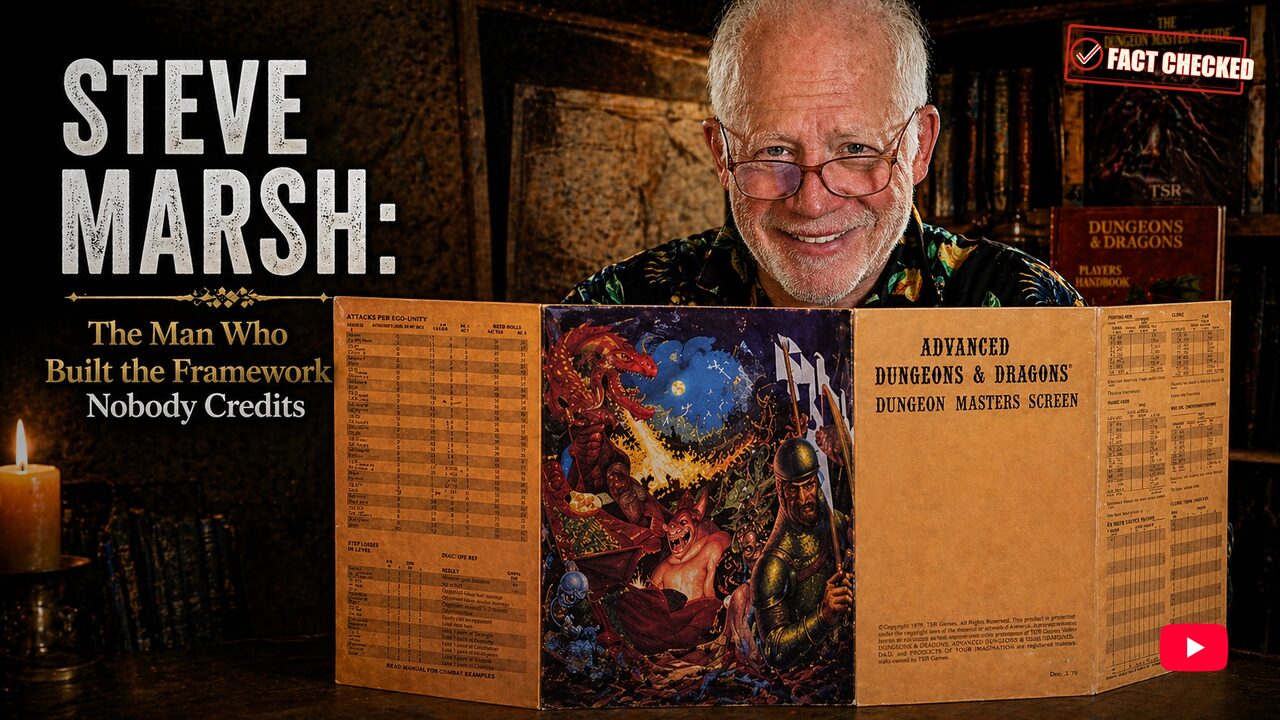
Every D&D player knows the alignment chart. Lawful Good. Chaotic Evil. Nine combinations that define how characters think, act, and betray each other across a table.
Most of them don’t know where it came from.
Steve Marsh contributed to the development and expansion of that system. The original game had three options: Lawful, Chaotic, Neutral. Marsh argued that wasn’t enough. Good and Evil needed their own axis. The evolution was gradual and collaborative, with Gygax crediting multiple influences, but Marsh’s push for a two-axis model helped shape what became one of the most recognized frameworks in gaming history. It eventually escaped the hobby entirely to become an internet meme, a personality shorthand, and a cultural reference point used by people who’ve never touched a twenty-sided die.
Like many early contributors, Marsh’s compensation and credit were inconsistent. Some acknowledgments exist. Many don’t. And that pattern, building foundational structures that other people build on, runs through everything he’s done since.
The Kid With The Bestiaries
Marsh was born in 1955 in Los Angeles County. His father was a technical sergeant in the Air Force, which meant the family moved constantly. Trailer parks, new schools, new towns. His maternal grandfather was George Emmanuel Mylonas, a professional archaeologist. His paternal grandfather finished a career as a cultural attache, rotating between Austria and Jordan.
That combination, military discipline and scholarly curiosity, shows up in everything Marsh designed. He wasn’t building fantasy from pure imagination. He was researching it.
At BYU, where he studied applied economics before law school, Marsh spent hours in the university library pulling from actual medieval bestiaries. Edward Topsell’s Historie of Four-footed Beastes. Andre Thevet’s accounts of New World creatures. He took a historical text that grossly misinterpreted opossums carrying young on their backs, described as "raveners and untamable wilde beasts," and turned it into the Su-monster: prehensile feet, psionic abilities, a permanent fixture in the D&D bestiary.
That’s not how most game designers worked in 1975. Most of them were pulling from Tolkien and pulp fantasy. Marsh was pulling from primary sources.
It was at BYU that he sat next to Sandy Petersen in a class. Petersen, who would later create Call of Cthulhu, had the original D&D rulebooks with him. Marsh started asking questions. That conversation opened the door to everything that followed.
Populating The Ocean
In 1975, the oceans of D&D were empty.
The game had dungeons. It had wilderness. It had monsters for both. But the water was a blank page. Marsh filled it. He designed an entire underwater ecology for the Blackmoor supplement: the Sahuagin, the Kuo-toa, the Ixitxachitl. These weren’t stat blocks with fins. They were societies. Cultures with hierarchies, religious structures, military tactics. The Kuo-toa brought deep-sea Lovecraftian horror into the game, reflecting Marsh’s shared interest in weird fiction with his college peer Petersen.
When Gygax compiled the AD&D Monster Manual in 1977, he thanked Marsh in the preface for the undersea encounters. Those creatures have appeared in every edition of D&D since. Nearly fifty years running.
Marsh also proposed a character class called the Mystic, built around teleportation and mental powers. The class itself was never published in that form, but the underlying mechanics were adapted into the first psionic powers in Eldritch Wizardry (1976). Psionics in D&D evolved through multiple designers, but some of the earliest conceptual seeds came from what Marsh submitted.
For most of this work, compensation was minimal or nonexistent. That was how the hobby operated in those years. Collaborative, generous, and financially informal.
The Expert Set And The Lost Companion
In the summer of 1980, Marsh took a break from law school to work at TSR’s offices in Lake Geneva.
He became lead writer on the 1981 D&D Expert Set, collaborating with David "Zeb" Cook. The Expert Set was the product that took D&D out of the dungeon. Where the Basic Set confined players underground, the Expert Set gave them the wilderness: hex-crawl travel, outdoor survival, encounters at scale, the first steps toward domain-level play. The B/X line (Basic and Expert together) remains a cornerstone of the Old School Renaissance because of how cleanly those systems were designed.
While at TSR, Marsh also co-created Saga: Age of Heroes, a Viking-themed board game. It was the only project from this era for which he received royalty payments.
There was supposed to be more. Marsh and Gygax had been collaborating on a hardcover called The Planes of Existence, an AD&D sourcebook governing travel between dimensions. Fragments appeared in Dragon magazine, but the book was never published after Gygax’s departure from TSR. Marsh also drafted a Companion Set that would have extended the B/X line to level 25, featuring planar travel and new classes. That set was shelved when TSR shifted to Frank Mentzer’s BECMI system.
The community hasn’t forgotten. There’s still an active group online, the Steve Marsh Companion Project, working to reconstruct and playtest those original drafts.
The Courtroom
After TSR, Marsh finished his law degree at BYU, passed the bar in 1982, and moved to Texas in 1985.
He became a litigator. A career spanning more than three decades, focused on litigation, appeals, and eventually mediation. The same mind that could balance encounter tables and ecological models turned out to be well suited for evidence analysis and appellate argument.
But the work that mattered most to him wasn’t adversarial. It was mediation.
In 1997, Marsh founded ADR Resources (adrr.com), a digital repository for alternative dispute resolution professionals. He became an advocate for consensus-based mediation, arguing that the traditional courtroom model, where one side’s victory necessarily comes at the other’s expense, was the wrong tool for most human conflicts. He contributed to mediation scholarship and authored Public Policy Mediation, advocating for interest-group mediation as a tool for improving governmental lobbying practices.
There’s a pattern worth naming here. In D&D, Marsh built frameworks that helped people navigate imaginary conflicts. Alignment charts, encounter systems, rules for how characters with different values coexist in the same world. In law, he built frameworks that helped people navigate real ones. Mediation structures, consensus models, systems for resolving disputes without destroying the relationship between the parties.
Different arena. Same instinct. Build the scaffold. Let other people use it.
He retired from active litigation on March 15, 2019.
The Losses That Shaped Him
This is the section that puts everything else in context.
Marsh has written openly about navigating profound family loss, including the deaths of three of his children.
He has never hidden from that grief. He writes about it without hollow comfort, bringing the same analytical honesty to loss that he brings to everything else. His essays on the biblical figure of Job read differently when you know they come from someone who lived that kind of devastation.
That proximity to real suffering is present in his mediation philosophy, in his advocacy for troubled youth, in his theological writing on the Wheat and Tares blog where he argues that faith should be measured by compassion, not certainty. It’s the thing that separates his systems thinking from cold abstraction. The frameworks aren’t academic exercises. They come from someone who needed them to work.
The Trail And The Table
Marsh didn’t stop after retirement.
He took up long-distance backpacking. He has hiked most of the Pacific Crest Trail and the Continental Divide Trail, plus all or parts of several shorter trails. His time on the Appalachian Trail was a shorter stint in the Smokies, where he playtested game material with fellow hikers. His trail name is "d20." That detail tells you everything about the man: retired lawyer, seventy years old, hiking mountain ridges with a twenty-sided die in his pack.
He remains active in the Old School Renaissance community. He’s a regular at North Texas RPG Con, where he runs historical scenarios and original modules for fans who grew up playing games built on frameworks he designed. In 2008, the First Edition Society published Monsters of Myth, an anthology of weird creatures by multiple authors. Marsh contributed Lovecraft-inspired entries he had created for his home games decades earlier.
His credit trail also reaches beyond TSR. Public RPG indexes connect Marsh to A Companion to Superworld, a Chaosium-era superhero supplement that sits in the Superworld, Champions, HERO System, and Villains & Vigilantes space, and to later Glorantha and HeroQuest material in the Greg Stafford orbit.
He’s still writing. Still running games. Still building systems for other people to use.
What He Actually Built
Steve Marsh helped build three things that millions of people use without knowing his name.
The alignment system. The underwater ecology of D&D. Early concepts that fed into psionics. Each one became a lasting part of the game. Each one was contributed during the hobby’s collaborative early years, then carried forward through every edition by designers who inherited the framework without necessarily knowing who shaped it.
He co-wrote the Expert Set that took D&D out of the dungeon and into the wilderness. He drafted a Companion Set and a Planes book that were never published but still generate community interest decades later. He then spent thirty-five years applying the same structural instinct to real-world conflict resolution through mediation and legal scholarship.
The pattern is consistent. Marsh builds scaffolding. Other people build on it. The scaffolding holds.
He’s never been a household name in gaming. He’s never been the person whose face goes on the cover. But the next time someone at a table says "my character is Chaotic Good" or fights a Sahuagin in an underwater temple, they’re using ideas Steve Marsh helped put into the game fifty years ago.
Where To Find Him
Marsh is still active. He attends conventions, runs old-school games, writes about mediation and theology, and racks up miles on long trails like the PCT and CDT with a trail name that tells you exactly where he came from.
You can find him on Facebook, where he posts about gaming history, ongoing projects, and the occasional trail update from somewhere on the ridge.
He’s the one who built the floor you’re standing on.
Fact Check Notes
Publication notes
This site is AI-assisted and human-reviewed. We use artificial intelligence to help gather research, organize source material, and draft profile content. Human editors then read, revise, and check each profile before it goes live. Most profiles are built through deep AI research and two separate rounds of fact-checking.
Leave a Reply
You must be logged in to post a comment.