Tabletop Game Iconic Company
Alliance Game Distributors
Alliance Game Distributors began with two companies that had learned the hobby business from opposite sides of the table.
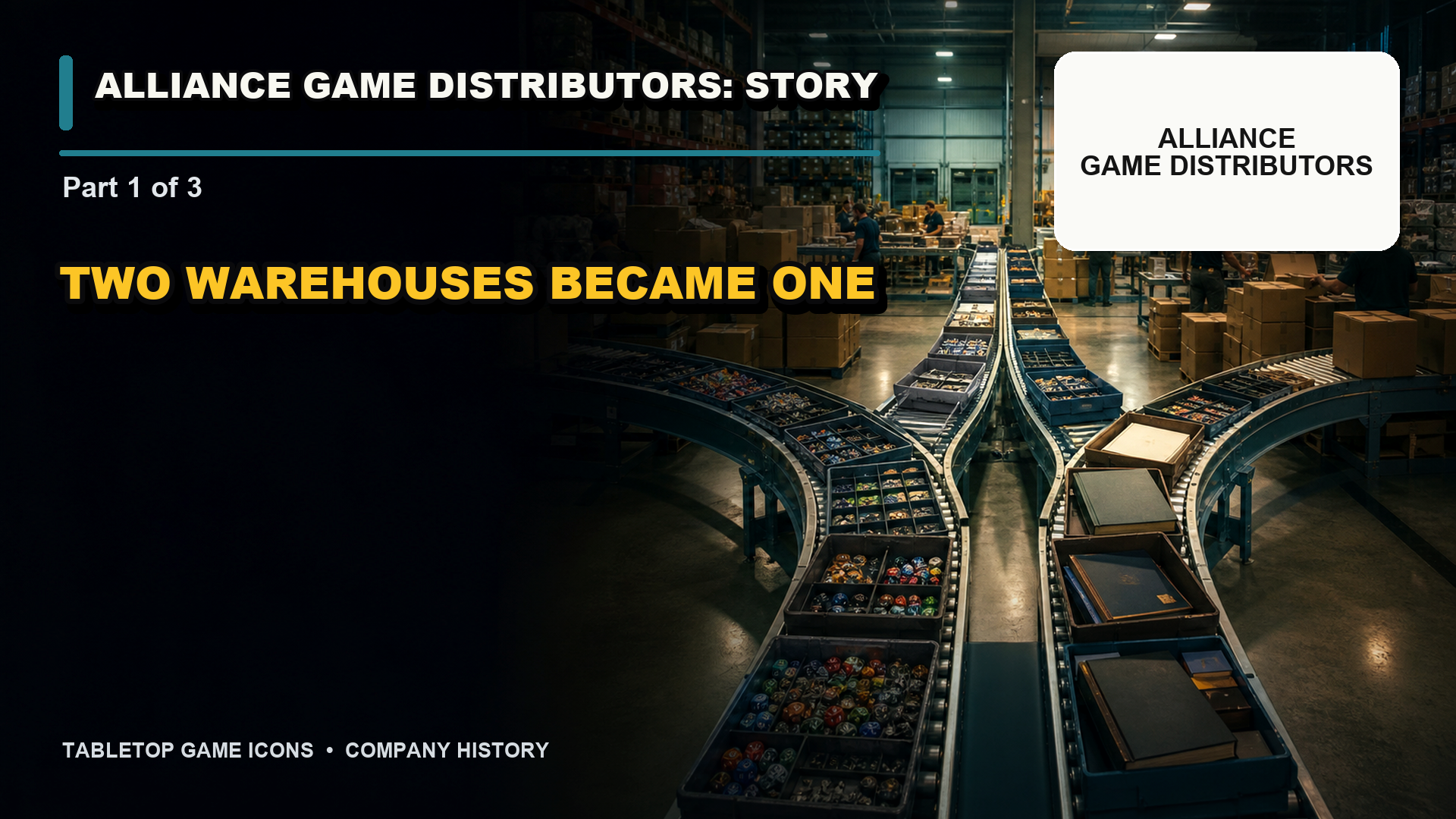
THE TWO WAREHOUSES BECAME ONE
Alliance Game Distributors began with two companies that had learned the hobby business from opposite sides of the table.
The Armory grew from the eastern United States. Roy Lipman founded the business in 1976, when roleplaying games were moving out of specialist circles and into a national network of hobby shops. The Armory supplied retailers with games and accessories, and it became especially familiar for dice. By the late 1990s it ranked among the largest American distributors serving roleplaying games and collectible card games.
The western side came through Don Reents. He opened Games of Berkeley in 1980, then built Berkeley Game Company and Berkeley Game Distributors. Chessex emerged from that activity as both a distribution business and a manufacturer of dice and gaming accessories. Chessex products became fixtures at tables, but its distribution operation did something less visible and just as important: it connected publishers with independent stores that could not buy every line directly.
Distribution is the part of tabletop gaming most players never see. A publisher can design a brilliant game and a retailer can know exactly which customers might love it, yet the product still has to cross the country in sensible quantities, on credit terms the store can support, with enough information to place an order before release. Warehouses, catalogs, sales representatives, freight schedules, and reorder systems make that possible.
By 1998, the industry had changed. Magic: The Gathering had created a new category of collectible play. Roleplaying games remained important, miniatures were growing, and specialty stores needed access to a wider range of products. Scale mattered. A distributor with more publishers could consolidate shipments. A distributor with more retailers could offer publishers broader reach.
Chessex and The Armory answered that pressure by combining their distribution operations. A contemporary trade notice reported that the new company formed officially on September 30, 1998, with the public announcement following that afternoon. The name was Alliance Game Distributors.
The transaction was really two combinations. The distribution arms became Alliance, while the manufacturing operations combined separately as Chessex Manufacturing. That distinction matters. Alliance did not become the maker of every Chessex die, and Chessex Manufacturing did not become the national distributor. They shared an origin but followed different corporate paths.
The merger brought together eastern and western relationships, facilities, staff, and customer accounts. Contemporary descriptions called Chessex and The Armory two of the country’s largest game distributors. The combined business immediately had the reach to claim the leading position in American hobby-game distribution.
Its value came from concentration. A neighborhood game store did not want dozens of separate freight bills and credit applications. Alliance could offer one account carrying roleplaying books, board games, trading cards, miniatures, dice, paints, and accessories. A small publisher did not want to contact thousands of stores individually. Alliance could place its products before buyers already assembling monthly orders.
That convenience produced influence. The catalog did more than report what existed. Product descriptions, release windows, preorder deadlines, and sales attention could determine what retailers noticed. Stocking decisions at the warehouse could help a new title reach stores or leave it difficult to find. Alliance occupied the middle of the market, where information and physical inventory met.
The company’s creation also belonged to a larger wave of consolidation. Hobby distribution had once been regional, built from local stores and small warehouses. As product lines multiplied, national retailers and publishers preferred partners that could cover more territory. The same forces were reshaping comic-book distribution, where Diamond Comic Distributors had grown from a Baltimore retailer’s supply operation into the dominant national company.
Diamond and Alliance were not yet one business in 1998. They served related markets, however, and many stores sold both comics and games. The logic of joining their networks was easy to see: one side understood weekly comic shipments and publisher solicitations; the other understood games, cards, miniatures, and accessories.
In 2000, Diamond acquired selected Alliance assets and liabilities. Public histories often simplify the deal by saying Diamond bought Alliance, which is functionally accurate but hides the legal structure. Alliance became the game-distribution operation inside the broader Diamond organization. Later reorganizations placed the names within Steve Geppi’s Geppi Family Enterprises network.
Alliance continued to operate under its own identity because the hobby trade required specialized knowledge. A box of board games did not move like a weekly comic shipment. Trading-card allocations, miniature lines, rulebook reprints, organized play, and long-tail accessories created their own demands. Keeping the Alliance name preserved relationships built by Chessex and The Armory while giving the operation access to Diamond’s larger infrastructure.
In 2001, the business acquired certain assets of Berkeley Distributors and Barchetta Distribution, strengthening its western reach. The national pipeline was taking shape.
Players would know the games.
Retailers would know the Alliance account number.
The warehouse connecting them had become one of the most powerful institutions in the hobby.
The 1998 combination gave Alliance more than size. It joined knowledge accumulated through retail, manufacturing, and regional distribution. Reents’s western businesses understood stores from the counter outward. The Armory understood the demands of supplying a broad roleplaying and card-game market. The new company could use those perspectives when deciding what to stock and how to present it.
Retailers experienced Alliance as a practical middle layer. It translated hundreds of publisher catalogs into one ordering relationship, extended credit, broke large shipments into store-sized quantities, and accepted the cost of keeping slow and fast products in the same system. The work was valuable precisely because no single game company wanted to perform it for every other publisher.
Publishers gained an indirect sales force. A small press title listed beside established brands had at least a chance to be noticed by buyers already placing orders. Distribution did not guarantee success, and sales attention was never equal, but it removed the impossible requirement that every designer build a warehouse network.
The Diamond acquisition extended that logic into a related specialty market. Comic stores were adding games, and game stores were adding comics and graphic novels. Shared corporate resources created opportunities for consolidated service while Alliance’s separate identity reassured a trade with its own release patterns and vocabulary.
The company’s beginning was therefore not a dramatic product launch. It was the construction of infrastructure. Alliance became important by making other companies easier to find.
THE PIPELINE TO GAME STORES
Alliance Game Distributors reached its height without putting its name on the front of the games it helped sell.
Its work happened before a customer entered a store. Publishers announced products, Alliance collected information and orders, warehouse teams received pallets and cases, and retailers combined many product lines into scheduled shipments. When the system worked, a new roleplaying book, board game, miniature release, and package of dice could arrive together.
That efficiency mattered most to independent stores. A local game shop rarely had the buying power, storage, or staff to maintain direct accounts with every publisher. Alliance gave the retailer access to a broad catalog through one commercial relationship. It also gave publishers a route into thousands of stores without building their own national sales and freight systems.
The company distributed roleplaying games, collectible and trading-card games, board games, miniatures, hobby supplies, and accessories. Its supplier relationships eventually included some of the largest names in tabletop gaming. Before the 2025 bankruptcy of its parent structure, court filings identified Wizards of the Coast, Bandai Namco, and Pokémon among important parts of the business. The products moving through Alliance warehouses included Dungeons & Dragons, Magic: The Gathering, Pokémon cards, miniature games, and modern hobby board games.
Alliance also published Game Trade Magazine. The publication worked as a catalog, news source, and sales tool, presenting forthcoming products to retailers and players. The bankruptcy declaration later reported a monthly print run above 17,000 copies. Like Diamond’s PREVIEWS catalog in comics, Game Trade Magazine turned advance information into an ordering cycle.
This was more than advertising. Specialty retail depends on timing. Stores need to know what will ship, when orders close, whether supply may be allocated, and which products have organized-play or marketing support. A distributor that coordinates those facts becomes part of the market’s nervous system.
Alliance’s warehouse network extended that system across the United States. By the final years of the old Diamond ownership, facilities in Visalia, California; Austin, Texas; Fort Wayne, Indiana; and Red Lion, Pennsylvania served the operation. Company materials said the network could reach most of the country within two days. That promise required inventory positioned near customers, working software, reliable freight, and enough sales volume to keep every location efficient.
The business served independent game and hobby stores while also supplying larger accounts, including booksellers. Its broad product mix softened some of the risks faced by a distributor tied to one format. Board games, cards, miniatures, and roleplaying products did not all rise and fall together.
Alliance benefited from being attached to Diamond Comic Distributors. Many comic shops sold games, and many game shops sold graphic novels or collectibles. Shared corporate infrastructure could support credit, warehousing, publisher services, and retailer relationships across overlapping markets. For store owners, consolidated access meant fewer separate systems to manage.
The relationship is often described incorrectly. Alliance was not Alliance Entertainment, the unrelated public company that later bid for Diamond’s assets. Alliance did not own Diamond. For much of the period after 2000 it functioned as Diamond’s game-distribution operation, and later descriptions treated Diamond and Alliance as related businesses under the Geppi organization. Legal filings in 2025 described Alliance as an operating division of Diamond Comic Distributors rather than a separate Chapter 11 debtor.
That structural detail became important because Alliance’s performance diverged from the comic side. Diamond’s exclusive comic-publisher relationships began eroding after 2020. Alliance, by contrast, grew. Bankruptcy records reported Alliance distribution sales rising from about $85.5 million in 2020 to $149.1 million in 2023.
Growth did not mean easy profits. Large distribution businesses carry expensive inventory, extend credit, depend on freight, and require warehouses and software whether every shelf is full or not. Hot products may be allocated. Slow products consume space and cash. A distributor can report rising sales while the larger enterprise around it struggles with debt and overhead.
Supplier concentration created another risk. A few major lines could represent a large share of revenue. When a publisher changed distributors or terminated an agreement, the lost volume could make the entire network less efficient. The system’s strength came from combining many orders. Remove enough important products and the same warehouses became costly.
Still, Alliance remained the more resilient side of the combined operation. Steve Geppi called it a “juggernaut” in a 2023 interview. The word captured how the company appeared inside the hobby: not glamorous, rarely discussed by players, but enormous in practical reach.
Its influence could be seen in ordinary store life. A retailer could preorder a small press roleplaying game, restock dice, take a chance on a new board game, and secure a limited card release through the same relationship. A publisher could print a title knowing there was a recognized path to shelves. The distributor did not create the demand, but it organized the route demand traveled.
That route survived changing fashions, recessions, and the rise of online retail. It also depended on trust. Publishers trusted the distributor with inventory and payments. Stores trusted it with credit and release dates. Customers trusted stores to have products when promised.
By 2024, Alliance was still moving an extraordinary volume of games.
The comic business beside it was shrinking.
The pipeline worked, but the corporate structure carrying it was running out of time.
Every part of Alliance’s service required working capital. The distributor paid for or took responsibility for inventory before retailers completed their own sales. It extended terms, managed returns where contracts allowed them, absorbed freight timing, and held products whose demand could change after a single review or announcement.
Collectible products made the balance especially delicate. A scarce card release could create allocations and frustrated stores, while an overprinted set could occupy valuable warehouse space. Board games and roleplaying books had longer sales lives but required thousands of individual stock records. Miniature and accessory ranges multiplied those records further.
Alliance’s scale let it manage that complexity better than most competitors. The same scale created large fixed costs. Four distribution centers could offer fast national delivery only if enough profitable product moved through them. Supplier concentration meant a change in one major relationship could affect labor, freight, inventory turns, and credit across the network.
The company’s strong growth through 2023 made it attractive when the broader Diamond organization sought a buyer. It also made the dependence visible. Alliance was not an isolated healthy company sitting beside a failed one. It shared ownership, systems, financing, and legal structure with the group. Saving the game-distribution operation would require separating a working pipeline from the obligations around it.
THE NETWORK CHANGED HANDS
Alliance Game Distributors did not collapse because Americans stopped playing tabletop games.
It was pulled into the bankruptcy of the larger Diamond structure that owned and operated it.
Diamond Comic Distributors entered Chapter 11 in Maryland on January 14, 2025. Alliance was not listed as a separate debtor because court records treated it as an operating division of Diamond. The filings described a company burdened by debt, trade obligations, declining comic volume, rising costs, and an unsuccessful sale effort begun before bankruptcy.
Alliance was one of the estate’s most valuable assets. It had warehouses, retailer accounts, supplier relationships, staff, ordering systems, and a recognized name. Universal Distribution, a Canadian hobby distributor founded in 1989, supported the case with a $39 million stalking-horse bid for the Alliance business.
The auction did not follow a simple path.
Alliance Entertainment Holding Corporation, a Florida-based distributor with no corporate connection to Alliance Game Distributors, emerged in March 2025 as the winning bidder for a larger package of Diamond assets. The coincidence of names caused confusion in public reporting. Alliance Entertainment was the proposed buyer; Alliance Game Distributors was one of the businesses it intended to buy.
That transaction never closed. In April, Alliance Entertainment terminated its asset-purchase agreement and later pursued claims concerning the sale process and disclosures. One crucial issue involved the ending of a Wizards of the Coast distribution agreement, a relationship reported to represent roughly one quarter of Alliance’s sales. Those allegations became part of litigation and should not be reported as finally adjudicated facts.
The bankruptcy court approved a replacement transaction dividing the assets between Universal Distribution and Ad Populum. Public reporting placed the combined value near $49.6 million, though totals varied depending on inventory, liabilities, credits, and adjustments.
Universal acquired the Alliance Game Distributors assets for a base amount reported near $42.1 million, subject to adjustment. Ad Populum’s acquisition vehicle took a separate package built around Diamond’s comic, book, toy, and grading operations. Public announcements dated completion to May 16, 2025, while later pleadings indicated Universal’s Alliance closing occurred on May 14.
The split mattered. Alliance and Diamond had shared ownership and infrastructure for about twenty-five years, but the sale separated their futures. The game-distribution network went to an established distributor with a related business. The comic-distribution and brand assets went elsewhere.
Universal continued operating Alliance through 2025. The continuity was practical rather than corporate nostalgia. Retailers still needed orders filled. Publishers still needed inventory placed. Warehouse staff, data, accounts, and product relationships carried more value as an operating system than as pieces sold separately.
On December 31, 2025, Universal formally rebranded its American operation from Alliance Game Distributors to Universal Distribution. The change accompanied a new website and business software. It also widened the American product offering beyond the former Alliance mix.
The Alliance name therefore reached an endpoint as a principal national distribution brand, but the network did not vanish. Its facilities, expertise, customer relationships, and supplier connections became part of Universal’s United States business. This was an asset-sale succession, not the survival of the old owner by merger.
That distinction protects the history from a tempting shortcut. It would be wrong to say Universal simply became the same company founded in 1998. It would also be wrong to say Alliance disappeared without a successor. The legal entity and brand history changed, while much of the working distribution platform continued.
Alliance’s twenty-seven-year run shows what a distributor contributes to a creative industry. It did not design Dungeons & Dragons, invent trading cards, sculpt miniature armies, or author board games. It made thousands of those products commercially reachable.
The service was especially important for small publishers. A creator could not visit every game store in North America. A new company might have only a few products and little bargaining power with freight carriers. By consolidating many publishers, Alliance made a national market possible for businesses that could never have built one alone.
Retailers gained a similar advantage. One store could explore unfamiliar titles without opening a new direct account for each experiment. It could reorder proven products, preorder announced releases, and combine categories in a manageable shipment. Distribution lowered the friction between curiosity and a place on the shelf.
The model also concentrated risk. A shared pipeline can become a bottleneck. Publishers and retailers depend on its credit, inventory accuracy, and delivery performance. Major supplier departures can destabilize the network. The 2025 sale exposed how relationships that looked durable could change the value of a business within weeks.
Alliance’s legacy is therefore both constructive and cautionary. It helped professionalize hobby distribution and supported the expansion of specialty retail. It also demonstrated how much power and vulnerability can gather in the quiet space between a publisher and a store.
The company began when two warehouses became one.
It ended when one network was separated from the corporation around it.
The boxes kept moving because the network was worth saving.
Universal’s acquisition illustrates the difference between a brand and an operating capability. A name can change on a website in one day. Rebuilding vendor trust, retailer credit, warehouse knowledge, and product data would take years. The buyer preserved value by continuing the relationships and systems that made Alliance useful.
The ending also clarifies why the 2025 auction produced so much confusion. Alliance Entertainment, Alliance Game Distributors, and Universal Distribution were three different companies. The first was an unrelated bidder whose proposed purchase failed. The second was the business being sold. The third became the successful buyer and eventual name of the American operation.
The Wizards of the Coast issue demonstrated how quickly a distributor’s value could shift. A major supplier relationship represented not merely one product line but traffic supporting the entire network. The resulting lawsuits concern disputed disclosure and conduct. Until courts resolve them, the safe history is that the contract change affected the sale and the parties contested responsibility.
Alliance’s legacy continues in every discussion about whether tabletop distribution should be consolidated or diverse. Centralization can lower costs and open national access. Multiple distributors can reduce dependence and give publishers alternatives. Stores pay for either model through freight, staff time, credit complexity, or vulnerability to one company.
For twenty-seven years, Alliance made centralization work well enough that most players never needed to learn its name. That invisibility was evidence of the service, not its absence.
Fact Check Notes
Publication notes
This site is AI-assisted and human-reviewed. We use artificial intelligence to help gather research, organize source material, and draft profile content. Human editors then read, revise, and check each article before it goes live.
Leave a Reply
You must be logged in to post a comment.