Tabletop Game Iconic Company
Ideal Toy Company
The teddy-bear pioneer that turned licensed ideas and mechanical spectacle into a mass-market toy empire.
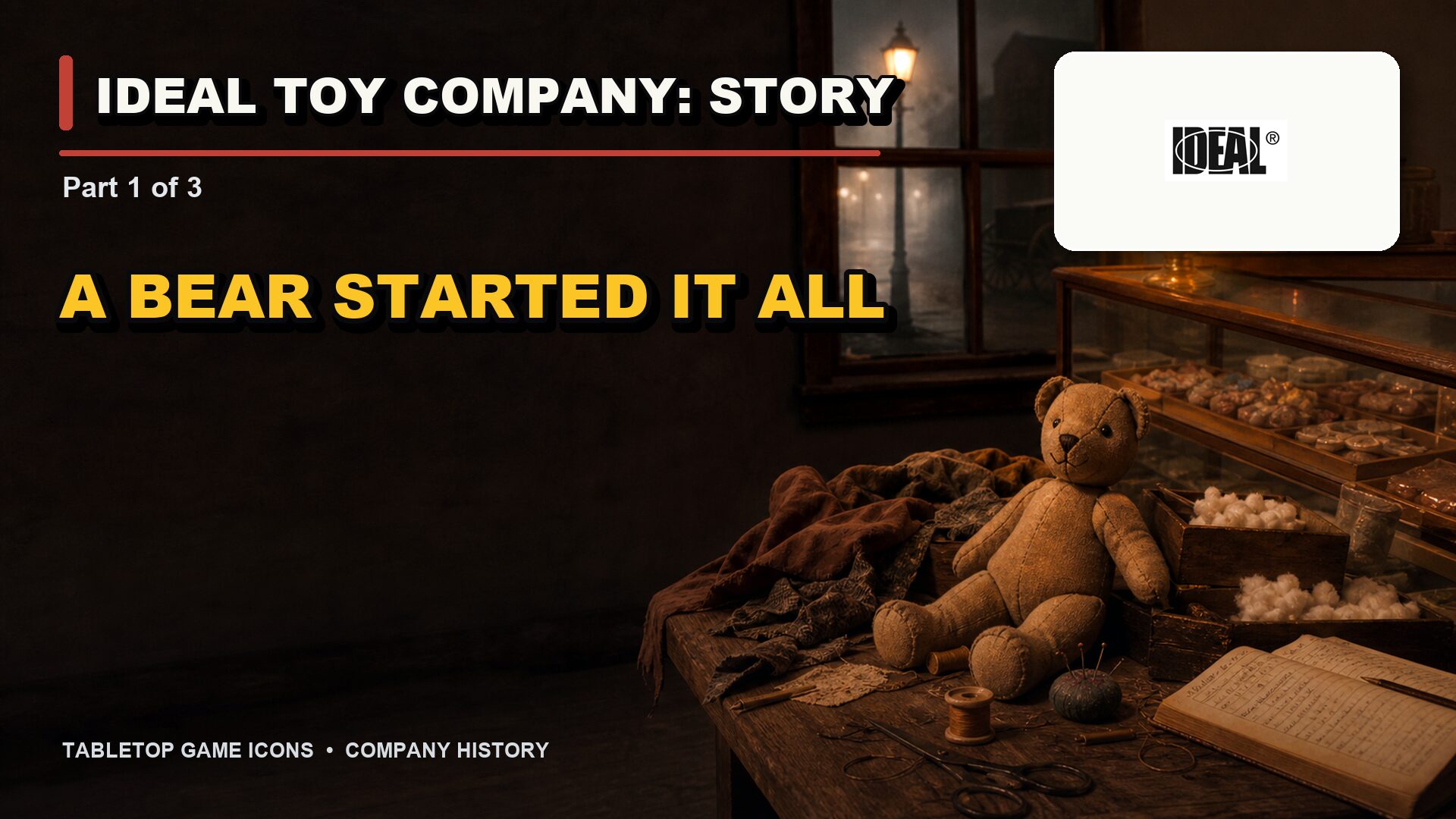
A BEAR STARTED IT ALL
The Ideal Toy Company began in a Brooklyn candy shop with a small stuffed bear and a story that grew larger with every retelling.
Morris and Rose Michtom were Jewish immigrants from Russia who ran a candy and novelty shop at 404 Tompkins Avenue. In November 1902, President Theodore Roosevelt refused to shoot a bear that guides had tied up during a Mississippi hunting trip. Clifford Berryman turned the episode into a political cartoon. According to Michtom family tradition, Rose sewed a bear cub, Morris placed it in the shop window as “Teddy’s Bear,” and Roosevelt permitted them to use his nickname.
The broad outline is famous. The evidence is less tidy.
Roosevelt’s hunt and Berryman’s cartoon are documented. The permission letter has never been found, and the family’s version did not appear in print until decades later. The German firm Steiff developed a jointed toy bear independently at about the same time. The safest history is also the most interesting: the modern teddy bear had nearly simultaneous American and German origins, and the Michtoms created the American version that helped give the toy its enduring name.
The surviving Michtom bear in the Smithsonian is dated to about 1903. Formal company dates vary among sources. Bear making began around 1902 or 1903, while the organized business appears to have taken shape closer to 1907 with help from the wholesale firm Butler Brothers. Some sources use 1908. The company’s origin should therefore be understood as a process rather than one clean incorporation day.
The Michtoms did not remain shopkeepers making bears by hand. Demand pushed them toward manufacturing. Butler Brothers could move stock, extend commercial reach, and connect the family to suppliers. The business became the Ideal Novelty and Toy Company, a name that captured its early mixture of dolls, novelties, and playthings.
Dolls quickly became central. The company’s early products included the Uneeda Kid, patented in 1914, and hundreds of composition dolls made from materials designed to withstand more play than fragile ceramic heads. “Unbreakable” was not only advertising. It told parents that a doll could survive the life of a child’s room.
Ideal also learned the power of recognizable personalities. Its Shirley Temple doll, introduced in 1934, became the company’s greatest early success. Licensed Disney dolls and a Judy Garland doll tied to The Wizard of Oz followed. Long before character licensing became a standard pillar of the toy business, Ideal understood that children wanted to hold the people and stories they saw elsewhere.
The family structure changed as the company grew. Morris died in 1938, after Rose’s death the previous year. The business adopted the Ideal Toy Company name, though legal-name dates remain imperfect in the surviving record. Morris’s nephew Abraham Katz became a central executive, and Morris’s son Benjamin Michtom also led the firm. Lionel A. Weintraub, Katz’s son-in-law, joined in 1941 and became the dominant operating figure of the postwar period.
Ideal’s beginning was built from several talents. The Michtoms supplied the founding energy and the bear story. Family managers created continuity. Sculptors, factory workers, salespeople, and outside inventors expanded the catalog. Retail and advertising turned each object into a promise about what play could feel like.
World War II changed the scale of American manufacturing, and Ideal emerged from the period with far greater value. During the postwar baby boom, the company became one of the largest doll makers in the United States. Betsy Wetsy let children feed a doll and then change it. Toni offered play connected to hair care. Saucy Walker appeared to move with personality. Miss Revlon brought fashion glamour to the nursery. Patti Playpal approached the size of the child who owned her.
These were not interchangeable dolls. Each had a mechanical action, a licensed identity, a body scale, or a fashion idea that could be explained in a sentence. Ideal repeatedly found the feature that made a child demonstrate the toy to someone else.
That habit would later define its games.
The company also showed how easily a toy maker could be confused with its products’ creators. Ideal employed designers, but it also licensed inventions from independent people and design houses. A box carrying the Ideal name did not mean every mechanism was born inside Ideal’s factory. The company’s skill was often recognizing an invention, developing it for mass production, and placing it before a national audience.
By the 1950s, Ideal had factories, international licensing arrangements, famous dolls, and a catalog that reached far beyond the teddy bear. The bear remained a powerful origin symbol, but it was no longer the business.
The next transformation came when Lionel Weintraub and his team looked beyond dolls toward hobbies, action toys, and games. A Chicago design firm would bring them a transparent mechanical man. Independent inventors would bring falling marbles, balancing platforms, and plastic rods holding up a pile of marbles.
Ideal had learned how to make children care about a face.
Now it would learn how to make an entire family lean over a table.
TOYS FILLED THE HOUSE
Ideal Toy Company reached its height by refusing to remain only a doll company.
Its mid-century catalog entered nearly every kind of play a department store could support: dolls, licensed characters, mechanical toys, action figures, hobby products, television tie-ins, games, and eventually the puzzle that became a worldwide obsession.
The shift was visible in 1960 with Mr. Machine. Marvin Glass and Associates developed the transparent wind-up robot, and Ideal president Lionel Weintraub embraced it so completely that the toy became a company mascot. Children could watch the gears work, take the toy apart, and rebuild it. The appeal came from seeing the mechanism rather than hiding it.
That relationship with independent inventors became one of Ideal’s strengths. The company did not need every successful idea to originate on its payroll. It needed the judgment and production skill to recognize which prototype could become a national toy.
Games offered a new path. Ideal had operated a hobby division in the 1950s, but it moved decisively toward family games in the early 1960s. Mouse Trap, released in 1963, gave the company a breakthrough. The concept came from Marvin Glass and Associates, with Marvin Glass, Gordon Barlow, and Burt Meyer tied to its development. Ideal staff then helped convert the idea into the published product.
The game’s great attraction was not the race around the board. It was the machine players built in the center. A crank turned gears, a lever moved, a ball rolled, and a plastic cage dropped. The sequence transformed a board game into a show. It was among the earliest mass-market three-dimensional action games and became one of the defining products of Ideal’s game business.
Other titles found their own physical hooks. Hands Down made players slap plastic hands. Tip-It balanced pieces on an unstable platform. Toss Across turned tic-tac-toe into a beanbag target. KerPlunk, invented by Eddy Goldfarb with Rene Soriano and published by Ideal in 1967, suspended marbles above a web of plastic sticks. Pulling one rod could do nothing or release disaster.
These games were easy to demonstrate in a commercial. They also created a form of anticipation that printed rules alone could not supply. Players could see the danger building.
Ideal’s doll business continued evolving. Tammy answered Barbie with a friendlier teenage image. Crissy used a growing-hair mechanism that reached Ideal through selected assets acquired after American Character Doll Company failed in 1968. The company also produced Thumbelina, the Evel Knievel line, Captain Action, Zeroids, Snoopy toys, and many licensed products.
The Evel Knievel Stunt Cycle became one of the company’s largest 1970s successes. The launcher sent a figure and motorcycle racing across floors and over improvised ramps. Ideal reported more than $125 million in sales from the Knievel line between 1972 and 1977. The property also showed the danger of attaching a toy line to a living celebrity. Knievel’s 1977 criminal conviction damaged his public image and weakened the brand.
Another Ideal classic began outside the company. Albert C. Carter and Abe Bookman created the fortune-telling device that became the Magic 8 Ball through their Cincinnati business, Alabe Crafts. Ideal acquired Alabe in 1971, repositioned the object for children, and helped turn its floating twenty-sided answer die into a permanent novelty-toy ritual.
By the early 1970s, games accounted for a substantial share of Ideal’s sales. The company’s strength came from variety. A doll line could cool while a mechanical game rose. A celebrity license could falter while a novelty object continued selling. Ideal’s shelves held products for different ages, prices, and forms of play.
Then Ernő Rubik’s cube arrived.
Rubik, a Hungarian professor of architecture, had created his “Magic Cube” as a way to explore three-dimensional movement. Tibor Laczi and licensing specialist Tom Kremer brought the puzzle to international attention. In September 1979, Ideal secured worldwide commercial rights through Seven Towns. The company renamed it Rubik’s Cube, giving the product a distinctive identity connected to its inventor.
Ideal launched the cube internationally at major toy fairs in early 1980 and supported the American release that spring. The object looked simple: six colored faces divided into smaller squares. Solving it required understanding a system that could be scrambled in seconds and resist casual intuition for weeks.
The craze moved with astonishing speed. Books, competitions, knockoffs, and public demonstrations followed. Ideal filed lawsuits against imitation sellers in 1981. Federal court opinions from the period preserve the company’s effort to protect the cube’s visual presentation and its exclusive distribution arrangements.
Rubik’s Cube became Ideal’s last great triumph, but it arrived during financial strain. The company earned a reported $3.7 million in fiscal 1979–80, then lost $15.5 million the following year while annual sales remained around $150 million. A worldwide hit could create demand, inventory, legal fights, and expectations faster than a company could safely manage.
The craze also belonged partly to someone else. Ideal distributed and marketed the cube, but Rubik created it and Seven Towns controlled the licensing relationship. When the boom faded, Ideal could not treat the property as an unlimited permanent asset.
At its height, Ideal looked like a complete American toy institution. Its products had filled nurseries, game tables, television commercials, and store aisles for generations. It could point to the teddy bear, Shirley Temple, Betsy Wetsy, Mouse Trap, Magic 8 Ball, Evel Knievel, and Rubik’s Cube.
That catalog made Ideal famous.
It also made the company attractive to a corporation trying to build a toy empire of its own.
THE NAME OUTLIVED THE COMPANY
Ideal Toy Company did not disappear in one bankruptcy or one factory closing.
It was sold, combined, sold again, and finally scattered into brands and product rights owned by different companies.
The first decisive transaction came in 1982. CBS had built a toy operation that included Gabriel Industries and Child Guidance. Ideal offered it a company with national recognition, a deep catalog, and recent Rubik’s Cube momentum. CBS agreed to acquire Ideal Toy Corporation in a transaction reported at up to $58 million, though the share-price arithmetic in contemporary reports produced a lower figure near $43 million. The difference reflects how the deal was characterized, not a reason to invent false precision.
The sale ended the Michtom family company as an independent business.
Ideal had already moved its headquarters from Queens to New Jersey. CBS absorbed the operation into its toy group, and the old Hollis factory wound down. The bear line that had supplied Ideal’s founding legend did not remain the center of the new structure. The company name survived on products, but the organization behind it was changing.
CBS soon retreated from toys. In 1984 it sold Ideal to View-Master International, a company controlled by an investor group led by Arnold Thaler. View-Master renamed itself View-Master Ideal Group. The order matters: View-Master bought Ideal, not the other way around.
The combination joined two familiar names and several product lines, but it did not restore Ideal’s independence. It created another corporate container.
Tyco Toys acquired View-Master Ideal in 1989 for a reported $43.9 million. Tyco gained View-Master products, Magna Doodle, and Ideal-associated lines. Eight years later, Mattel acquired Tyco in a deal valued at about $755 million. By March 1997, the remaining Ideal assets inside Tyco had entered Mattel.
That chain can make it sound as if Mattel simply owns everything Ideal ever touched. It does not.
Ideal had licensed inventions, acquired selected assets, distributed products under territorial agreements, and marketed properties controlled by outside owners. Some rights expired before later acquisitions. Some moved elsewhere. Some trademarks followed one chain while a related game followed another.
Rubik’s Cube is the clearest example. Seven Towns and Tom Kremer regained worldwide rights in the 1980s. Spin Master announced its acquisition of Rubik’s Brand in 2020 and completed it in January 2021. Ideal’s historic role was vital, but it is not the current owner.
Magic 8 Ball followed the Tyco-to-Mattel path and remains an active Mattel product. KerPlunk has a documented United States trademark chain from Ideal Toy Corporation to Mattel, while editions in other territories and other former Ideal games have appeared under Hasbro or licensee labels. Mouse Trap became strongly associated with Milton Bradley and Hasbro. Packaging history is not a single global ownership chart.
The Ideal name itself had another afterlife. Jay Horowitz and related companies gathered old toy molds and marks. The brand moved through American Classic Toys, Poof-Slinky, and Alex Brands. When Alex Brands collapsed and its assets went to auction in 2020, Out There First announced that Ideal would continue inside a new company called Alex Global Products.
That modern Ideal brand is not the Michtom corporation revived. It is a licensing and product identity built from surviving marks and selected assets. Mattel, Hasbro, Spin Master, Alex Global Products, and other rights holders can each possess pieces of what consumers remember as Ideal.
The fragmentation reveals what a toy company really contains. There is the legal entity. There are factories, workers, patents, trademarks, molds, licenses, royalty agreements, and inventory. There is also public memory, which tends to compress everything into the logo printed on a childhood box.
Ideal’s history deserves the longer version.
Morris and Rose Michtom did not conclusively invent the world’s first toy bear, but they helped create the American teddy-bear tradition. Ideal did not invent every doll, game, and mechanism it sold, but it built a system capable of turning outside ideas into mass-market events. Marvin Glass, Eddy Goldfarb, Ernő Rubik, Albert Carter, Abe Bookman, independent sculptors, licensors, and company designers all belong inside the story.
The company also helped define action as a selling point. Children did not merely own Mr. Machine; they watched the gears. Players did not merely move pieces in Mouse Trap; they built a machine and waited for it to work. KerPlunk made collapse visible. Evel Knievel turned a floor into a stunt arena. Rubik’s Cube placed a hard spatial puzzle in millions of hands.
Ideal understood demonstration.
Its decline shows the limits of that gift. A hit can generate huge sales without creating stable ownership. A license can disappear. A fad can reverse before inventory clears. A corporation can buy a beloved name, retain only some assets, and sell the rest again.
The original Ideal operating company is gone. Its current namesake is a separate brand business. The old catalog is divided, and no single modern owner can claim every invention, relationship, or memory.
Yet the company’s influence remains easy to find. A child asks the Magic 8 Ball a question. A family turns the crank on Mouse Trap. Collectors restore composition dolls. Puzzle solvers race a cube that Ideal once carried into the world. Toy designers still license prototypes to manufacturers rather than building factories of their own.
The teddy bear in the Smithsonian is small enough to hold.
The company that grew around it became too large to stay in one pair of hands.
Fact Check Notes
Publication notes
This site is AI-assisted and human-reviewed. We use artificial intelligence to help gather research, organize source material, and draft profile content. Human editors then read, revise, and check each article before it goes live.
Leave a Reply
You must be logged in to post a comment.