Some designers are remembered for the engine.
Some are remembered for the world.
Ed Stark is remembered by a different kind of trace: the product line that did not fall apart, the team that got through the deadline, the setting that kept its shape, the giant relaunch that needed someone to hold creative direction steady while other people built the system underneath it.
That makes him hard to score in the usual designer-history way.
Stark did not create Dungeons & Dragons Third Edition. He did not design the d20 system. He did not build the feat engine, the unified d20 resolution, the challenge-rating math, or the Open Gaming License ecosystem. Those credits belong elsewhere, and they matter.
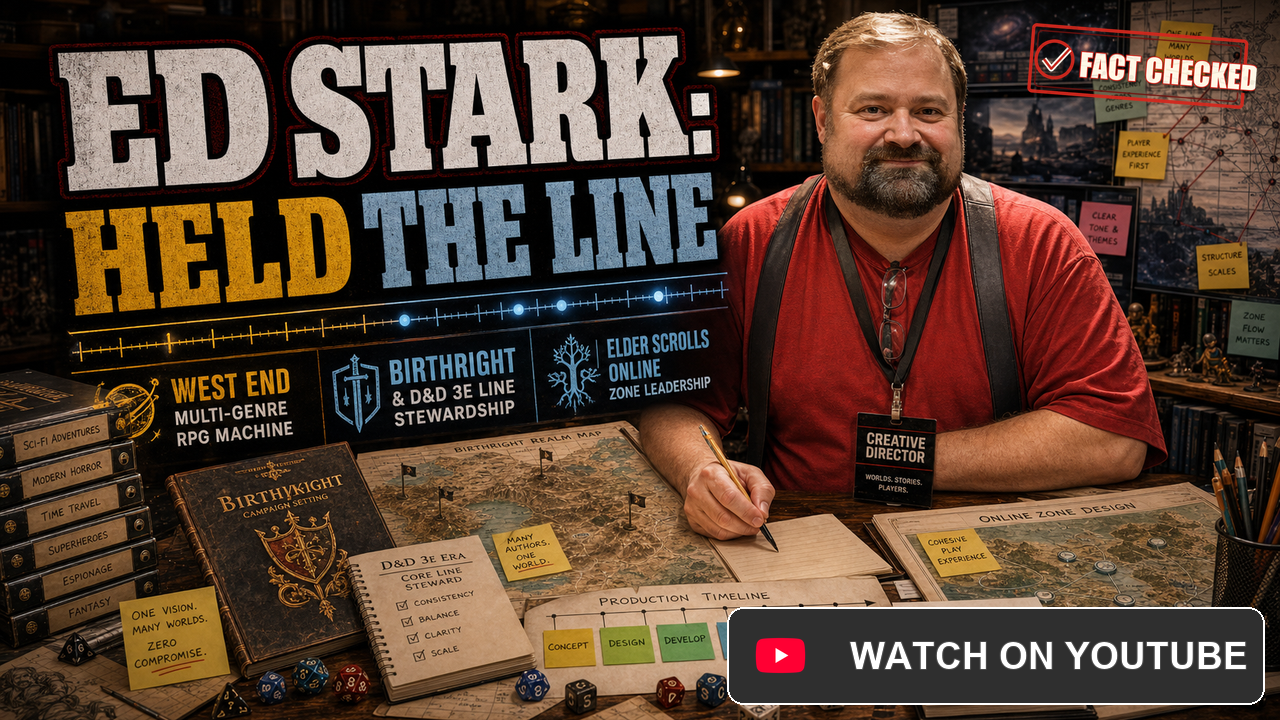
But Stark was Creative Director for Dungeons & Dragons during that era. He was one of the people responsible for keeping the line coherent while the biggest RPG relaunch in modern history moved from design to product reality.
That is the pattern of his career.
Not always the inventor. Often the indispensable man.
West End Games
Stark entered the tabletop industry through West End Games.
In a 2013 interview with Ross Watson, he said he had been writing RPG material since his teenage years but did not seriously pursue publication until graduate school. An editorial job at West End opened the door. Within months, because West End was small and busy, he was not only editing. He was also lead designer and line editor for Paranoia.
That is an absurd amount of responsibility for a young designer.
Stark later described that early opportunity with some honesty. He was grateful for the start, but said he developed bad habits as a designer because the company had little backstop. That admission is useful. It explains both the ambition and the unevenness of his West End work.
West End was a wild place to learn.
TORG had already tried to do something enormous: turn Earth into a battlefield of invading realities, each with its own genre logic, powers, tone, and rules pressure. Stark’s early credits included TORG work, Star Wars material, Paranoia line work, ShatterZone, and MasterBook. Gary Con’s 2025 guest bio summarizes the climb neatly: Paranoia Line Editor, lead designer for ShatterZone and MasterBook, designer on TORG and Star Wars projects.
That is not a narrow apprenticeship.
It is immersion by flood.
Shatterzone And Masterbook
ShatterZone, published in 1993, was Stark’s space-opera RPG for West End. It drew from the company’s broader love of cinematic adventure, but used a system related to the TORG and MasterBook family rather than West End’s simpler D6 engine.
The result had energy. It also had weight.
ShatterZone built a setting of frontier danger, alien zones, corporate and political tension, and action-adventure possibility. People who liked it tended to remember it with affection. But it did not become the space-opera engine people copied. Its mechanical complexity and product-line gravity kept it from escaping cult status.
MasterBook followed in 1994 and made the ambition explicit.
One generic rules engine. Many worlds. Licensed and original settings could plug into the same underlying system: Bloodshadows, Indiana Jones, Necroscope, Species, Tales from the Crypt, Tank Girl, and others. RPGnet’s index describes it as a more detailed, less cinematic descendant of TORG and ShatterZone.
That phrase tells the story.
MasterBook could handle a lot. It also asked a lot. The card deck, value table, and universal-system ambitions created power and friction at the same time. In the 1990s, universal RPGs already had strong competitors. GURPS and Hero System were better established, easier to explain to their own audiences, and supported by clearer identities.
MasterBook did not become the standard.
But its failure is not uninteresting. It shows Stark reaching for architecture at real scale. He was not doing small, safe work. He was trying to make a machine that could carry every licensed world West End wanted to publish.
The machine was too heavy.
That is a design lesson too.
The Uneven Solo Record
Stark’s early design record is not a clean victory parade.
ShatterZone found fans but stayed niche. MasterBook was ambitious but commercially weak. Paranoia Fifth Edition, produced during his West End period, became one of those uncomfortable editions a later fan culture mostly preferred to forget.
That matters because honest profile writing cannot turn every professional into a secret genius.
Stark’s personal systems were often big, ambitious, and professionally made. They were also often too complex, too late to the market, or wrong for the tone players wanted. His best work was not always the work where his name stood alone on the cover.
The pattern points elsewhere.
Stark was strongest when a line needed judgment, coordination, and stewardship. He was the person who could take other people’s work seriously, understand the shape of a setting, and help keep a product moving through a real company. That is less visible than invention, but it is not lesser labor.
It is one of the reasons he kept getting hired.
Birthright And D&D
In 1995, Stark joined TSR as a lead designer in the D&D Worlds group, focusing heavily on Birthright.
Birthright was one of AD&D’s strangest and most interesting settings: bloodlines, regency, domain turns, noble houses, national politics, and adventure tied to rule rather than wandering. Rich Baker and Colin McComb were central to the setting’s original design. Stark’s role was development and line work, not sole creation.
That distinction matters.
It also does not make the work unimportant.
In the Ross Watson interview, Stark’s affection for Birthright is obvious. When asked about bringing it back, he said he would focus more on roleplaying and the world, using adventuring to fuel domain turns and regency. The key, he said, was getting players invested in the world and then trying to tear it apart while they held it together.
That sentence feels like Stark’s whole career in miniature.
Get people invested. Hold the structure. Put pressure on it.
After Wizards of the Coast acquired TSR, Stark moved into larger D&D responsibility. MobyGames and Gary Con both summarize the arc: Associate Brand Manager, Creative Director for D&D, and creative leadership during Third Edition and 3.5.
Again, the credit line needs care.
The core design of Third Edition belongs to Jonathan Tweet, Monte Cook, and Skip Williams. Stark’s job was not to steal that light. It was to help the light reach the room. D&D 3E had to become more than a good rules manuscript. It had to become books, supplements, settings, licensing, tone, internal alignment, and a product line that could survive the explosion that followed.
Creative direction is not system architecture.
It is the discipline that keeps system architecture from becoming a pile of disconnected products.
The Professional’S Professional
Stark’s own comments about professionalism explain why organizations valued him.
In the Watson interview, he talks about freelancers asking questions, communicating regularly, hitting deadlines, warning early when deadlines slip, and treating freelance work like office work. He talks about publishers needing to plan ahead, pay, communicate, and understand that they depend on freelancers as much as freelancers depend on them.
It is not glamorous advice.
It is operational advice.
That is what makes it revealing.
Stark’s career was built on understanding that creativity needs a working container. A game line is not just an idea. It is assignments, deadlines, art direction, editing, approvals, developer notes, freelancer relationships, licensing demands, schedules, budgets, and personalities. Someone has to make that whole apparatus produce something coherent.
That someone is rarely the person fans quote first.
But everyone in the building knows when that person is missing.
The Long Second Act
After Wizards of the Coast, Stark moved into video games.
He worked at Red 5 Studios on Firefall, then at Vigil/THQ on the Warhammer 40,000 MMO project, then joined ZeniMax Online Studios in 2011. MobyGames lists credits across Elder Scrolls Online and its expansions, including Zone Lead Designer credits on major releases. Gary Con’s 2025 page says he is currently a Zone Lead at ZeniMax and has worked on ESO for more than ten years.
That is a long run in video games.
It also makes sense.
MMO zone design is not tabletop product-line development, but it rewards similar instincts: continuity, lore discipline, encounter pacing, map flow, team coordination, and the ability to make a large shared world feel like it was built by one mind even when hundreds of hands touched it.
Stark’s second act did not abandon his central skill.
It translated it.
What He Actually Built
Ed Stark did not build the d20 system. He did not create D&D Third Edition. He did not create Birthright alone, and his own West End systems did not become dominant engines for later designers.
What he built was coherence under pressure.
At West End, he learned fast inside messy ambition. At TSR, he helped develop one of AD&D’s most politically interesting settings. At Wizards, he carried creative direction through the D&D 3E and 3.5 era. At ZeniMax, he spent more than a decade helping make one of the largest fantasy video game worlds feel playable zone by zone.
That contribution is hard to display on a single cover.
It is spread across credits, teams, and products where the point is not that Ed Stark did everything. The point is that the work became easier to finish because he was there.
Some designers leave mechanics.
Some leave worlds.
Stark leaves functioning lines.
Where To Find Him
As of Gary Con’s 2025 guest profile, Ed Stark remains a Zone Lead at ZeniMax Online Studios, working on Elder Scrolls Online. He also continues to appear in tabletop spaces, including Gary Con, where the old tabletop industry and the current one still overlap in hotel halls, panels, games, and long conversations after the scheduled event ends.
That feels right for him.
Stark’s career has always lived between the visible and invisible parts of game creation. The rules people remember. The deadline no one sees. The setting everyone loves. The line editor who kept it from contradicting itself. The huge relaunch. The creative director making sure the pieces could stand together.
He was not always the architect.
He was often the person who kept the building upright while everyone else was still inside.
Fact Check Notes
Publication notes
This site is AI-assisted and human-reviewed. We use artificial intelligence to help gather research, organize source material, and draft profile content. Human editors then read, revise, and check each profile before it goes live. Most profiles are built through deep AI research and two separate rounds of fact-checking.
Leave a Reply
You must be logged in to post a comment.