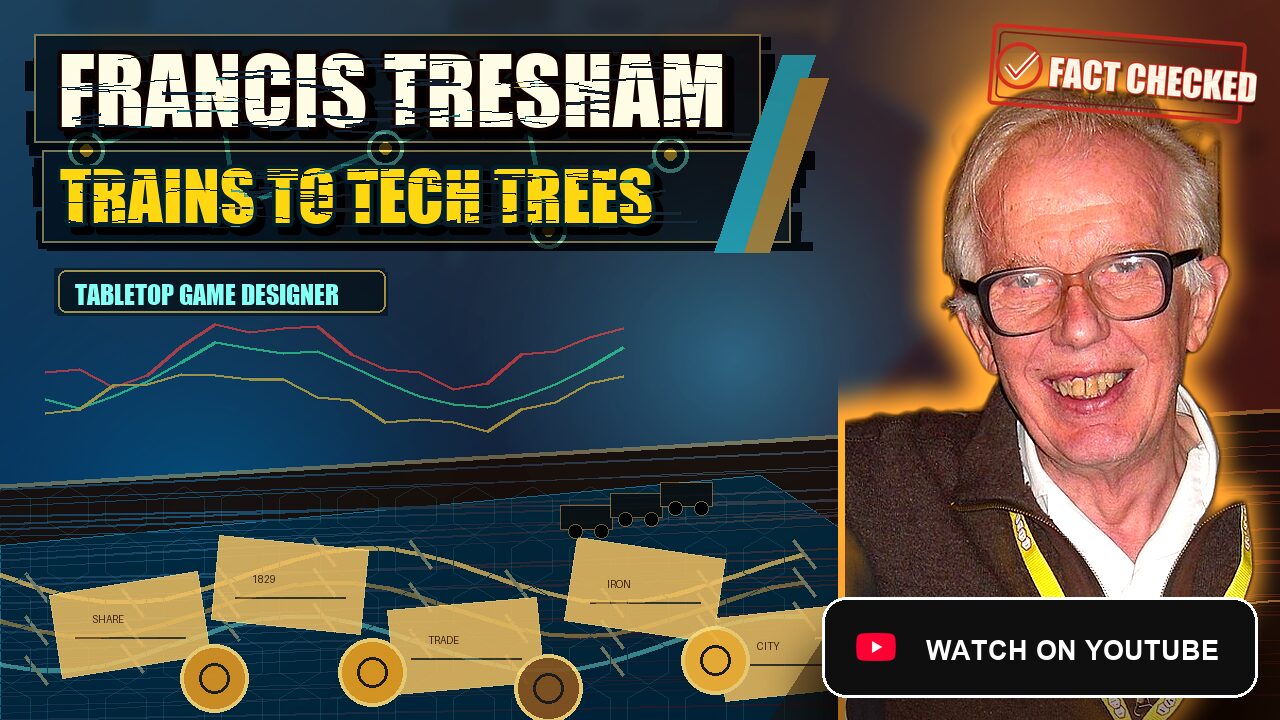
Francis Tresham did not flood the hobby with designs.
He did something stranger.
He built two game languages and left other people enough room to keep speaking them after he was gone.
One language was made of railway shares, track tiles, trains, dividends, stock rounds, operating rounds, and the terrible little moment when a company that looked safe suddenly became somebody else’s problem.
That became 18xx.
The other language was made of population, cities, trade, calamities, advances, and the slow climb from early agriculture toward the edge of the Iron Age.
That became Civilization.
The odd thing is how small the catalog is beside the shadow it casts. Tresham was not a machine of annual releases. He was not a convention celebrity brand. He was not a designer who seemed to finish a game every time the market turned its head.
He waited.
Sometimes for years.
Sometimes for more than a decade.
The Railway That Took Twelve Years
Tresham began working on the idea that became 1829 in the early 1960s. The game did not appear until 1974.
That span matters because 1829 was not a light entertainment looking for a theme. It was a working economic model disguised as a railway game. Players bought shares, ran companies, built routes, paid dividends, managed money, and watched value move through a system that could punish greed, reward timing, and turn ownership into leverage.
The trains were visible.
The real game was the economy.
That was the breakthrough. 1829 was not a wargame with trains painted onto it. It was not an abstract game wearing a Victorian hat. It gave the table a stock market, then made the stock market depend on track, trains, timing, and player appetite.
The president of a company was not simply the owner of a piece. That player carried responsibility. Track had to be built. Trains had to be bought. Routes had to earn. Dividends changed value. Shares moved. The same table could feel like a map, a ledger, and a knife fight, depending on whose money was exposed.
That is why 1829 lasted.
It gave later designers a chassis. They could change the map, the trains, the market, the company structure, the geography, the historical period, and the pressure. The family still held together because Tresham had solved the deeper question:
How do you make ownership, operation, and speculation live inside one board game?
The answer became a genre.
The Game That Made Progress Branch
Civilization arrived in 1980 with a different kind of audacity.
The game tried to put ancient history in a box. Not one battle. Not one empire at one moment. A long arc: people expanding, cities rising, trade moving, disasters striking, knowledge accumulating, and societies pushing toward the next age.
It was big. It was long. It asked a table to think in centuries.
The key was not size.
The key was reduction.
Tresham found a way to make development feel like choice. Players did not simply move forward because time passed. They bought advances. Those advances opened possibilities, changed costs, softened dangers, and pointed toward later growth. The old story called attention to the Archaeological Succession Table, and that is the right place to look. Civilization made progress into a structure with prerequisites.
Players now had a reason to ask a new kind of game question:
What must I learn before I can become the thing I am trying to become?
That question became the technology tree.
The phrase is common now, almost too common to feel invented. Strategy gamers expect branching progress. Computer games use it. Board games use it. Civilization builders use it. Economic games use it. Campaign games use it. Development no longer has to be a straight line. It can be a map of dependencies.
Tresham got there with cardboard.
He did not need animation, hidden code, or a processor calculating state changes in the background. He needed counters, cards, a table, and the discipline to make a huge historical idea legible.
That is the Tresham move.
He did not shrink the subject until it became trivial.
He compressed it until people could play.
Hartland Trefoil
Hartland Trefoil was Tresham’s company, founded in 1971. That matters because his design career was also a publishing career. He was not only sending finished games into somebody else’s system. He built the system that carried them.
The company put 1829 and Civilization into the world. Avalon Hill later licensed Civilization for North America, which helped the game reach a wider audience. The creative source, though, remained Tresham’s own patient operation in England.
That independence helps explain the pace.
He did not seem driven by the churn of release schedules. The games came when the structure was ready, or close enough to survive contact with serious players.
Spanish Main followed in 1984 with colonial trade and exploration. 1853 moved the 18xx idea to India. 1825 revisited the railway system in modular form, letting players engage the design in smaller pieces or combine units into a wider experience. Revolution: The Dutch Revolt 1568-1648 appeared much later, in 2004, and tried to model religious conflict, military pressure, and political struggle across the long Dutch revolt against Spanish rule.
That final published design is important because it shows the risk inside Tresham’s gift.
He loved large systems.
Large systems do not always reduce cleanly.
When Reduction Worked
Tresham’s best games are often praised for ambition, but ambition is not the useful word by itself.
Many designers are ambitious. Many games want to model a kingdom, a war, an economy, a civilization, or a century. The hard part is deciding what to remove.
1829 does not model every part of railway history. It focuses on the working relationship between investment, operation, route building, and revenue. Civilization does not model all of human development. It focuses on expansion, trade, city growth, calamity, and the acquisition of advances. Those are choices, not omissions.
The elegance is in the cut.
Tresham could look at a vast subject and find the minimum playable skeleton that still carried the weight of the idea. He did not always succeed. Revolution appears to have found a smaller audience, and its density made it harder to love than his two landmarks. But the attempt is consistent with the career. He kept reaching for systems that were bigger than a normal evening and trying to make them behave on a table.
That is why his thin catalog does not feel thin.
Each major design carries architectural weight.
The games are not just remembered as titles. They are remembered as structures other games could inherit.
The Quiet Blueprint
The 18xx community may be the clearest proof.
Players gather around games that can take a whole day, sometimes more. They study track tiles, stock movement, train timing, private companies, rusting trains, capitalization rules, and market traps. New titles keep appearing because the base idea remains flexible. A designer can change one rule and create a different economic personality. A map can alter every incentive. A train roster can change the temperature of the entire game.
That is not a normal legacy.
Most games end at the edge of the box.
18xx did not. It became an architecture.
Civilization left a different kind of blueprint. Its board-game descendants matter, but the wider echo is the technology tree. Once progress can branch, game time changes. A player can plan backward from a desired future. A designer can turn knowledge into terrain. Development becomes a sequence of meaningful gates rather than a pile of bonuses.
That idea has traveled so far that many players no longer know where it came from.
That may be the purest sign of influence.
The invention becomes ordinary.
What He Actually Built
Francis Tresham did not publish a huge catalog.
He did not create modern board gaming by himself. He did not invent every economic game, every civilization game, or every strategy game about progress. The technology tree and 18xx both have long histories after him, shaped by many designers, publishers, players, and communities.
What he built was a pair of load-bearing frameworks.
1829 made railway finance playable as a living system. Civilization made civilizational development playable as branching progress. Those two achievements would be enough for almost any designer’s career, even if the rest of the shelf were empty.
His strength was patience joined to reduction.
He could wait for a system. He could test it, cut it, rebuild it, and wait again. That patience limited the number of games the hobby received from him, but it gave the finished games unusual structural life.
Tresham’s career is not a story about output.
It is a story about inheritance.
Where To Find His Work
Francis Tresham died on October 23, 2019.
His work did not go quiet with him.
Civilization remains available through Gibsons as a rereleased classic, still asking players to trade, build cities, manage calamities, and move an ancient society toward advancement. BoardGameGeek remains the easiest public index for his design credits. The 18xx family remains active through publishers, fan communities, online implementations, conventions, and new designs that still begin from the railway-stock grammar Tresham established with 1829.
That is the legacy.
Not volume.
Not noise.
A railway game that became a language.
A civilization game that taught progress how to branch.
Francis Tresham designed systems for the century.
The century kept playing.
Fact Check Notes
Publication notes
This site is AI-assisted and human-reviewed. We use artificial intelligence to help gather research, organize source material, and draft profile content. Human editors then read, revise, and check each profile before it goes live. Most profiles are built through deep AI research and two separate rounds of fact-checking.
Leave a Reply
You must be logged in to post a comment.