It is stewardship.
That word can sound soft until you look at what it requires in tabletop publishing. Stewardship means keeping a game alive when the market changes around it. It means knowing when to chase a boom and when to leave before the boom eats you. It means publishing strange work because it deserves a table, not because a spreadsheet can already prove it. It means saving a classic from corporate drift, then decades later trusting the community enough to open it.
That is Nephew’s shape in the hobby.
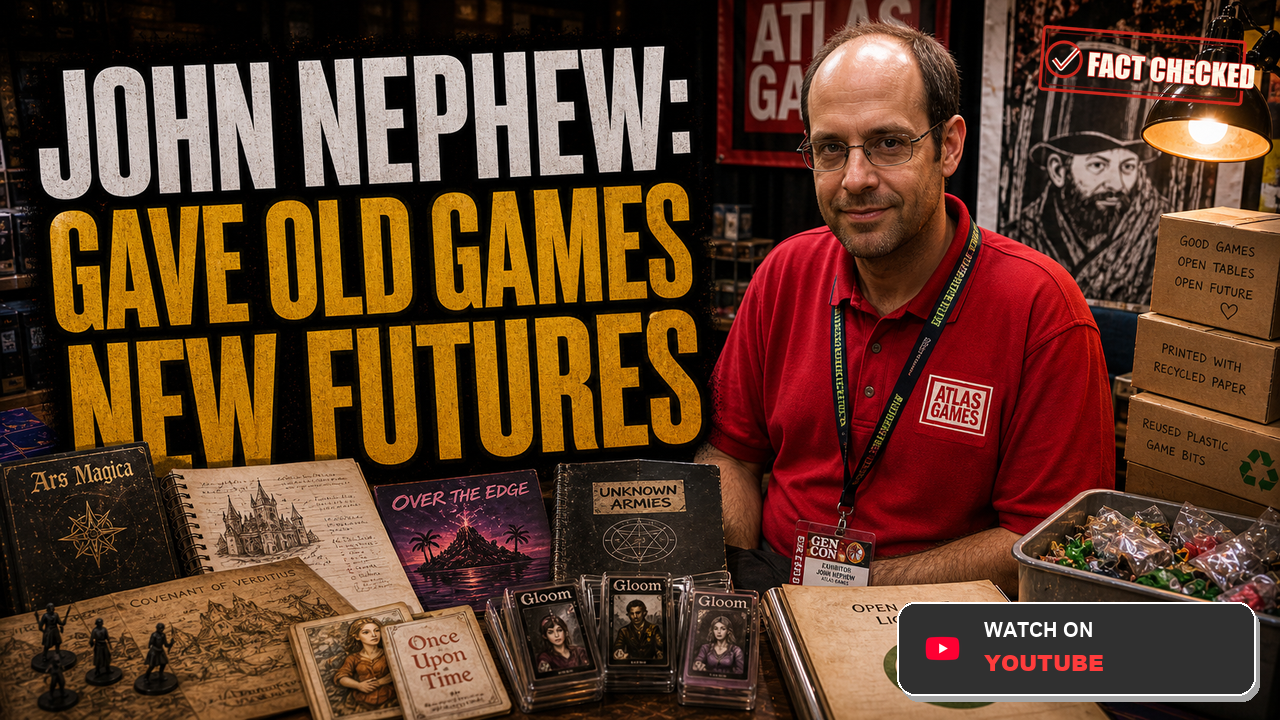
TSR freelancer. Lion Rampant editor. Founder of Atlas Games. Publisher of Over the Edge, Ars Magica, Unknown Armies, Once Upon a Time, Lunch Money, Gloom, Feng Shui, Magical Kitties Save the Day, and a long list of games that do not all behave the same.
Atlas is not famous because every product looks alike.
It is famous because it kept making room for games with a point of view.
Nephew built the business that let those games survive.
The Teenage Freelancer
Nephew entered the industry young.
Before Atlas Games, before Ars Magica came home to him, before open licensing became part of his public philosophy, he was writing for TSR. His early credits in Dragon, Dungeon, and D&D material put him inside the biggest machine in role-playing at a moment when the field was still learning what professional game writing looked like.
That start matters because it gave him two educations at once.
The first was creative: monsters, adventures, fantasy logic, setting texture, and the practical needs of a Dungeon Master.
The second was industrial: deadlines, layout, editorial standards, production schedules, and the knowledge that a game is not finished when the idea is good.
A game has to ship.
That lesson would carry through his whole career.
The Lion Rampant Years
At Carleton College, Nephew came into the orbit of the small Midwestern scene that produced Lion Rampant.
Lion Rampant was the company behind Ars Magica, the game created by Jonathan Tweet and Mark Rein-Hagen. It was a strange, brilliant, historically minded fantasy RPG about magi, covenants, companions, grogs, seasons, magic, and Mythic Europe. It was not trying to be D&D with different wallpaper. It had its own grammar.
Nephew joined that world as an editor and publisher-in-training.
Those small-company years were an apprenticeship in the unromantic side of independent games. Everyone does everything. The same person may acquire material, edit it, paste up pages, call printers, worry about cash, and still argue about the rules. It is exhausting, but it teaches the whole organism.
When Lion Rampant later merged into what became White Wolf’s early shape, Nephew did not go with the company to Georgia. Instead, he kept a license to publish Ars Magica material.
That decision became Atlas Games.
The Atlas Start
Atlas began in 1990 with licensed Ars Magica books.
That was a modest start, but a meaningful one. Nephew was not building from a pile of venture money. He was building from relationships, taste, hustle, and the ability to turn manuscripts into objects.
Early Atlas published Ars Magica adventures and licensed material for other games. But the company became something more durable when Nephew recognized what Jonathan Tweet was doing with Over the Edge.
Over the Edge was not a safe bet in the ordinary sense.
It was a surreal conspiracy RPG set on the island of Al Amarja. It used free-form traits, loose mechanics, and a tone that felt like a dangerous conversation with a stranger who knew too much. It did not ask players to start from a class list. It asked them to define what made their characters strange, capable, damaged, or impossible.
Publishing that game in 1992 was a statement.
Atlas would not only publish useful supplements.
It would publish games that widened the field.
Over the Edge became one of the company’s defining titles and helped give a platform to a cluster of designers who would matter deeply to the next decades of narrative and indie RPG work.
That is part of Nephew’s gift.
He could see when a game did not look like the market but did look like the future.
The Card Boom
Then Magic: The Gathering happened.
The collectible card game boom changed tabletop economics almost overnight. Every publisher had to decide whether to enter the rush, watch from the side, or get swallowed by the shift in retailer attention.
Atlas entered with On the Edge, a collectible card game based on Over the Edge’s world. It was early enough in the CCG wave to matter, and it gave Atlas a major burst of growth.
But booms have teeth.
When the CCG market overheated, many companies were left with unsold inventory, unpaid invoices, and businesses built around a demand curve that had already vanished. Atlas was hit hard, but Nephew did not let the company become only a CCG casualty.
The important move was the pivot.
Atlas leaned into non-collectible card games: complete boxes, no booster chase, no speculative trap. Once Upon a Time gave players a collaborative fairy-tale storytelling game. Lunch Money turned schoolyard combat into a dark, sharp little card game. Later, Gloom used transparent cards to make misery stack visibly and mechanically on doomed families.
Those games helped Atlas survive because they were not trying to be the next Magic.
They were trying to be complete.
That became part of the Atlas identity too.
Strange, playable, finished.
The D20 Boom
Nephew saw the next boom coming as well.
When Dungeons & Dragons Third Edition launched with the Open Game License, Atlas moved fast. Three Days to Kill, written by John Tynes, became one of the first third-party d20 products to reach players.
For a while, d20 was a gold rush.
Atlas published into it and made money. But Nephew had already seen what happened when a market became too excited to stay healthy. So he did not convert the entire company into a d20 machine. Atlas kept supporting its own lines, its card games, and its more idiosyncratic identity.
That restraint matters.
Many companies confused temporary demand with permanent reality. They overprinted, overextended, and drowned when the d20 shelf got crowded.
Atlas stepped back before the collapse could define it.
That is not glamorous design work, but it is the reason design work survives.
Every weird game needs someone who knows when not to bet the company.
Ars Magica Comes Home
The most important act of Nephew’s stewardship may be Ars Magica.
The game had passed through several hands after Lion Rampant: White Wolf, Wizards of the Coast, and then Atlas. When Atlas acquired it in the mid-1990s, the game finally gained a long-term home with someone who understood where it came from.
That mattered because Ars Magica is not a disposable license.
It is one of the foundation stones of modern RPG design. Its troupe-style play, covenant-centered campaigns, and flexible magic system influenced how designers think about shared authorship, long-term campaign communities, and player rotation between different kinds of characters.
Under Atlas, Ars Magica received stability.
Fourth Edition made the game widely accessible. Fifth Edition became a critically respected version of the line. The supplement library grew deep, dense, and scholarly, the sort of catalog that could only happen when a publisher believed the audience was willing to think.
Nephew’s work here was not simply acquisition.
It was caretaking.
He kept the game alive long enough for it to become a classic instead of a memory.
The Open Future
In 2024, Atlas announced Ars Magica Definitive Edition and a major open-license move.
The Definitive Edition was planned as a large, full-color, consolidated version of the game, bringing decades of development into one major artifact. But the bigger philosophical move was licensing. Atlas announced that the core rules and setting material would be released under a Creative Commons Attribution-ShareAlike license, with careful carve-outs where trademarks and outside rights required them.
That is a serious statement.
It says a role-playing game is not only a thing a company owns.
It is a practice a community carries.
Nephew has framed this kind of decision as stewardship rather than surrender. The goal is not to stop selling books. The goal is to let the game outlive bottlenecks. Fans, writers, small publishers, and tables can build without waiting for permission from one corporate desk.
That move belongs beside the OGL conversation, but it is not the same move. It came from a publisher with decades of relationship to one beloved game, looking at the future and deciding that control was less important than continuity.
That is the article’s heart.
Nephew gave an old game a new future.
The Atlas Shelf
Atlas under Nephew is also more than Ars Magica.
Unknown Armies, by Greg Stolze and John Tynes, became one of the great modern occult RPGs, a game about obsession, power, trauma, belief, and the terrible magic of wanting something too much.
Feng Shui brought Robin D. Laws’s Hong Kong action cinema RPG into Atlas’s catalog, giving players a system built for speed, stunts, melodrama, and impossible fights in collapsing restaurants.
Once Upon a Time became a lasting storytelling card game. Lunch Money showed Atlas’s willingness to publish something nasty, funny, and visually unnerving. Gloom became a modern card-game hit with a mechanical idea you could see through the plastic. Magical Kitties Save the Day opened a younger, friendlier doorway into role-playing while still carrying the Atlas habit of clean, complete play.
This is a strange shelf.
Good.
The shelf says Nephew did not publish one taste.
He published points of view.
The Business Of Survival
Nephew’s importance also sits in the less romantic part of the industry.
Manufacturing. Warehousing. Tariffs. Environmental choices. Retail realities. Open licenses. Convention cycles. Cash flow. Printing risk. The difference between a brilliant PDF and a pallet of books a company has to pay for before anyone buys one.
In recent years, he has been a public voice on supply-chain pressure and tariff risk for game publishers. That may sound far from game design, but it is not. Independent games do not exist outside economics. If a publisher cannot survive the cost of printing, shipping, and warehousing, the design never reaches a table.
Atlas has also made sustainability part of its public operations: reduced waste, recycling efforts, and the Replay Workshop, which turns reclaimed plastic into game accessories.
That is part of Nephew’s modern profile.
He is not only asking what games should be.
He is asking how the business around games should behave.
What He Actually Built
John Nephew did not create Ars Magica alone. Jonathan Tweet and Mark Rein-Hagen created the original game, and many writers kept it alive.
He did not create Over the Edge alone. Jonathan Tweet and Robin D. Laws belong there.
He did not create Unknown Armies, Feng Shui, Gloom, Once Upon a Time, Lunch Money, or Magical Kitties Save the Day by himself.
What he built was the house that held them.
He built a publishing company that could survive speculative bubbles without becoming a hollow trend-chaser. He built a catalog where odd games had room to be themselves. He built long-term stewardship around Ars Magica. He built a public argument that open licensing can be an act of care, not just a marketing tactic.
That is why he belongs in a Game Designers series even when the word "publisher" is doing a lot of the work.
In tabletop, publishing is design at the level of survival.
Where To Find Him
John Nephew is alive and active.
Atlas Games remains the clearest place to find his work: Ars Magica, Over the Edge, Unknown Armies, Feng Shui, Once Upon a Time, Lunch Money, Gloom, Magical Kitties Save the Day, and the company’s current open-license and sustainability projects.
He was inducted into the Origins Hall of Fame in 2016, but the stronger memorial is the living catalog.
The old games are still playable.
The weird games still have shelves.
The company is still thinking about what the next version of stewardship should look like.
That is Nephew’s achievement.
He did not only publish games.
He gave them somewhere to keep becoming.
Fact Check Notes
Publication notes
This site is AI-assisted and human-reviewed. We use artificial intelligence to help gather research, organize source material, and draft profile content. Human editors then read, revise, and check each profile before it goes live. Most profiles are built through deep AI research and two separate rounds of fact-checking.
Leave a Reply
You must be logged in to post a comment.