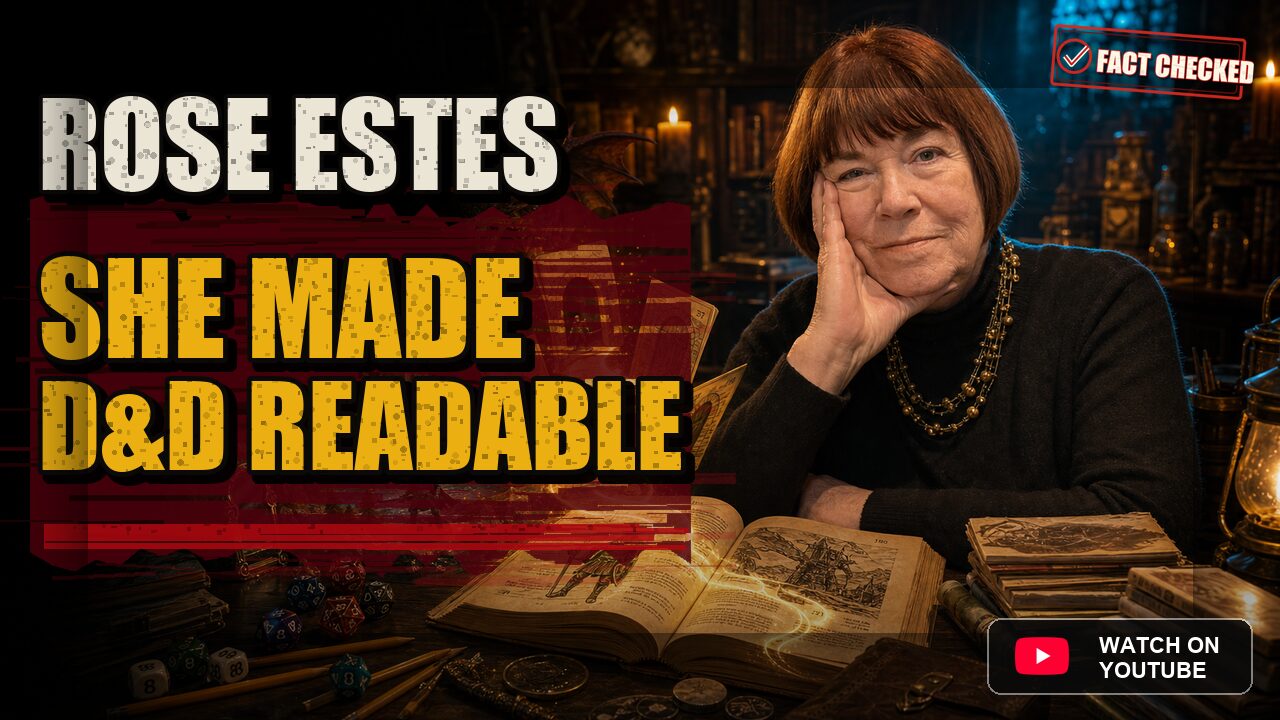
It was not a dungeon door. It was a paperback.
Estes took a hobby that many outsiders saw as strange, dense, suspicious, and too full of rulebooks, and she turned it into something a young reader could hold in both hands. You opened the book. You became the hero. You made a choice. The page number sent you deeper.
That was the magic of Endless Quest.
It did not ask a child to learn THAC0. It did not require a Dungeon Master, graph paper, a boxed set, or a table of experienced players. It taught the emotional logic of D&D through story: risk, consequence, curiosity, courage, and the possibility that a wrong turn might still become your favorite memory.
Rose Estes did not invent choice-based books. She did not create Dungeons & Dragons. What she built was a bridge between them. For a generation of readers, that bridge was the first safe crossing into fantasy role-playing.
The Woman On The Phone
Estes arrived at TSR before the company knew what it was becoming.
Later profiles describe her as one of the early employees of TSR Hobbies in Lake Geneva, Wisconsin. She did the unglamorous startup work: phones, office tasks, packaging, customer contact, whatever needed doing. TSR was growing fast, but it was also rough-edged, male-heavy, and underprepared for the public attention D&D was about to receive.
Then came the moral panic.
In the late 1970s and early 1980s, Dungeons & Dragons became a target for anxious parents, religious critics, and reporters who did not understand the hobby. The game was falsely tied to occult practice, youth danger, and tragic events that had far more complicated causes. TSR needed someone who could talk to the outside world without sounding evasive or contemptuous.
Estes had worked as a reporter and advertising copywriter. She knew how to listen. She knew how to explain. When angry or frightened people called TSR, she could translate the game into plain human terms: this was collaborative imagination, problem solving, reading, math, improvisation, and friendship.
That part of her career matters because it leads directly to what came next. Estes saw the communication gap. D&D fans knew the game was about adventure and decision-making. Outsiders saw hardcovers, charts, monsters, demons, and rumors. The game needed a front door that looked less threatening.
Endless Quest became that front door.
The Paperback Dungeon
The spark was simple. Estes saw the popularity of choose-your-path books and understood that TSR could do something similar with D&D.
The company was not instantly convinced. According to later interviews, she had to push hard for the project. The assignment became a trial by deadline: produce several interactive manuscripts fast enough to prove the idea was real. Estes did it.
In 1982, TSR launched the first Endless Quest books: Dungeon of Dread, Mountain of Mirrors, Pillars of Pentegarn, and Return to Brookmere. The books were small, fast, and irresistible. They carried D&D imagery and adventure structure into a format children already understood.
But Estes did something more interesting than simply copy a format.
Many choice books of that period treated "you" as a blank slot. Estes gave the reader enough character to role-play. You were not just a camera with legs. You had a place in the world, a problem to solve, people to protect, and dangers that felt tuned to fantasy adventure rather than random novelty.
That made the books feel closer to tabletop play. A choice was not only "left door or right door." It could be caution or bravery, trust or suspicion, a bargain or a fight, a strange kindness toward a creature that might otherwise become an enemy. Estes was teaching readers to think like players.
The books moved quickly because they had to. A gamebook cannot spend fifty pages clearing its throat. It has to put the reader under pressure and then hand them the wheel. Estes had the right toolkit for that. Journalism had taught her compression. Advertising had taught her hooks. Parenting and reading had taught her how a child follows tension.
Endless Quest worked because it respected young readers. It did not talk down to them. It let them fail, try again, and discover that rereading was not punishment. It was part of the game.
The Series That Opened The Hobby
The commercial success was enormous.
The early Endless Quest books stayed visible on bestseller lists, and later public biographies credit the line with selling in the tens of millions worldwide across editions, languages, and related titles. Exact totals vary by source, but the pattern is not in dispute: these books traveled far beyond the core hobby shop audience.
That reach is the central fact of Rose Estes’s career.
The child who bought Dungeon of Dread did not need to know TSR politics. The kid reading Return to Brookmere in the back seat did not need a group. A reader with dyslexia, attention challenges, or simple boredom with school reading could find a different rhythm: short sections, immediate decisions, vivid danger, and the reward of agency.
That last word is the heart of it. Agency.
Estes helped turn reading from a passive assignment into an active event. Readers could test themselves. They could make bad calls without being judged. They could go back. They could find another ending. That structure quietly taught cause and effect, inference, emotional risk, and persistence.
TSR did not fully seize the educational opportunity. Estes and James M. Ward reportedly tried to build an education department inside the company, but the business did not support it with the staff and sales structure it needed. The idea was early. The company was not ready.
Readers were ready.
The Greyhawk Years
After Endless Quest, Estes moved into longer fiction, including Children of the Dragon and several D&D novels set in Greyhawk.
Those Greyhawk books remain the most contested part of her career. She wrote them after Gary Gygax had been pushed out of TSR, at a time when Greyhawk fans were protective, wounded, and suspicious of corporate control over the setting. Estes was asked to write inside a beloved world while the emotional ownership of that world was in open dispute.
The reaction could be harsh.
Some readers felt her tone did not match Greyhawk. Some objected to lore choices. Some believed the novels moved too far from the style they associated with Gygax’s campaign. Even Estes, in later interviews, spoke with humility about the controversy and said she would have approached that inheritance differently if she could do it again.
The honest reading is not that every criticism was unfair. Shared-world fiction has obligations, and Greyhawk had a devoted audience. But it is also true that Estes took a remarkable amount of heat for standing in the wrong place at the wrong time. She was writing fast, inside a franchise system that did not yet have the continuity infrastructure modern licensed fiction now expects.
Those novels are part of her story, but they are not the center of it.
The center is the doorway she made.
Beyond The Quest
Estes wrote far more than Endless Quest and Greyhawk.
Her bibliography includes original fantasy, science fiction, gamebooks tied to other properties, and later nonfiction. She wrote for Find Your Fate, including Indiana Jones and The Three Investigators material. She built her own fantasy and speculative series, including the Saga of the Lost Lands, Hunter, and Katherine Sinclair books.
Then a 1994 car accident changed her life and her writing career.
Estes has described a severe head injury that damaged her access to words. For an author, that is a brutal kind of loss. The imagination did not vanish. In some accounts, ideas became more abundant after the injury. The problem was language itself: the retrieval, arrangement, and command of words that had once been her working instrument.
That interruption matters because it complicates the easy version of the career. Rose Estes was not simply a prolific writer who slowed down. She was a writer who had to renegotiate the basic tools of writing.
She shifted creative energy elsewhere. With her husband, artist Gary Hauser, she became connected to the Hauser Gallery on the Oregon coast. After his death, she continued as part of that creative place, now known publicly through Hauser Gallery and Dragon Emporium references. Fans still find her through that trail, often carrying old Endless Quest books that survived childhood, moves, attics, and decades.
That is a different kind of royalty statement.
What She Actually Built
Rose Estes did not build D&D’s combat system. She did not design the first role-playing game. She was not the sole creator of interactive fiction.
What she built was an invitation.
She made D&D legible to readers who were not yet ready for the full game, and to families who did not understand why the game mattered. She turned a rules culture into a story culture without stripping away the essential experience of choice. She gave young people a way to enter fantasy through action, not explanation.
Her work also widened the idea of what game writing could be. A designer writes procedures. A novelist writes scenes. Estes wrote a hybrid: a story that behaves like a game without needing the game on the table.
That hybrid still matters. Modern game writing, visual novels, branching games, solo RPGs, and narrative design all live in the long shadow of that question: what happens when the reader gets to choose?
Rose Estes answered it in paperbacks that kids wore out.
Where To Find Her
Rose Estes is still publicly connected to the Oregon coast through the Hauser Gallery and Dragon Emporium. In 2022, the Academy of Adventure Gaming Arts and Design honored her with induction into its Hall of Fame, recognizing the importance of Endless Quest in bringing readers toward role-playing games.
Recent public bios and publisher announcements also point to new work. A Gary Con profile says she was working on a book titled Different. Savage Realms Gamebooks announced in 2025 that Estes had joined them to write four new Endless Quest-style books, and its 2026 updates page describes Into Shadows Deep as the first book in Different: The Quest Continues.
That is a fitting return.
The writer who helped children find D&D through a page turn is back in the form that made her name: a choice, a danger, a strange companion, and a reader asked to decide.
Rose Estes made the doorway.
Millions of readers walked through.
Fact Check Notes
Publication notes
This site is AI-assisted and human-reviewed. We use artificial intelligence to help gather research, organize source material, and draft profile content. Human editors then read, revise, and check each profile before it goes live. Most profiles are built through deep AI research and two separate rounds of fact-checking.
Leave a Reply
You must be logged in to post a comment.