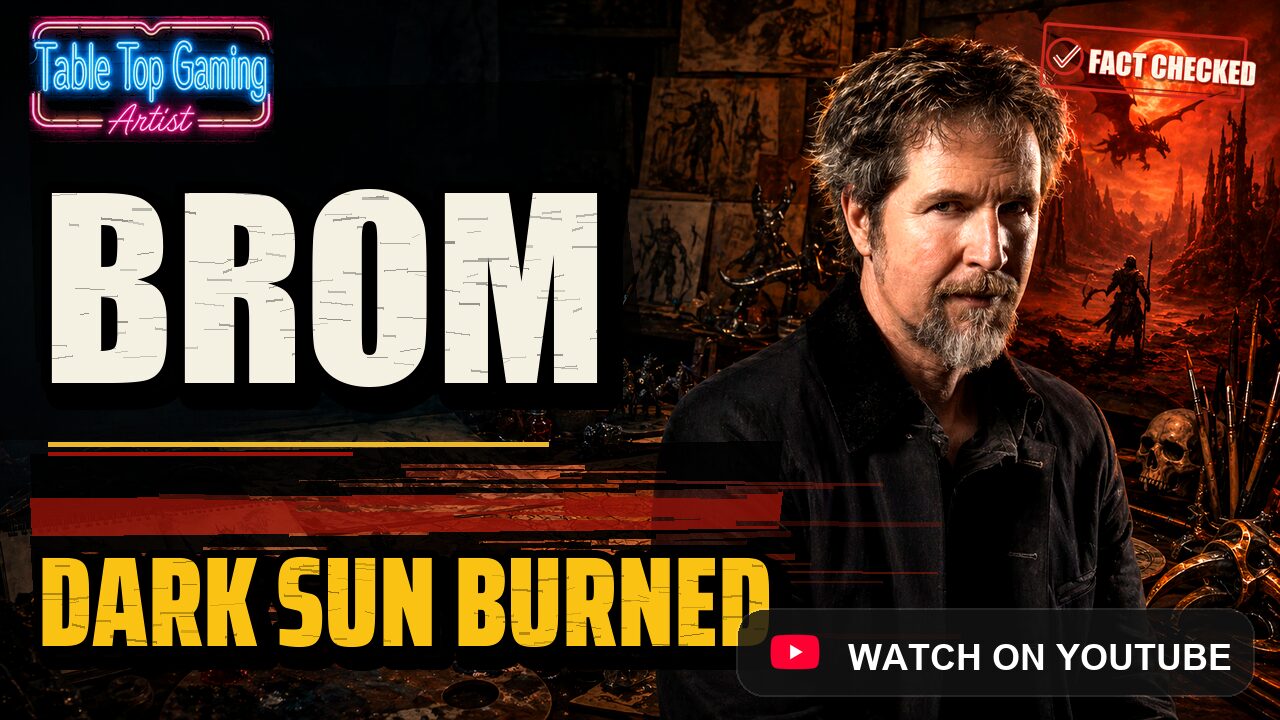
You could feel it in the art.
The air was too hot. The metal was scarce. The bodies looked carved by hunger and sunlight. The heroes did not stand in shining armor outside a welcoming castle. They crouched, glared, bled, endured, and looked as if the world itself had been designed to grind them down.
That was Brom.
Gerald Brom, known professionally as Brom, entered tabletop gaming at the moment when fantasy art was doing more than selling books. It was teaching players how to imagine worlds. Larry Elmore had given Dragonlance its heroic warmth: banners, dragons, companions, romance, a sense that adventure could be beautiful even when it was dangerous. Brom brought a different gift. He made a setting feel hostile before the first paragraph of rules told you why.
His importance to tabletop games is not just that he painted memorable covers.
It is that his images could act like design documents.
The Image Before The World
Brom’s official biography gives the outline of a restless early life: a military-family childhood, travel through places such as Japan, Hawaii, Germany, and Alabama, and an early fixation on the weird, the monstrous, and the beautiful. He studied commercial art in Atlanta, worked young, learned speed, and built the technical discipline that would later let him survive in deadline-heavy publishing.
He did not arrive as a polished academic painter following a tidy route into fantasy art. He has described his painting education as largely self-built, formed through looking hard at the artists who had already solved problems he cared about. Frank Frazetta gave fantasy its muscle and heat. Norman Rockwell and N. C. Wyeth gave story, gesture, and readability. John William Waterhouse and Alphonse Mucha gave beauty, ornament, and tragic atmosphere.
Those influences explain why Brom never felt like a standard monster painter.
His figures can be brutal, erotic, wounded, majestic, grotesque, or holy, sometimes all in the same image. His monsters do not merely threaten the scene. They tell you what kind of world could produce them.
That distinction matters.
Fantasy illustration often shows a moment. Brom’s best work implies an ecology.
The Tsr Room
Brom joined TSR in 1989, entering the same broad creative era that held artists such as Fred Fields, Jeff Easley, Clyde Caldwell, Larry Elmore, Tony Szczudlo, Robh Ruppel, Dana Knutson, and others who gave late TSR its visual force.
This was before fantasy publishing became so digitally scattered. Artists were near the books, near the editors, near the designers, and near each other. A painting could shape how a product was understood inside the building, not just how it looked on a shelf after everything else was done.
For Brom, that mattered most with Dark Sun.
The original Dark Sun Campaign Setting, released in 1991, remains the clearest case of Brom operating as a visual architect. Timothy B. Brown and Troy Denning designed the setting, but the look of Athas came from a different kind of collaboration. Brom painted gladiators, sorcerer-kings, raiders, bone weapons, desert bodies, and creatures that looked born from famine and ritual. The design team did not simply ask him to illustrate an already familiar fantasy world. His visual language helped tell them what the world was.
That is why Dark Sun did not feel like “Dungeons & Dragons, but in a desert.”
It felt like a system of pressures.
Scarcity was visible. Violence was visible. Class, slavery, psionics, ecological collapse, and physical survival were visible. The setting’s rules and prose gave players the formal structure, but Brom gave them the first shock of recognition. This was not a place where heroes arrived to restore a lost golden age. This was a place where the age had already burned away.
The art did not decorate that idea.
The art made it believable.
Athas As A Body
Brom’s Dark Sun art is often remembered for its surface markers: shaved heads, bone armor, exposed skin, impossible weapons, reptilian beasts, and a palette of dust, blood, and tarnished bronze.
But the deeper achievement is bodily.
Athas looks like a world where the body is always being tested. Characters are lean, strained, dangerous, and exposed. Armor is never simply decoration. Weapons look improvised from whatever survived. Muscles are not superhero fantasy muscles; they are survival muscles. Beauty appears, but it is rarely safe. Power appears, but it is almost always corrupting.
That gave Dark Sun a mature tone without relying only on gore or shock. It felt adult because the world had consequences.
The genius of the look is that it was instantly readable. A player could see one Brom gladiator and understand that Athas was not Krynn, not the Forgotten Realms, not Greyhawk, not Ravenloft. The art carried the product’s market identity and its emotional identity at the same time.
That is a rare feat.
A lot of game art tells you what is in the setting.
Brom’s Dark Sun art told you what the setting would do to you.
The Dark Grammar
After TSR, Brom’s work moved across the wider field of fantastic art: book covers, comics, collectible cards, video games, film concept work, and personal paintings. He became one of those artists whose name itself carried a promise. If Brom painted it, the object was likely to be darker, stranger, and more mythic than the assignment strictly required.
His technique helps explain the effect. In interview material, Brom has described a working method that begins with fast acrylic underpainting and then moves into oil for the softness, atmosphere, and depth associated with older painting traditions. The result is a useful contradiction: his images can feel commercially sharp and classically haunted at the same time.
They read quickly.
Then they stay with you.
This quality made him a natural fit for Magic: The Gathering. Card art has to survive being reduced to a tiny rectangle. It needs silhouette, contrast, concept, and emotional force. Brom’s Magic work includes one of the great documented examples of image feeding design: Platinum Angel. Wizards’ own design history has described the art coming back so strong that the card needed an effect worthy of the image. The final card became famous because the mechanic and the picture made the same promise: this angel does not simply fight for you. It refuses to let you lose.
That is Brom’s gift in miniature.
He turns a visual idea into a rule you can feel.
The Author Who Paints
The later phase of Brom’s career reveals something that had been present all along. He was not only an illustrator of other people’s worlds. He was a storyteller whose first language happened to be image.
The Plucker, The Devil’s Rose, The Child Thief, Krampus: The Yule Lord, Lost Gods, Slewfoot, and Evil in Me all belong to that author-illustrator phase. These books matter because they do not treat art as bonus material. Brom’s paintings and prose work together. The image is not there merely to show what the words already said. It participates in the spell.
The themes are consistent with the paintings that made him famous. Innocence curdles. Folklore grows teeth. Childhood stories become dangerous again. Saints, devils, witches, toys, gods, and monsters are not stable categories. The sacred can rot. The monstrous can grieve. The beautiful can wound.
The Child Thief turns Peter Pan into something feral and predatory. Krampus drags a winter-devil back into American fantasy consciousness. Slewfoot moves through historical folk horror with rage, beauty, and old-world dread. Evil in Me continues the mature Brom pattern: myth, horror, music, possession, and image all feeding the same furnace.
This is not a late-career side road.
It is the center becoming visible.
Brom had always been building worlds. The novels simply gave him control of the words too.
What Tabletop Owes Him
Tabletop gaming owes Brom one very specific debt: he proved that setting art could be foundational design.
That may sound obvious now, but it was not always treated that way. Game books often used art as atmosphere, cover appeal, or page relief. Brom showed what happens when art becomes the first argument a setting makes. Dark Sun did not need to ask for attention because its visual identity was impossible to confuse with anything else on the shelf.
That lesson carried forward.
Modern tabletop publishing now understands that a setting’s visual identity is not secondary. The right art direction can teach tone faster than exposition. It can tell players what kinds of characters belong there, what kind of violence the world permits, what kind of beauty survives, and what kind of stories the table is being invited to tell.
Brom’s career also helped broaden the emotional range of fantasy game art. He did not replace heroic fantasy. Elmore’s Dragonlance paintings still matter because they gave players warmth, friendship, longing, and wonder. Fred Fields still matters because he brought classical oil-painted authority to TSR fantasy, Ravenloft horror, Forgotten Realms novels, Magic lands, and later Western fine art.
Brom’s lane was different.
He made fantasy feel dangerous in the body.
He made beauty suspect.
He made worlds look as if they had laws older and crueler than the heroes.
The Man Still Making Myths
Brom remains active as an artist and author. Current public-facing material presents him through his official art site, his novels, his prints, and his continuing role in dark fantasy and horror. His honors include major recognition from the fantastic art community, including the Spectrum Grand Master honor and the Chesley Award for Lifetime Artistic Achievement.
Those honors are appropriate, but they are not the real measure.
The real measure is that people still know a Brom image when they see one.
Not because every piece looks identical. Not because the costumes repeat. Not because the palette is always the same. They know because the image seems to have a religion, a wound, a climate, and a secret history. It feels like there is a whole cruel world outside the frame.
That is why Brom belongs in the story of tabletop gaming.
He did not just paint fantasy darker.
He made darkness constructive. He gave it design value. He showed publishers and players that a picture could build a world before the map, before the rules, before the first session began.
Dark Sun burned because Brom painted the heat.
And once players saw it, they knew exactly what kind of world they had entered.
Fact Check Notes
Publication notes
This site is AI-assisted and human-reviewed. We use artificial intelligence to help gather research, organize source material, and draft profile content. Human editors then read, revise, and check each profile before it goes live. Most profiles are built through deep AI research and two separate rounds of fact-checking.
Leave a Reply
You must be logged in to post a comment.