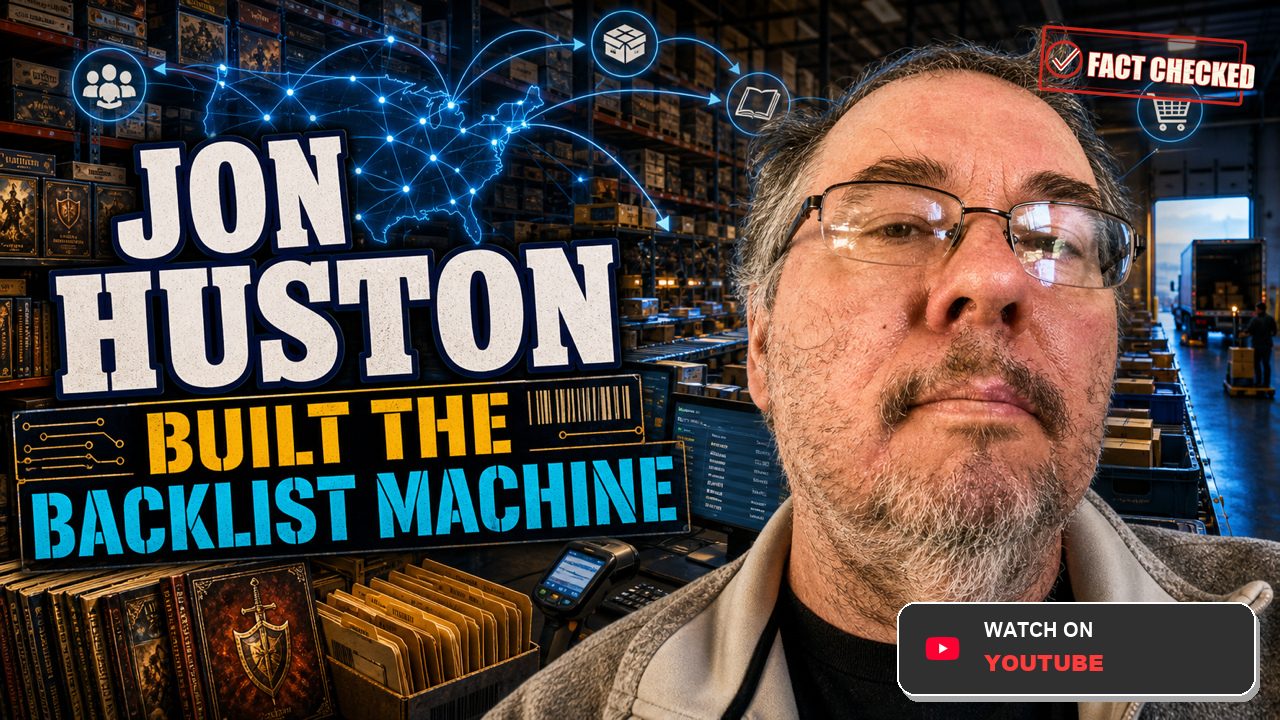
Most game companies begin with a design.
Jon Huston’s story begins with inventory.
Cards in boxes. Cards in binders. Cards bought at shows, priced by hand, listed in catalogs, packed into orders, and shipped to players who might be hundreds or thousands of miles away. Before collectible games became a mature online marketplace, the whole thing was a mess of price guides, convention tables, phone calls, mail orders, grading arguments, and sudden shifts in card value.
Huston built inside that mess.
Troll and Toad, the company he started with Lana Huston in 1994, became one of the major online retailers of collectible games. From rural Kentucky, it sold Magic: The Gathering, Pokemon, Yu-Gi-Oh!, board games, RPGs, miniatures, supplies, toys, and out-of-print oddities to a global customer base.
That alone would make him important to hobby commerce.
But Huston’s later career added another layer. Through Webbed Sphere, he moved from selling the pieces of the hobby to managing the infrastructure around them: warehouse space, online retail systems, secondary-market logistics, imported goods, house brands, and eventually legacy tabletop intellectual property.
Flying Buffalo passed through Webbed Sphere. Mayfair Games returned through Webbed Sphere. Mr. B Games was folded into the revived Mayfair structure.
That does not make Huston a game designer in the normal sense.
It makes him a builder of pipes, shelves, warehouses, websites, and corporate containers. The hobby remembers designers because they make the games. Huston’s work sits in the less visible question: how do old games, loose cards, abandoned brands, and weird back-catalogs keep moving?
From Show Tables To Online Orders
The clearest public account of Troll and Toad’s early growth comes from The Center for Rural Development, which profiled Huston in 2017.
He started Troll and Toad in 1994. At first, the model was physical and exhausting: travel to trade shows around the eastern United States, sell collectible gaming cards, and fulfill by mail order. In 1997, the company launched its first website. It was not yet full e-commerce. Customers could browse items online, but orders still happened by phone or mail.
Then 2000 changed the business.
Troll and Toad began taking orders online, and the company expanded rapidly. For collectible cards, that mattered more than it would for ordinary retail. A sealed board game has one SKU. A collectible card operation can have hundreds of thousands of small SKUs, each with condition, edition, language, rarity, and shifting price. The value of a card can move because of tournament results, reprints, format changes, collector demand, or a newly discovered combo.
The internet did not just let Troll and Toad reach more buyers.
It let the company update reality faster.
That was the breakthrough. Printed catalogs froze the market in place. Online listings could move with the market. A rural Kentucky company could suddenly compete for a global audience because the shelf was not limited to the people who could walk into the store.
By 2011, Troll and Toad had made the Inc. 5000 and had been ranked in Internet Retailer Magazine’s Top 500. That same year, it moved into the former American Greetings plant in Corbin, a one-million-square-foot facility in Laurel County. WEKU reported that the company had added 50 jobs, bringing employment above 160, with plans to add more.
The scale is almost funny for a business built on small pieces of cardboard.
But that is the point. In secondary-market collectibles, the small pieces become the warehouse.
The Fiber Line
Huston’s most important infrastructure story may be the fiber line.
When Troll and Toad moved into the big Corbin facility, the local internet service was not reliable enough for the business. The Center for Rural Development article quotes Huston describing days when the cable would go out and employees had to be sent home. No internet meant no shipping, no processing, no inventory work, no customer service, and no database.
That is what modern hobby commerce had become by then.
The cards were physical. The business was digital.
Huston paid to have a fiber optic direct connection run from the nearest cable to the facility and continued paying a premium for the service. He described internet access as a necessity like electricity, water, or sewerage.
That line should be read as more than a rural broadband quote. It is a philosophy of the business.
Troll and Toad was not a local game store with a website attached. It was an internet business using a Kentucky warehouse as its body. The servers, listings, grading, pick lists, order tracking, shipping labels, payment processing, and customer information all had to talk to each other all day.
When they did, Corbin became a global hobby-commerce node.
The Center’s 2017 profile reported that Troll and Toad was doing up to $15 million in annual business, employed around 120 people, and earned more than a third of its sales internationally. Huston chose Kentucky for practical reasons: low cost of living, proximity to the interstate, central shipping reach, and winters that did not paralyze the operation.
That was the hidden design.
Not a game system. A logistics system.
Webbed Sphere
As the operation grew, Webbed Sphere became the parent structure around the business.
ICv2 reported in 2019 that Webbed Sphere, parent of Troll and Toad and several other companies, had hired John Ward, former GAMA Executive Director, as Chief Operating Officer, and Angela Ward as Chief of Internal Operations. The same report said Webbed Sphere companies generated nearly $40 million in sales in 2018.
The list of businesses mattered: TrollandToad.com, Six Hogs, Toy Vault, Auldhome Designs, Solstice Tea Traders, Attatoy, Cornucopia Brands, Golden Groundhog, Binanza Stores, Sunset Properties, and others.
That is not a single-store story anymore.
It is a holding-company story.
Six Hogs, which Huston began in 2012 with Andrew Pennington, sold household goods, plush items, tea, coffee, and other products online. Gambit bought discounted goods from big retailers for resale on the internet. These ventures may look far away from game design, but they came from the same infrastructure: online listings, warehouse space, price awareness, sourcing, fulfillment, and enough broadband to keep the whole machine moving.
Huston had learned the core lesson of the card market.
If you can catalog it, price it, store it, and ship it, you can turn chaos into commerce.
Flying Buffalo
Then Webbed Sphere moved into old game-company IP.
In 2021, Webbed Sphere acquired Flying Buffalo, the company founded by Rick Loomis. Flying Buffalo was not just another small publisher. It was one of the foundational companies of role-playing history: play-by-mail games, Nuclear War, Tunnels & Trolls, Grimtooth’s Traps, Citybooks, Mercenaries, Spies and Private Eyes, and decades of strange, durable catalog.
The deal was finalized July 31, 2021, according to ICv2. It came after Loomis’s death and raised the question that haunts many old tabletop companies: what happens when the founder is gone and the catalog still matters?
Webbed Sphere’s tenure was brief.
In 2023, the Flying Buffalo RPG properties went to Rebellion Unplugged, the tabletop arm of the UK creative studio Rebellion. That moved Tunnels & Trolls and related lines into a larger media company with the resources to develop them further. Rebellion later moved toward a new edition of Tunnels & Trolls.
That chapter is complicated. Fans had strong opinions about Webbed Sphere’s ownership, and Webbed Sphere did not turn Flying Buffalo into a burst of new releases during its time with the catalog.
Still, the structural role is clear.
Webbed Sphere acted as a bridge owner. It acquired a legacy catalog at a vulnerable moment, then the RPG properties moved on to a company built for new development. That is not the same as creative stewardship in the designer sense. It is corporate transfer, preservation, and repositioning.
In older hobby businesses, that can be the difference between a backlist remaining accessible and a backlist disappearing into legal uncertainty.
Mayfair Returns
The Mayfair story shows Huston’s strategy even more clearly.
Mayfair Games had once been one of the major names in American board gaming. Catan made the company famous to a generation of players, but the Mayfair catalog was much wider: Empire Builder, DC Heroes, Role Aids, train games, family games, and decades of American hobby publishing.
Mayfair ceased operations after selling assets to Asmodee in 2018.
In 2023, ICv2 reported that Webbed Sphere would launch games under the Mayfair Games trademark and shield logo. The old marks had been abandoned, Webbed Sphere filed with the USPTO, and the company received Notices of Allowance by January 31, 2023. New Mayfair Games LLC had begun operations on December 2, 2022.
That is a very particular kind of business move.
Not buying a whole old company. Not licensing a single title. Reviving a dormant brand with residual trust, then giving it a new operating body.
In August 2023, Webbed Sphere’s Mayfair Games acquired Mr. B Games. Mr. B, founded by Sean Brown, brought an active catalog, modern production experience, crowdfunding experience, and a working publishing engine. Mayfair brought the old shield and the memory of an American board game institution.
Together, they made a plausible new company.
Huston’s own quote in the ICv2 announcement was measured: both brands shared a commitment to creativity, innovation, and customer satisfaction, and the combination expanded the portfolio and ability to deliver games worldwide.
That is corporate language, yes.
But the move underneath it is interesting. Huston was no longer only selling other people’s old cards. He was building containers for old brands to re-enter the market.
What He Actually Built
Jon Huston did not create Magic: The Gathering, Pokemon, Tunnels & Trolls, Flying Buffalo, Mayfair Games, or the modern board game market.
He did not design the major systems attached to those names. He did not invent e-commerce. He did not single-handedly save any legacy brand from oblivion.
What he built was operational leverage.
Troll and Toad turned the messy secondary-card economy into a large online retail operation from rural Kentucky. Webbed Sphere turned the warehouse, fiber, staff, sourcing, fulfillment, and brand-management experience into a broader platform. Flying Buffalo showed the company could absorb legacy tabletop IP. Mayfair showed it could revive an abandoned brand identity and combine it with a functioning modern publisher.
That is a different kind of influence than design influence.
It is the influence of infrastructure.
A designer creates a game. A warehouse keeps the game in circulation. A website makes the backlist searchable. A holding company can move an old catalog from one era to another. A revived trademark can give a new publisher a familiar banner. A fiber line in a rural county can become the difference between local limitation and global reach.
Huston’s career sits in those pipes.
Where To Find Him
The current Troll and Toad retail operation should not be treated as simply the same Huston-led company it was during the early growth period. Public records and ICv2 coverage show Troll and Toad Enterprises LLC forming in 2021, and by 2023 ICv2 was quoting owner Ben Burns on the company’s Magic: The Gathering decisions. The current Troll and Toad site lists a North Carolina address.
Huston’s current public hobby footprint is better understood through Webbed Sphere and Mayfair Games.
Webbed Sphere remains tied to the Corbin warehouse and its portfolio of brands and ventures. Mayfair Games has returned as a Webbed Sphere project, now connected to Mr. B Games and its active catalog. Flying Buffalo’s RPG legacy moved on to Rebellion Unplugged, where Tunnels & Trolls is being developed for a new era.
That is the pattern.
Huston built systems that move things: cards, orders, brands, catalogs, trademarks, warehouses, and backlists.
The hobby usually tells its history through the people who made the games. Huston’s story belongs to the people who made the games findable, buyable, sortable, shippable, and transferable after the first wave of creation had passed.
Not the designer of the old worlds.
One of the people who kept the old worlds moving.
Fact Check Notes
Publication notes
This site is AI-assisted and human-reviewed. We use artificial intelligence to help gather research, organize source material, and draft profile content. Human editors then read, revise, and check each profile before it goes live. Most profiles are built through deep AI research and two separate rounds of fact-checking.
Leave a Reply
You must be logged in to post a comment.