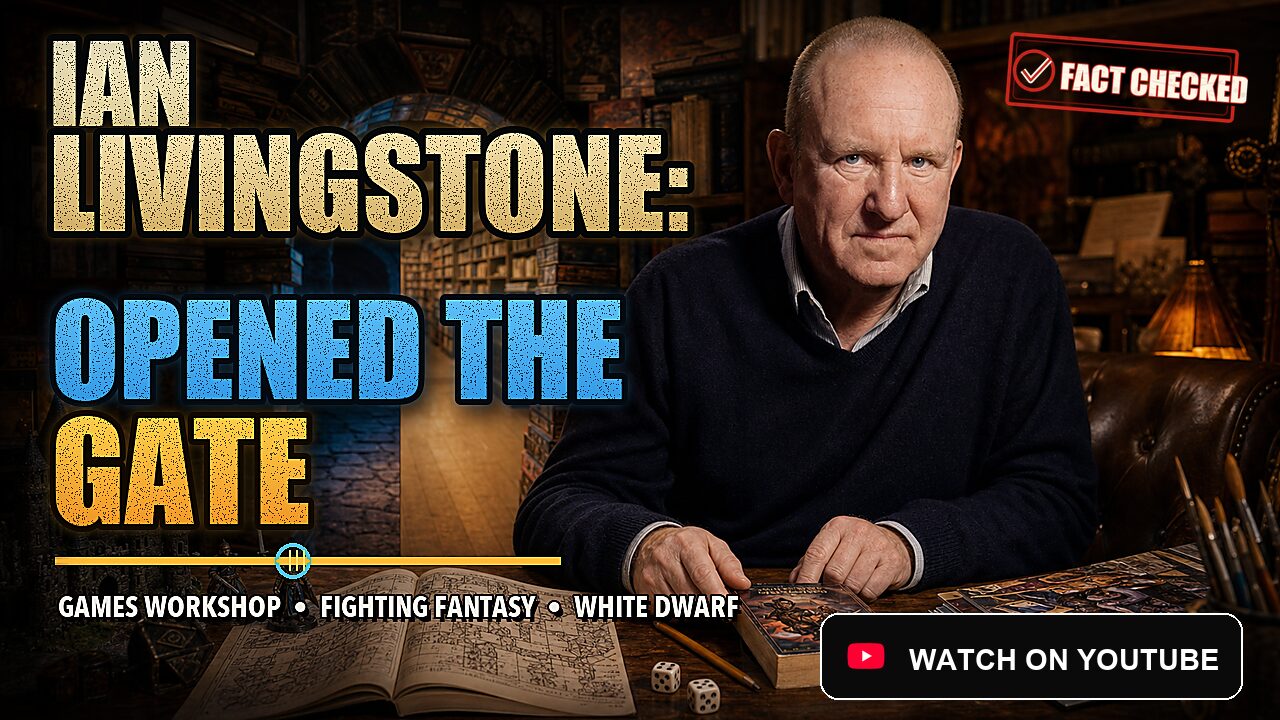
Not a dungeon door. Not a Warhammer army list. Not a board game mechanism. A doorway into the hobby itself.
Before Games Workshop became a global miniatures empire, it was three young men trying to sell strange imported games from a flat in Shepherd’s Bush. Before Fighting Fantasy became a paperback phenomenon, role-playing games were still hard to find, hard to explain, and usually required a group, a referee, rulebooks, dice, and several hours of commitment.
Livingstone saw the gap.
He helped build the stores, the magazine, the distribution channels, the conventions, and the paperback format that carried gaming into places it had not yet reached. He did not design Warhammer. He did not design Dungeons & Dragons. He did not design Talisman or Tomb Raider. Much of his most important work happened around other people’s games.
That is the honest boundary.
It is also the point.
Ian Livingstone did not simply make games. He made it easier for people to find them.
Games Workshop
Games Workshop began in 1975 with Ian Livingstone, Steve Jackson, and John Peake making wooden games, publishing a newsletter, and hunting for a way into a hobby that barely existed in Britain.
Then Dungeons & Dragons arrived.
Livingstone and Jackson understood that this weird American game was not just another product. It was a new kind of play, and Britain needed a way to get it. Games Workshop secured distribution rights, opened dedicated game shops, launched White Dwarf, and helped create a public culture around role-playing games in the UK.
That work was not game design in the narrow sense.
It was infrastructure.
White Dwarf gave British gamers a shared voice. The shops gave them somewhere to gather. Games Day gave the hobby a public ritual. Distribution gave D&D, RuneQuest, Traveller, and the wider RPG wave a route into British hands. Citadel Miniatures connected RPG culture to figures, painting, and the visual language that would later help define Warhammer.
Livingstone was not the rules architect of the games that grew from that soil. His genius was seeing the soil itself.
That is why the "gatekeeper" label fits. He was not guarding the door to keep people out. He was building the gate so people could get in.
Firetop Mountain
The Warlock of Firetop Mountain changed the scale of the doorway.
Co-written with Steve Jackson and published by Puffin in 1982, it took the role-playing promise and compressed it into a paperback: choose a path, roll dice, track stats, fight monsters, die horribly, try again.
The idea was not created from nothing. Branching fiction already existed. Solo RPG adventures already existed. What Livingstone and Jackson did was fuse those pieces into a mass-market shape that a child could buy in a bookshop and play alone that afternoon.
That packaging mattered as much as the mechanics.
Fighting Fantasy did not ask a reader to recruit a group. It did not ask them to understand a full RPG rulebook. It did not ask them to find a specialist store. It sat on ordinary shelves, with fantasy art on the cover and a promise inside: you are the hero.
That sentence carried a lot of future gamers across the threshold.
The system was simple: SKILL, STAMINA, LUCK, two dice, pencil, eraser. Combat was fast. The Adventure Sheet made the book feel like a game. The branching numbered sections turned reading into navigation. The books felt dangerous in a way ordinary children’s fiction rarely did.
Livingstone also gave the series one of its most important names. Fighting Fantasy is a clean piece of branding: direct, pulpy, instantly understood. It told readers what they were getting before they opened the cover.
That, too, is part of design.
The Simple Machine
Fighting Fantasy’s greatest strength was its brutal clarity.
The system was easy enough to teach itself. Roll the dice. Compare numbers. Lose STAMINA. Test your LUCK. Mark your map. Keep going until the book kills you or lets you win.
That clarity made the series travel. It made the books cheap to produce, easy to translate, and simple enough for millions of readers to understand without a referee. It also gave later gamebook series a template to react against: Lone Wolf, Way of the Tiger, GrailQuest, Blood Sword, Fabled Lands, and many others.
The format propagated.
The architecture, however, was never perfect.
SKILL dominates the system. A character with high SKILL can cruise through fights that crush a weaker character. Random character generation can quietly decide whether an adventure is possible before the reader has made a meaningful choice. LUCK is more interesting because it spends itself down every time it is tested, turning luck into a resource rather than a simple blessing. Even there, the mechanic can become a spiral once the number gets low.
The books work because they are fast, exciting, and easy to replay.
They do not work because the system is deep.
That distinction matters. Fighting Fantasy opened the door to solo role-playing for millions. It did not solve every problem of solo role-playing design. Many later successors kept the doorway and rebuilt the lock.
The Livingstone Formula
Livingstone’s own Fighting Fantasy books have a recognizable personality.
They are harsher, more adversarial, and more treasure-hunt driven than many readers remember. City of Thieves, Forest of Doom, Deathtrap Dungeon, and Caverns of the Snow Witch ask the reader not just to survive encounters, but to identify the correct route, collect the correct objects, and learn the hidden shape of the book by repeated failure.
That is the Livingstone machine.
The wrong choice may look tempting. The right object may be missed twenty sections earlier. A reader can reach the end and discover that victory was already impossible because some jewel, spell, clue, or talisman never made it onto the Adventure Sheet.
Some players love that. Some hate it.
The pleasure is not only in winning. It is in mapping the trap. You die, learn, restart, and gradually turn a hostile book into known territory. Deathtrap Dungeon is the purest version of this style: a competition dungeon in paperback form, less a story than a gauntlet daring the reader to master it.
That design voice is real.
It is also stable. Livingstone has been candid that he returned to the same practical methods decades later: flowcharting the adventure, assigning paragraph numbers, and building from the all-important map. His later work often feels like a continuation of the same instincts rather than a reinvention of them.
Steve Jackson, by contrast, pushed the format mechanically in more restless directions: spell systems, science fiction structures, superhero point-buy, language puzzles, and the Sorcery! epic. Livingstone was less experimental. He was the reliable dungeon builder, the one who understood that a cruel maze with a good cover and a clean promise could keep readers turning pages.
That is a valid craft identity.
It just is not the whole story of his importance.
The Industry Around The Games
Livingstone’s larger career keeps returning to the same pattern.
He builds conditions.
Games Workshop made British hobby gaming visible and reachable. White Dwarf gave that audience a magazine. Fighting Fantasy put interactive adventure into mainstream paperback racks. Eidos helped video games become a bigger global business, with Tomb Raider becoming one of the defining entertainment properties of the 1990s. Later, Livingstone turned toward education, policy, investment, and the next generation of digital creators.
The UK government recognized that wider body of work when Livingstone was named a Knight Bachelor in the 2022 New Year Honours for services to the online gaming industry. Hiro Capital currently lists him as a founder and general partner. Livingstone Academy Bournemouth carries his name into education, built around the idea that children should learn as digital makers, not just digital consumers.
That is not a retired designer polishing a legacy shelf.
It is the same gateway instinct in another form.
Find the next locked door. Open it.
What He Actually Built
Ian Livingstone built access.
His personal design work is genuine. Fighting Fantasy matters. Deathtrap Dungeon matters. Judge Dredd, Battlecars, and the other board game credits are part of the record. His style is identifiable: dangerous choices, item hunts, hard routes, compact rules, and adversarial dungeon logic.
But he was not primarily a mechanical innovator. The Fighting Fantasy system was collaborative. The books are simple by design and flawed in ways later designers improved. His strongest gamebook work sells on clarity, danger, and accessibility more than on deep mechanical architecture.
That is the honest boundary.
Livingstone did not need to be the deepest rules designer in the room to change the room.
He changed who could enter it.
Where To Find Him
Sir Ian Livingstone is still active in the games world. Hiro Capital lists him as a founder and general partner. Livingstone Academy Bournemouth continues the education side of his work. Fighting Fantasy remains in print, in reprints, histories, art books, digital editions, and new editions that keep finding readers who were not alive when The Warlock of Firetop Mountain first appeared.
That is the legacy.
Not one game. Not one system. Not one company.
A chain of doors.
Games Workshop opened one. White Dwarf opened one. Fighting Fantasy opened one. Eidos opened one. Education and investment opened more.
Ian Livingstone’s career is the story of a man who kept finding the place where games were trapped behind a wall and building a gate through it.
Fact Check Notes
Publication notes
This site is AI-assisted and human-reviewed. We use artificial intelligence to help gather research, organize source material, and draft profile content. Human editors then read, revise, and check each profile before it goes live. Most profiles are built through deep AI research and two separate rounds of fact-checking.
Leave a Reply
You must be logged in to post a comment.