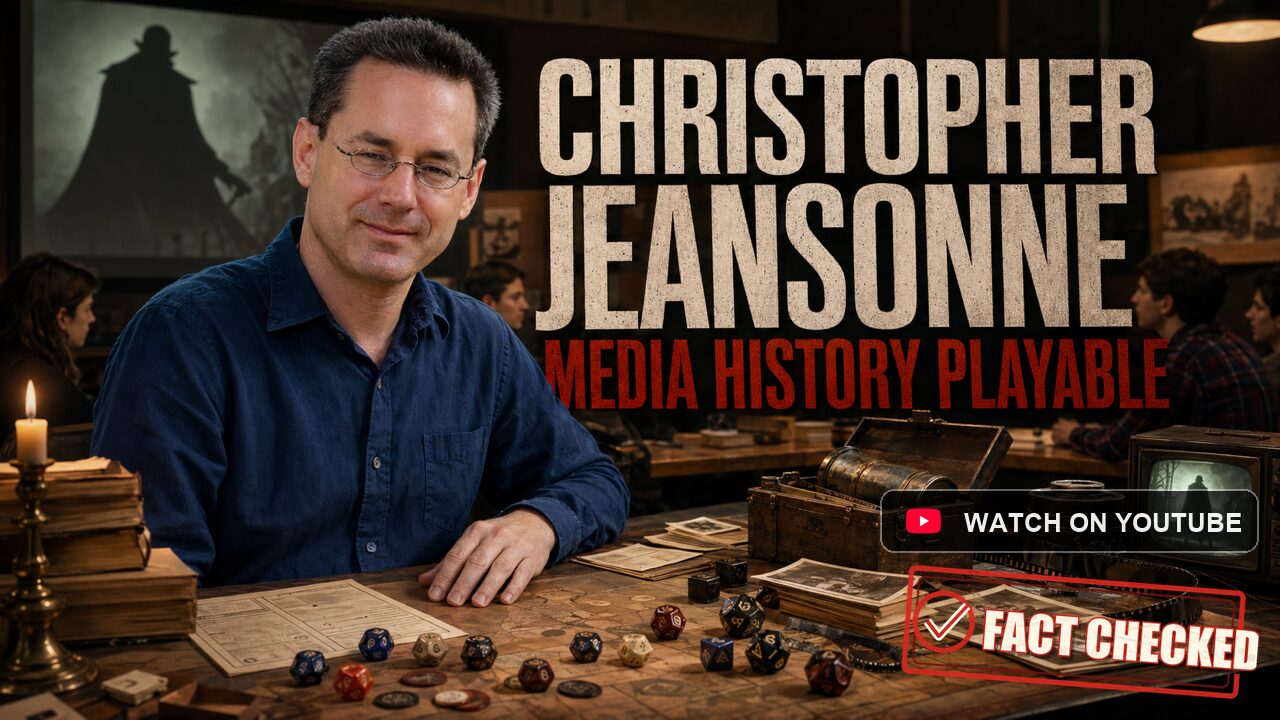
He teaches it as something you can inhabit.
One of his most distinctive courses asks students to become vampires shortly after the invention of photography. From that starting point, they move through two centuries of image culture. They track what changes when still images give way to film, when film gives way to television, and when television gives way to streaming media.
It is not a gimmick.
It is a way of turning an abstract subject into a memory you can carry. Media history can turn into a list you memorize. In Jeansonne’s structure, it becomes a lived relationship between technology, culture, and the parts of yourself that want to remember.
That matters because most people live inside media without ever being taught how to see it.
We learn how to watch before we learn how to question. We learn how to scroll before we learn what scrolling is doing to us. A good media course does not only explain the past. It changes what a student can notice in the present.
Jeansonne’s work uses play to do that, but it never treats play as a joke.
He is not a commercial tabletop designer. His influence runs through a different channel. He uses tabletop roleplaying structure and game design principles to rebuild what a classroom can do.
The Filmmaker First
Jeansonne’s teaching starts with the fact that media is made.
He earned a BA in French in 1994, then completed an MFA in Film at Ohio University in 1999. Language study teaches you that meaning is built from systems. Film production teaches you that systems have consequences.
Someone chose that frame. Someone cut that scene. Someone decided what the audience would see and what would stay outside the shot.
Many media courses begin with interpretation.
Jeansonne begins with construction.
Students do not only learn what a piece of media means. They learn that meaning was built, and that it could have been built differently.
There is a quiet relief in that.
If media is built, then a student can build back. They can see the joints. They can name the trade-offs. They can stop treating the feed as fate.
The Years In Japan
From 1999 to 2006, Jeansonne lived and taught in Japan.
He worked first as an ESL teacher for the Ibukiyama Board of Education, then as co-director of the ESL program at Seisen University in Minami-Hikone. He also taught American culture and film and served as the lead instructor of the Aikido club.
Teaching across languages changes your sense of what “normal” means. Translation is not only vocabulary. It is assumptions. It is what a story expects you to feel.
That is the engine behind adaptation studies.
When a story crosses borders, it does not merely travel. It changes shape. It asks a new audience to recognize themselves in it, and that recognition comes with a price.
One of his published examples is the transnational remaking of Ju-On into The Grudge. Horror makes the translation problem easy to see. Fear is never as universal as people claim. Change the fear, and you change the whole machine.
The Program Builder
At The Willow School in New Orleans, Jeansonne founded and chaired a media arts program. He also received a 2008 educational support grant from the Selley Foundation to support establishing the program.
Building a program forces you to face the real question behind teaching.
What do you want students to be able to do when they leave the room?
Not what do you want them to repeat.
Not what do you want them to agree with.
What do you want them to be able to make, to notice, to question, and to rebuild.
This is where his pattern becomes visible. Give students a system, then let them act inside it long enough to discover how it behaves.
The Superhero Classroom
Jeansonne completed a PhD in Arts Education at The Ohio State University in 2019.
His dissertation, Superheroes in the Classroom, Or: An Autoethnography of Great Power, Responsibility, and Community in a Critical Media Pedagogy, was the recipient of the 2019 Manuel Barkan Dissertation Award.
Superheroes are a power fantasy, but they are also a vocabulary for responsibility. They are stories about what happens when someone can act and cannot pretend they are neutral.
That is why they are useful in a classroom.
If you teach a genre obsessed with power, you can no longer ignore the power inside teaching itself. Who sets the rules. Who gets to speak. Who gets to be an author rather than a consumer.
Those are not side questions.
They are the medium.
Rpi And Gameful Learning
Jeansonne is a Senior Lecturer and Undergraduate Program Director in Communication and Media at Rensselaer Polytechnic Institute.
At a technical university, students arrive already fluent in systems. Gameful learning meets them there. It borrows what games do well and uses it for something more serious than entertainment: meaningful constraints, active roles, feedback loops, multiple paths, collaboration, and safe failure.
His faculty profile credits him with leading professional development initiatives, including co-organizing the 2023 and 2024 Gameful and Immersive Learning Symposium, the 2024 Innovative Pedagogy Fellowships for Faculty, and the 2025 Reflective Pedagogy Workshops.
That is how a method becomes culture.
It stops being one teacher’s style and starts becoming a shared vocabulary.
That is where the tabletop connection stops being metaphor.
Tabletop players already know that rules create meaning. You can feel it when a group agrees to live inside a new set of constraints. You become a slightly different person in that world. Gameful learning treats education with the same seriousness. It builds constraints on purpose, then asks what kind of thinking those constraints produce.
The Vampire Course
200 Year Old Vampires: Reflecting on Motion Picture History Through Undying Eyes uses a tabletop roleplaying framework to study the history of photographic images and motion pictures.
Students create characters who become vampires shortly after the invention of photography. In small groups, they move through changing eras of images, films, television, and streaming media.
The vampire premise is not there because vampires are cool.
It is there because vampires remember.
They remember what humans forget.
They watch the world build new ways to store memory, to sell memory, to fake memory, and to weaponize memory. When a new medium arrives, it does not simply add options. It changes what the past feels like.
Jeansonne’s structure gives students a way to feel that shift across centuries, not just describe it in a paragraph.
The work is collaborative by design.
Students form covens. They share a timeline. They collect artifacts and reflections that have to be explained to someone else. They practice curation and interpretation, but they also practice listening. A century is too long to carry alone, even in fiction. The group is part of the lesson.
The Tabletop Connection
Jeansonne is currently co-writing a monograph on the Tolkien-inspired board game War of the Ring for the University of Michigan Press Tabletop Gaming series, with Maurice Suckling (forthcoming).
War of the Ring is an adaptation problem with teeth. It is a story about hope and exhaustion, about hiding and revealing, about the cost of victory and the cost of delay. A board game has to carry that using rules and procedures.
That translation is never neutral.
A board game has to decide what gets quantified, what stays ambiguous, and what only exists as social pressure at the table. It has to decide when players get clarity and when they have to act in partial information. Those decisions are interpretation, but they are interpretation that lives in the hands.
That is the bridge between his scholarship and his pedagogy.
Meaning is not only what a story says.
Meaning is what a system makes you do.
What He Actually Built
Christopher Jeansonne did not invent roleplaying in the classroom. He did not invent game-based learning. He did not create adaptation studies.
What he built is a practice that treats students like participants in a system, not spectators.
He builds structures where they have to make choices. They have to carry memory. They have to negotiate meaning with other people. They have to see how the medium pushes back.
In other words, he builds classrooms where students are allowed to be changed by contact with the material.
Not because the teacher declares that the material matters, but because the structure makes it hard to pretend it does not.
The student is not a container.
The student is a person inside a world of systems, learning how to move.
Where To Find Him
Christopher Jeansonne is a Senior Lecturer and Undergraduate Program Director in Communication and Media at Rensselaer Polytechnic Institute.
His current course list includes Media and Society, Adaptations in Games and Media, Critical Television, The Film Experience, Superheroes in the Classroom, and 200 Year Old Vampires.
The throughline of his work is simple to state and hard to execute:
Media is not only something students watch.
Games are not only something students play.
In his classrooms, both become systems for thinking, and for choosing how you want to live inside those systems.
Fact Check Notes
Publication notes
This site is AI-assisted and human-reviewed. We use artificial intelligence to help gather research, organize source material, and draft profile content. Human editors then read, revise, and check each profile before it goes live. Most profiles are built through deep AI research and two separate rounds of fact-checking.
Leave a Reply
You must be logged in to post a comment.