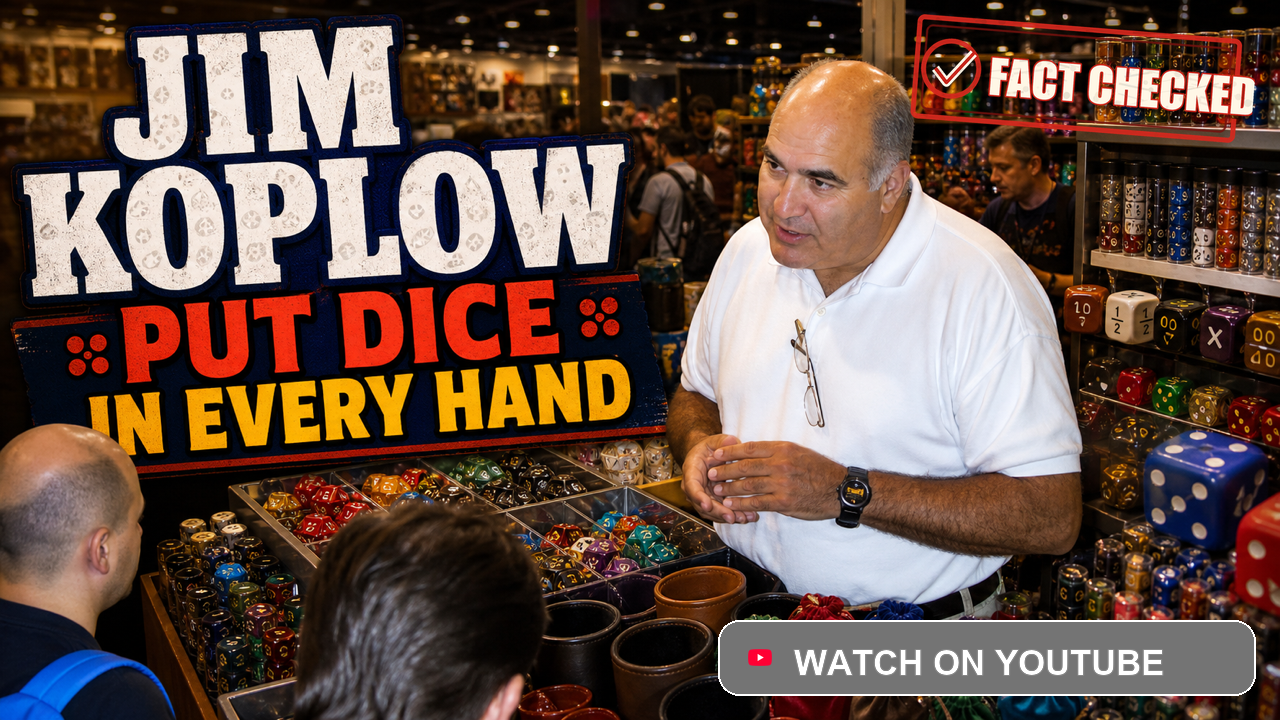
Every tabletop game has a moment when the idea has to leave the page.
For role-playing games, that moment often sounds like plastic on wood. A d20 tumbles. A handful of six-sided dice hits the table. A teacher shakes fraction dice in a classroom. A player picks up a strange little object marked with letters, colors, symbols, signs, animals, operators, or numbers that do not fit any ordinary board game.
Rules tell you what to do with chance.
Dice make chance physical.
That is the part of the hobby James "Jim" Koplow helped build. Not the grand theory of game design. Not the famous fantasy world. Not the rulebook that gets quoted in arguments forty years later. Koplow built the supply layer: the bright, cheap, weird, useful, tactile objects that make games playable, teachable, salable, and memorable.
Koplow Games, known as The Nice Dice Company, became one of the quiet fixtures of the hobby. Its dice sat in game stores, classrooms, convention booths, novelty bins, math kits, and RPG bags. The company made the ordinary tools of play feel abundant.
That is not a small thing.
When a hobby depends on specialized components, the person who makes the components available shapes what designers can imagine and what players can actually do.
Harvard Square And Organized Crime
Koplow did not begin as the dice man. He began as a game publisher.
In the mid-1970s, he published Organized Crime, a strategy and simulation board game about underworld competition. The game was a period object in the best possible sense: direct conflict, negotiation, money, hit men moving around a board, and the lurid energy of a small publisher trying to get noticed in a market that barely existed.
Getting noticed required theatre.
Carol Monica, founder of The Games People Play in Cambridge, Massachusetts, later remembered Koplow walking into her store shortly after she opened in 1974 to pitch Organized Crime. On Saturdays, he walked around Harvard Square with a sandwich board. One side advertised his game. The other advertised her store.
It is a wonderful image: the future supplier of thousands of dice walking through Harvard Square as his own moving billboard.
The moment mattered because Monica’s store sat near Harvard and MIT, exactly where a new kind of game customer was appearing. Students were hearing about Dungeons & Dragons. The old assumptions about games as family boxes or abstract classics were beginning to shift. Hobby gaming needed retailers who could understand odd demand before wholesalers did.
Monica saw that demand. She also saw what D&D required.
Special dice.
According to Monica’s later account, she told Koplow about the dice needed for D&D and helped get him into the dice business. That conversation changed the center of his career. Organized Crime gave him a door into the market. Dice gave him a future.
The Nice Dice Company
Koplow Games took the unglamorous path that turned out to be durable.
Instead of chasing only finished games, the company became a full-line supplier of dice and game accessories. Its official site still describes The Nice Dice Company in those terms: standard dice, polyhedral dice, pawns, timers, sorting chips, dice bags, dice cups, dice jewelry, novelty dice, educational dice, language dice, souvenir dice games, family games, gambling dice games, and custom dice.
That catalog tells you what Koplow understood.
There is no single dice market. There are many small dice markets that overlap just enough to support a business if someone is willing to serve all of them. The RPG player wants a polyhedral set. The math teacher wants operators and fractions. The toy store wants colorful impulse items. The souvenir shop wants state dice. The designer wants a prototype part that makes a new probability curve possible. The classroom wants an object students can touch instead of another worksheet.
Most game companies sell one experience.
Koplow sold the component language behind many experiences.
That is why the product range feels almost comic when listed out. Loaded dice. Round dice. Crooked dice. Mini dice. Dice bones. Wood dice. Alphabet dice. Thirty-sided alphabet dice. Decimal dice. Positive and negative number dice. Place value dice. Dice numbered to 100.
Some of these are jokes. Some are tools. Some are both.
The important part is that the same company treated all of them as legitimate uses of dice. That widened the idea of what a die could be. Not just a cube with pips. Not just a d20 in a wizard’s hand. A die could be an alphabet spinner, a math prompt, a language exercise, a classroom manipulative, a novelty gift, a probability toy, or a custom part for somebody else’s design.
The Classroom Table
Koplow’s educational dice may be the least glamorous part of the catalog and the clearest proof of the company’s deeper value.
Teachers know something game designers sometimes forget: the hand matters. A student who will glaze over at a worksheet may wake up when the same problem becomes an object to roll, catch, compare, and argue about. The randomness makes the exercise feel alive. The tactile object lowers the fear of being wrong.
Math operator dice turn arithmetic into a small procedure. Fraction dice let students build and compare values with their hands. Place value dice make abstraction visible. Alphabet dice turn spelling and word formation into play. Language dice do similar work across vocabulary and syntax. Braille and other symbol dice widen access and use.
That is design, even when it does not look like a game box.
It is not the design of one finished title. It is the design of affordances. Give teachers different objects and they can invent different lessons. Give students dice and the classroom can become a table.
This is where Koplow’s work crosses out of hobby gaming and into everyday learning. A D&D player may remember the first d20 they bought. A teacher may remember the fraction dice that finally made a concept land. Those are different audiences, but the mechanism is related. Chance draws attention. Touch anchors memory. Repetition becomes easier when it feels like play.
The Trade Show Method
Koplow’s career also belongs to the trade show era of the game business.
Before the modern internet flattened discovery, the industry ran on booths, catalogs, samples, handshakes, and people who could connect one small need to another. Dice are perfect trade show objects. They fit in a pocket. They sparkle under bad convention lighting. They can be handed to a retailer, teacher, distributor, designer, or curious passerby in two seconds.
Koplow Games understood that kind of selling.
The supplied history describes Koplow as a long-haul trade show presence, the kind of person who built business by showing up again and again. That matters because component companies live on trust. A retailer does not need one novelty die once. A retailer needs a source that can fill a rack, refresh it, explain what sells, and keep strange little SKUs available long after a trend passes.
The company’s association with Will Niebling reinforces that service identity. Niebling, a major industry sales and marketing veteran, received GAMA’s Rick Loomis Service Award in 2021, and ICv2 noted his decades-long relationship with Koplow Games. The award belongs to Niebling, not Koplow. Still, the connection tells you the kind of industry niche Koplow Games occupied: not loud creative celebrity, but distribution, service, relationships, and continuity.
The dice business is not just manufacturing.
It is remembering what everyone needs.
What He Actually Built
James Koplow did not invent dice. He did not invent polyhedral dice. He did not create Dungeons & Dragons, and he did not design the RPG systems that made d4s, d8s, d10s, d12s, and d20s famous.
What he built was access.
He took a small-game publisher’s hustle, listened to a retailer who understood the new D&D demand, and turned Koplow Games into a supplier for the many physical forms chance could take. His career sits in the space between design and logistics. That space is easy to miss because it is not usually credited in rulebooks.
But games are made of parts.
A designer can imagine a mechanic that needs unusual dice, but somebody has to make those dice findable. A store can build a rack of RPG accessories, but somebody has to fill it. A teacher can turn arithmetic into play, but somebody has to manufacture the object that makes the lesson roll.
Koplow’s contribution was not one great mechanic. It was the steady multiplication of usable chance objects.
That changes design indirectly. When the component exists, designers can reach for it. When it is cheap enough, players can buy it. When it is colorful enough, children pick it up. When it is available in enough forms, whole categories of play become easier to prototype, teach, and sell.
This is the quiet infrastructure of tabletop gaming.
Where To Find Him
Koplow Games remains active online through koplowgames.com, with its current web catalog and Boston contact information listing the company at 369 Congress Street. The site still presents The Nice Dice Company as a full-line supplier of dice and accessories, including gaming, novelty, educational, language, souvenir, and custom dice.
That is the right legacy for Jim Koplow.
Not a monument. A catalog.
Page after page of small objects waiting to become a lesson, a prototype, a dungeon roll, a party game, a souvenir, a joke, or the one weird die a designer suddenly realizes they need.
The rules get the glory. The worlds get the posters. The dice sit in the palm, waiting for someone to ask what happens next.
Jim Koplow helped make sure there were enough of them.
Fact Check Notes
Publication notes
This site is AI-assisted and human-reviewed. We use artificial intelligence to help gather research, organize source material, and draft profile content. Human editors then read, revise, and check each profile before it goes live. Most profiles are built through deep AI research and two separate rounds of fact-checking.
Leave a Reply
You must be logged in to post a comment.