Iconic Tabletop Game Convention
Gen Con UK
The licensed British convention that moved from holiday camps to London and back again.

Gen Con UK: The Holiday Camp That Brought Gen Con to Britain
Part 1 of 3
The first British Gen Con came with a bed.
For £39.95, the advance registration package promised admission and accommodation at a Pontin's holiday centre on the Sussex coast. The date was November 30, 1990. The sea air at Camber Sands was cold, the summer crowds were gone, and hundreds of gamers were being invited to spend three days inside a closed little world of chalets, dice, tournaments, and trade stands.
The advertisement in Dragon magazine called it the 1990 European Gen Con Games Fair. It named TSR guests from the United States, including Jim Ward, Jeff Easley, Jean Rabe, Larry Elmore, and Tom Wham. It promised the AD&D European Open alongside tournaments for Buck Rogers, Star Wars, 2300 AD, Spelljammer, BattleTech, Call of Cthulhu, and the BattleSystem miniatures rules.
This was not a small club day with an ambitious name. It was an attempt to translate the Gen Con model into British hobby culture.
And it happened. A later issue of Dragon referred to the final round of the 1990 European Gen Con tournament. That small piece of follow-up evidence matters because later histories disagree about when the British convention began. The contemporary record fixes the beginning at Camber Sands in 1990.
There was a history before the name. Richard Rowlands, who helped organize the British events, recalled an earlier TSR Games Fair at the University of Reading and a period of smaller one-day gatherings. Those events belong to the prehistory. They helped build the people and habits that made a national show possible, but they were not yet Gen Con.
Camber Sands was different because the venue became part of the program.
A convention in a city exhibition hall begins when the doors open and ends when security pushes the last visitor out. A residential holiday camp keeps going. Players leave a scheduled role-playing session and continue the story in a chalet. Designers, fans, traders, and volunteers eat in the same places. Someone finds an unused table after midnight. The official timetable loosens, but the convention does not stop.
That intimacy came with discomfort. The first event was held at the edge of winter. British seaside holiday camps were built for families in summer, not for gamers carrying boxes through wet November wind. Rowlands later remembered the cold as a serious problem. The schedule gradually moved toward spring, when the same residential idea was easier to enjoy.
The timing was not the only thing that changed. The early event was branded European Gen Con because TSR was using Britain as a base for a wider regional gathering. The audience was still unmistakably shaped by the British hobby. Organized role-playing sat beside miniatures, board games, live action, tournament card games, charity activity, a trade area, and large numbers of volunteers. Publishers and distributors did more than sell products. They ran games and supplied the social machinery around them.
The British convention scene already knew how to build communities from volunteer labor, club newsletters, university groups, shop networks, and organized campaigns. Gen Con supplied a powerful international banner. The British organizers supplied the room.
Year by year, Camber Sands became less an imported American show and more a national reunion. Dragon advertised another English European Gen Con for November 1991. The magazine's 1992 coverage told readers it would see them at European Gen Con again. By 1993, the British AD&D Open was feeding a winner into the next European event.
That tournament pathway shows what the convention did for players. Local clubs could compete in a shared national structure. A game run at a shop or regional gathering could lead to a table at Gen Con. The convention connected the British hobby's scattered rooms without asking them to become one uniform community.
Camber Sands remained the home through 1995. Then the show moved to Loughborough University in 1996.
The university preserved the feature that mattered most. It was still a place where visitors could sleep, eat, play, and socialize within the same campus. Loughborough offered lecture rooms, halls, accommodation, and enough shared space for both scheduled and improvised gaming. The sea disappeared, but the weekend village survived.
The move also reflected ambition. Gen Con in Britain was no longer an experiment that needed an empty holiday resort. It had an established organized-play audience, publisher support, and a volunteer base capable of filling a university program.
The name shifted with the institution. By 1998, Gen Con UK had become the ordinary label for the British series. The change made the show's national identity clearer at a time when other Gen Con-branded events were appearing in Barcelona, the Benelux countries, and elsewhere in Europe. It also avoided pretending that every European Gen Con belonged to one unbroken circuit.
Gen Con UK stayed at Loughborough through 1999. In 2000 it moved to the Manchester Conference Centre.
Manchester carried the convention into a more urban setting, but it did not yet represent the full break that was coming. The show's strength still came from participation. People traveled to play, run events, volunteer, sell games, meet designers, and see friends they might encounter only once a year. The trade hall mattered, yet it was attached to a convention of tables rather than the other way around.
That is the central achievement of the first decade. Gen Con UK proved that a large British gaming convention could be national without losing the texture of a long club weekend. It joined industry launches to volunteer labor and formal tournaments to games that began because someone found four empty chairs.
The formula was awkward, social, and resilient. It also had a ceiling.
At the start of the new century, London offered something Loughborough and Camber Sands could not: a world-famous exhibition venue, international travel links, a vast local audience, and the prestige of a capital-city show. Olympia 2 could make Gen Con UK look like a major commercial event.
It could also take away the residential world that had made the convention feel like home.
In 2001, Gen Con UK moved to London. The holiday-camp experiment had become a national institution. Now that institution was about to gamble on scale.
Continue with Part 2: “When Gen Con UK Gambled on London.”
[Reconciled source ledger](../Sources/Gen_Con_UK_Reconciled_Source_Ledger_V1.md)
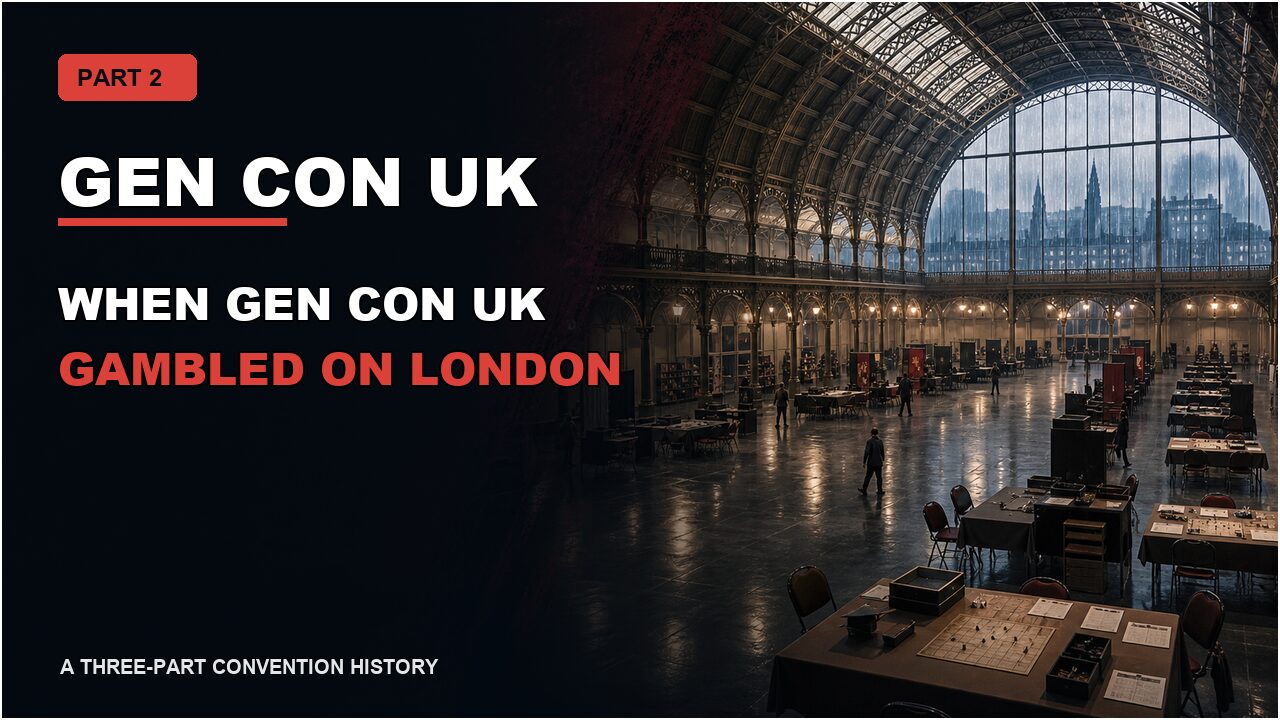
Gen Con UK: When Gen Con UK Gambled on London
Part 2 of 3
Olympia 2 looked like the future.
The London exhibition hall had high ceilings, professional trade space, and a name that carried weight beyond the gaming hobby. When Gen Con UK arrived in 2001, the move made a clear statement. The British convention was ready to leave the residential campuses and seaside resorts behind and stand in the capital as a major industry event.
For a time, the bet worked.
The 2001 and 2002 shows brought together organized role-playing, collectible card games, board games, live action, computer games, guests, and a large trade area. A period report on the 2002 convention described hundreds of role-playing tables across dozens of systems and scenarios. Wizards of the Coast's own Living Greyhawk Journal announced special RPGA events at Olympia 2 from August 29 through September 1.
The program carried the same participatory heart as the older events. People did not travel only to shop. They came to run campaigns, judge tournaments, earn organized-play results, demonstrate new games, and occupy a table for hours. Publishers, distributors, volunteer coordinators, and local clubs made the timetable possible.
London gave that activity a stronger commercial frame. Guests could fly into a major international city. Companies could treat the show as a product showcase. Retailers and press could reach Olympia without committing to a holiday camp weekend. The Gen Con name looked less like a British adaptation and more like part of an expanding international convention brand.
The price was separation. Most visitors left the building when the hall closed. Hotels, meals, and late-night play scattered across an expensive city. The convention still had a community, but it no longer controlled the whole weekend environment. Olympia concentrated the program while London pulled the people back apart.
That expansion was changing hands.
In May 2002, Peter Adkison purchased Gen Con from Wizards of the Coast and formed Gen Con LLC. Adkison had founded Wizards, built it into the company behind Magic: The Gathering, and sold it to Hasbro. Buying Gen Con gave him control of an institution he had attended for years and placed the convention brand under a privately held company focused on events.
The transaction did not create Gen Con UK. British organizers had been building the series since 1990, first under the European Gen Con label and later as Gen Con UK. The purchase did change who controlled the name and the international strategy attached to it.
The United States convention was moving from Milwaukee to Indianapolis in 2003. A Southern California edition would follow. Licensed Gen Con events were appearing in other countries. Within that larger plan, the London show could be presented as more than a national gathering. It could be Gen Con's European stage.
The branding around the 2003 event reflects that ambition and its confusion.
Some contemporary listings and participants called the April show Gen Con Europe. Other attendees remembered it as Gen Con UK 2003. Both names appeared close to the event. Later timelines often choose one and erase the other, but the historical record is not that tidy. The safest description is the London Gen Con held at Olympia 2, known under both labels.
The date was less ambiguous.
Instead of returning in late August, the convention ran from April 18 through 21, 2003, over Easter weekend.
That calendar move broke a rhythm the British audience already understood. The late-summer Gen Con weekend had become part of the hobby year. Clubs, volunteers, traders, and returning players planned around it. Easter competed with family commitments, school holidays, travel, and the long-established British national science-fiction convention, which ran the same weekend in another English town.
The hall did not fill.
Surviving accounts describe a convention with major guests and a substantial program but too few people moving through the space. One participant remembered being paid in trade-hall vouchers to run games whose players did not arrive. Dealers cut prices. Visitors who did attend could enjoy unusually easy access to tables and guests, but that intimacy was not the planned experience. It was the result of empty capacity.
No reliable organizer attendance statement has been recovered. One period listing gives 4,500, while participant testimony describes a hall that felt nearly deserted. Those pieces cannot be forced into a precise total. The responsible conclusion is narrower: the 2003 show was widely experienced as a commercial and attendance failure compared with the prior London edition.
Olympia made the weakness visible. A thin crowd in a holiday camp can still feel like a lively gathering because everyone shares the same small rooms. A thin crowd in an exhibition hall becomes empty floor. The venue that had made Gen Con UK look important now made the shortfall impossible to hide.
The problem was not that British gamers had suddenly stopped caring about conventions. The event had changed too many parts of its offer at once. It had moved away from the residential model, taken on a major London cost structure, shifted its date, and stretched its identity between a national show and a European brand.
The 2003 outcome ended the direct London experiment. Gen Con LLC did not bring the same operation back to Olympia the following year. Instead, the British show moved to a licensed model.
That distinction matters. Gen Con UK did not simply close in 2003. The name, community, and event idea passed into another operating arrangement. Horsemen Events, a British convention company associated with organizers Richard Rowlands and Mark Smith, became the licensee. Gen Con LLC retained the brand; the British group would take on the practical risk of venues, programming, volunteers, and attendance.
The new operators faced a hard design question. Should they keep chasing the visibility of a London trade show, or return to the social architecture that had made Camber Sands work?
Their answer was visible in the next venue.
Gen Con UK 2004 would not be held at Olympia. It would run at Butlin's in Minehead, a seaside holiday resort with accommodation, shared facilities, and the possibility of gaming late into the night.
After thirteen years of growth, rebranding, and metropolitan ambition, the British Gen Con was going back to camp.
It was not going backward. It was trying to remember what kind of convention it had been.
Continue with Part 3: “The Last Roll at Reading.”
[Reconciled source ledger](../Sources/Gen_Con_UK_Reconciled_Source_Ledger_V1.md)

Gen Con UK: The Last Roll at Reading
Part 3 of 3
The British Gen Con survived London by going back to a holiday camp.
In October 2004, Horsemen Events brought the convention to Butlin's Minehead under license from Gen Con LLC. The move replaced Olympia's exhibition-hall scale with accommodation, shared social space, and the possibility that a game could continue after the formal program ended.
It was an old idea with a new operator.
Horsemen Events inherited a recognizable name, an experienced volunteer community, and a national audience. It did not inherit an easy business. The licensee had to find a venue, build the timetable, sell space to traders, recruit guests, coordinate organized play, and set badge prices that British gamers would accept. Gen Con LLC owned the brand. The practical convention still had to be rebuilt in Britain.
The 2004 edition ran from October 14 through 17. A contemporary announcement presented Minehead as a return to the atmosphere of the early residential events. The show moved to another Butlin's resort at Bognor Regis in 2005.
Later attendance compilations list 1,957 people for 2005, but the underlying organizer count has not been recovered. The number is useful as a rough sign of scale, not as an audited fact. Gen Con UK was a convention of a few thousand people, far smaller than the American event but large enough to function as a national hobby gathering.
Then the sequence breaks.
No held Gen Con UK edition has been documented for 2006. Later summaries sometimes write as though the show ran continuously from 1998 through 2008, but their own event tables leave the year blank. Organizer memories connect the gap to venue problems. No direct cancellation notice has been recovered, so the honest chronology simply marks 2006 as a missing edition.
The convention returned in 2007 at the University of Reading.
Horsemen Events announced the campus as the show's new home and scheduled four days from August 30 through September 2. Reading offered a compromise between the old and new versions of Gen Con UK. It had halls for trade and organized play, but it also had campus accommodation, lawns, food, and rooms where the social convention could keep breathing.
The program included role-playing games, card tournaments, board games, computer games, industry guests, and a large trade hall. Contemporary reports name Wizards of the Coast, publishers, distributors, and designers. The show was not a trade conference with a few public demonstrations attached. It was a consumer participation convention. The tables were the reason to come.
Reading hosted Gen Con UK again from August 28 through 31, 2008.
The final edition did not look like a funeral. Exhibitors later described it as successful. Attendees remembered a friendly campus atmosphere. The guest program included veteran game creators, while demonstrations and organized play tied the show to a year of major change in fantasy gaming.
Paizo used the convention for Pathfinder Society's official launch in the United Kingdom. The scheduled sessions sold out. That detail has sometimes been inflated into a claim that the Pathfinder role-playing game itself launched worldwide at Gen Con UK. It did not. The achievement was more specific and more revealing: a new organized-play community proved it could fill its UK tables at the British convention.
Nobody had announced that this would be the last Gen Con UK.
A March 2009 issue of Mongoose Publishing's Signs & Portents still listed a 2009 edition at the University of Reading from September 2 through 6. The announcement proves that another show was planned and publicly promoted.
It does not prove that the doors opened.
No completed program, post-event report, exhibitor review, attendee account, or organizer result has been found for Gen Con UK 2009. The evidence trail that exists for 2007 and 2008 simply stops. Until a contemporary record surfaces, 2008 remains the last verified held edition and 2009 remains an announced show that did not occur.
The mechanics of that failure are still uncertain. No reliable ticket notice, refund record, or direct cancellation statement has been recovered. Richard Rowlands later explained the broader problem in plain economic terms: venues wanted higher prices while gamers wanted to pay less. The financial crisis made that squeeze worse. His testimony explains the pressure, but it is a retrospective account rather than a set of convention books.
The final break came through a separate licensing attempt.
In March 2010, an EN World discussion reproduced a message attributed to Gen Con LLC chief executive Adrian Swartout. According to that message, a group that had been awarded a license for a future British show could not secure a venue. Swartout said that she and Peter Adkison had decided to stop seeking a Gen Con UK licensee and to put the show to rest.
The surviving evidence is a secondhand copy of private correspondence, not a Gen Con press release preserved on the company's site. It is still the strongest contemporary account of the formal ending. It should not be confused with the advertised 2009 edition. One was an announced Reading show that left no evidence of taking place. The other was a later licensing effort that could not find a venue.
As of 2026, there is no Gen Con UK. Gen Con LLC's official fact sheet identifies its annual convention with Indianapolis and lists Peter Adkison as owner of the privately held company. The Gen Con name remains active. The British edition does not.
The British convention culture around it did not disappear.
UK Games Expo began independently in Birmingham in 2007, while Gen Con UK was still running at Reading. The two conventions overlapped for two years. There is no evidence that UK Games Expo bought the British Gen Con, inherited its license, or continued its organization under a new name. Calling it a legal successor would turn cultural influence into a transaction that never happened.
The relationship is better understood as proof of demand. British gamers still wanted a national weekend where publishers, designers, retailers, clubs, families, tournament players, and role-players could share the same building. UK Games Expo found another business model and grew. Smaller specialist conventions continued to thrive. The social form that Camber Sands had helped establish outlived the Gen Con license.
That is Gen Con UK's real legacy. It gave the British hobby a recurring room large enough to see itself. It connected local play to international publishers, gave volunteers national responsibility, and made a long weekend of gaming feel like temporary citizenship.
The convention ended because a famous name could not solve ordinary event economics. Venues, dates, travel, accommodation, volunteers, badges, and trade stands still had to add up.
For eighteen years, often imperfectly, they did.
[Reconciled source ledger](../Sources/Gen_Con_UK_Reconciled_Source_Ledger_V1.md)
Fact Check Notes
Publication notes
This site is AI-assisted and human-reviewed. Research from independent sources was reconciled, revised, and fact-checked before publication.
Leave a Reply
You must be logged in to post a comment.