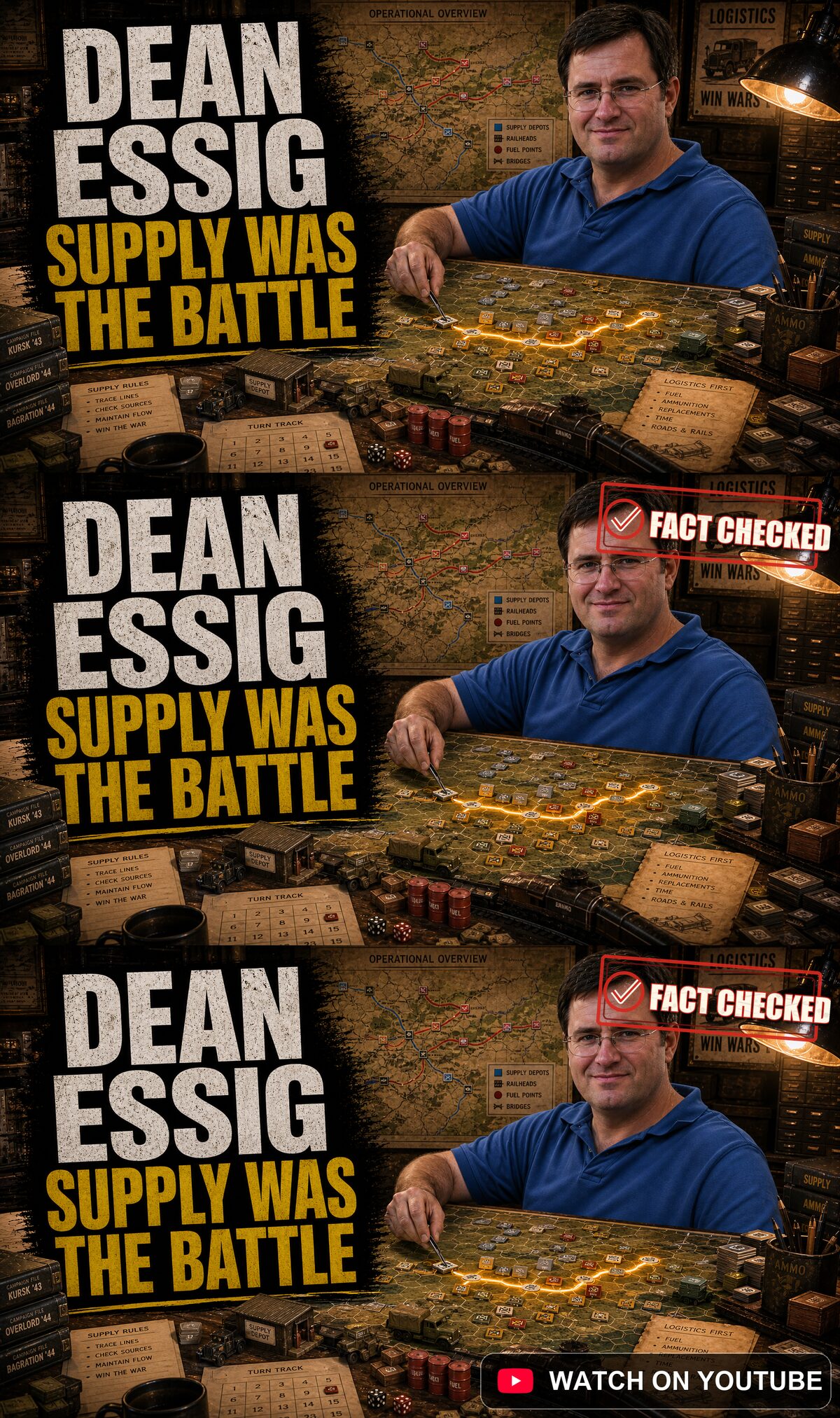
Dean Essig built games where the glamorous part of war could not escape the unglamorous part.
You can have the attack plan.
You can have the armor.
You can have the map, the odds, the artillery, the air support, and the perfect opening.
If the fuel and ammunition are not there, the offensive dies.
That was Essig’s great lesson to hex-and-counter wargaming. He did not treat supply as a bookkeeping nuisance sitting beside the real game. He made logistics the real game. Combat became the visible eruption of a deeper system: depots, trucks, railheads, weather, roads, ports, command friction, and the terrible distance between intention and capacity.
The emotional effect of that choice is simple and brutal. The game does not let you stay in the fantasy of the perfect plan. It keeps pulling you back to what you can actually move, what you can actually feed, and what you can actually afford to spend.
That insight shaped his career in modern historical wargaming.
Essig founded The Gamers in 1988 in Homer, Illinois, and spent the rest of his career building series systems: shared rules frameworks that could carry many different battles across many different titles. The approach rewarded player investment. Learn the system once, and the next game in the series did not start from zero.
That sounds natural now.
In late-1980s wargaming, it was a structural bet.
Essig bet that players did not want to relearn the language of war every time they opened a box. They wanted a language strong enough to let the history change while the rules foundation held.
He spent decades proving the bet.
The Gamers
The Gamers became a kind of workshop for serious operational wargaming.
The company did not chase ease. It chased coherence. The house style was demanding, exacting, and sometimes intimidating, but it gave players something rare: trust that the system underneath the counters had been thought through.
Essig’s series model was the key.
A standalone wargame can be brilliant, but it asks the player to climb a new hill each time. A series system compounds. Every scenario, campaign, module, errata pass, and new title feeds back into the larger structure. The rules become a shared professional vocabulary between designer and player.
That is why The Gamers mattered beyond any one box.
Operational Combat Series.
Standard Combat Series.
Tactical Combat Series.
Battalion Combat Series.
Napoleonic Brigade Series.
Line of Battle.
Each line had a scale, a tempo, and a problem it wanted to solve. Some were more accessible. Some were dense enough to scare off casual curiosity at the lid. But together they showed Essig’s central habit: design the framework, refine it under pressure, and let the specific battle breathe inside it.
Multi-Man Publishing later acquired The Gamers line in 2001, and the systems and series frameworks continued under that umbrella. A one-off title can become a memory. A series can become an institution.
OCS
The Operational Combat Series is Essig’s defining achievement.
OCS does not ask players only where they want to attack.
It asks whether they can afford to attack.
That difference changes everything.
In many wargames, supply exists as a restriction. A unit is in supply or out of supply. The player checks a line and then returns to the fun part. OCS makes supply a resource, a schedule, a route, a vulnerability, and a weapon. Supply stocks must move. Offensives consume them. Exploitation burns them faster. A brilliant breakthrough can become a trap if the spearhead outruns the system that keeps it alive.
This is why OCS players talk about logistics with the seriousness other gamers reserve for combat odds.
The system models operational command as a chain of enabling conditions. Air power matters. Weather matters. Terrain matters. Naval support can matter. But all of it meets the same hard question:
Can you keep the machine fed?
That is a different kind of drama.
It is slower than a cinematic charge. It is more anxious. It makes players feel the weight of distance and preparation. It also teaches history in a way a paragraph cannot. The player does not merely read that North Africa was a logistical nightmare. The player tries to make North Africa work, then feels the nightmare close around the plan.
That is design doing historical explanation.
The Other Series
Essig’s career should not be reduced to OCS, even if OCS is the mountain.
The Standard Combat Series gave players a faster, cleaner operational framework. SCS titles could still carry serious history, but they did not demand the full logistics immersion of OCS. That mattered because not every battle needs the same weight. Good series design means knowing what not to model.
The Tactical Combat Series moved toward smaller-scale combat, where orders, timing, and tactical friction take a different shape. The Napoleonic Brigade Series tackled a different military age with different assumptions about formations, command, and battle rhythm. The Battalion Combat Series, developed later, gave modern players another operational lens at battalion scale. Line of Battle addressed the American Civil War with its own procedural needs.
The catalog shows an unusual kind of range.
Not range across hobby categories. Essig did not wander into party games, deck-builders, eurogames, or role-playing games.
His range was vertical.
He stayed inside historical hex-and-counter wargaming and kept changing the scale of the problem. Regiment, battalion, brigade, operational theater. Different wars. Different command assumptions. Different friction.
That narrowness is part of the story.
Essig did not broaden the audience by softening the form.
He deepened the form for the audience that was willing to meet it.
The Developer
Essig was also a developer, and in wargaming that role carries unusual weight.
A developer is not only a copy editor or production coordinator. The developer is the person who turns a design into a publishable historical argument. Does the system create the right pressures? Are the special rules actually special, or are they just chrome? Does the game reward historical understanding without forcing scripted outcomes? Can players see why the real commanders faced the choices they faced?
Essig spent decades answering those questions for his own work and for other designers.
That is field stewardship in practical form.
He created series systems, then held them to standards. He let other designers build inside them, but the work still had to meet the language of the line. That kind of development produces a culture. Players come to trust the logo. Designers learn the discipline of the framework. The publisher becomes more than a storefront.
The old story says Essig designed dozens of games and developed many more. The exact count can be checked title by title, but the shape is clear: his influence was not limited to the games with his name on the cover as designer.
He built the rails other games ran on.
The Honest Shape Of The Legacy
Dean Essig did not make hex-and-counter wargaming mainstream.
He did not make it easy.
He did not chase the broader board game market as it moved toward shorter play times, smaller rulebooks, app polish, miniatures spectacle, and fast table turnover.
What he did was more stubborn and more valuable to his corner of the hobby.
He kept serious operational wargaming intellectually alive. He gave its players systems worth studying. He gave designers frameworks strong enough to sustain decades of titles. He showed that depth was not a defect if the depth served a historical problem.
That is the credibility boundary.
Essig’s work lives inside a niche.
Inside that niche, he was one of the central architects.
OCS is not a casual recommendation. It is not gateway gaming. It is not the thing you put on the table when someone says they have twenty minutes before dinner.
But for the player who wants operational command to feel like logistics, timing, risk, and accumulated preparation, OCS remains one of the clearest statements the hobby has produced.
That is why the community speaks of Essig with such force.
He did not merely publish hard games.
He made the hard parts mean something.
What Remains
Dean Essig died on March 24, 2024, after a cancer-related stroke. He was 63.
The tributes that followed came from the world he had served for more than three decades: players, designers, developers, publishers, and people who had learned to think about war through his systems.
His legacy is best framed as living infrastructure rather than a sealed memorial. A series framework can outlast its founder. Development standards keep shaping new work. And the line can keep carrying the same design language forward even after new hands pick up the tools.
Essig’s hidden subject was always infrastructure.
Supply is infrastructure.
Series rules are infrastructure.
Development standards are infrastructure.
And the publishing line that outlives its founder is infrastructure too.
He designed games about keeping the line moving.
Then he built a career that did the same thing.
Fact Check Notes
Publication notes
This site is AI-assisted and human-reviewed. We use artificial intelligence to help gather research, organize source material, and draft profile content. Human editors then read, revise, and check each profile before it goes live. Most profiles are built through deep AI research and two separate rounds of fact-checking.
Leave a Reply
You must be logged in to post a comment.