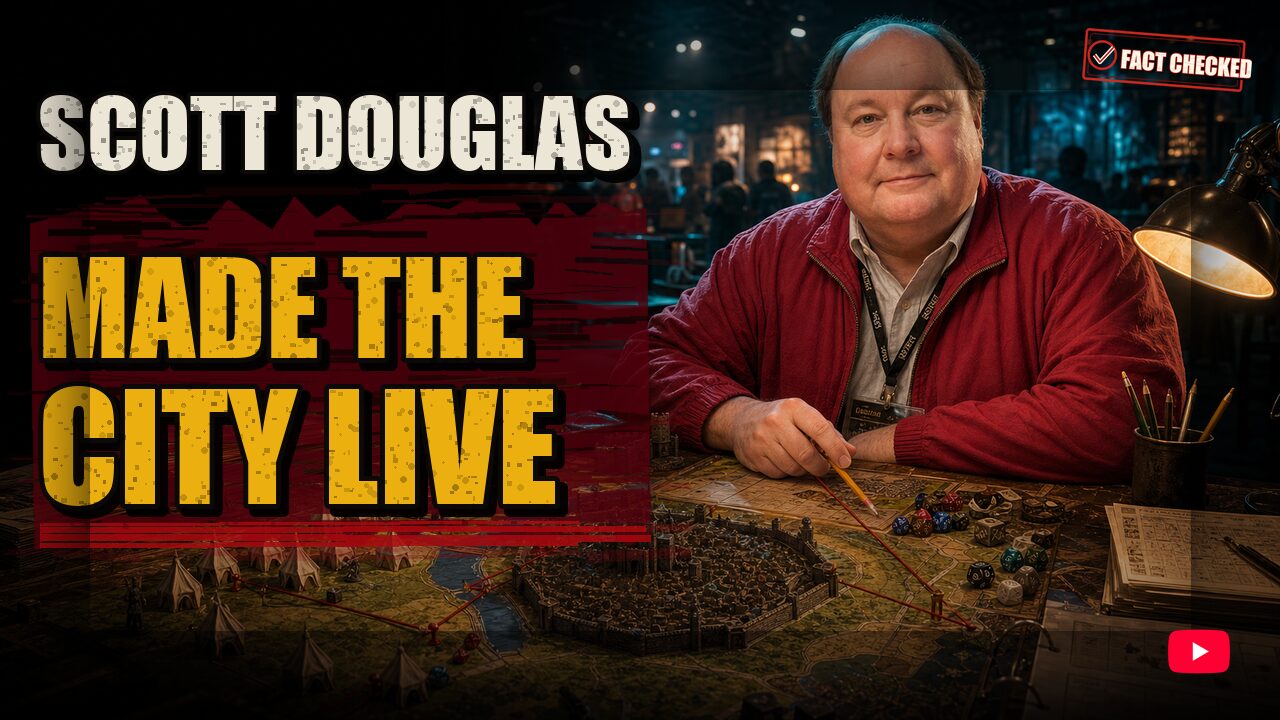
It tried to make a city remember.
That city was Ravens Bluff, the Living City of the Forgotten Realms. Players brought characters to conventions, sat at tables run by volunteer judges, played official adventures, and carried the consequences forward. Their characters earned reputations. Their choices shaped local lore. The city had districts, politics, rumors, armies, street vendors, temples, corrupt officials, and running wounds from previous events.
Scott Douglas did not create organized play by himself. He did not singlehandedly invent the Living City. The RPGA was already a large network when he stepped into its center. What Douglas did was help keep that shared machine human at a moment when it could have become only paperwork.
From 1995 to 1997, Douglas served as RPGA Network Coordinator at TSR. That put him in charge of one of the most unusual community engines in gaming: a fan army that wanted official structure, creative freedom, fair rulings, reliable tournament support, and a sense that their characters mattered somewhere beyond one table.
His contribution was not just administration. It was tone. Douglas understood that organized play only works when players believe the world is listening.
From The Table To The Network
Douglas came up through the RPGA the hard way: by being there.
According to later TSR and fan-history records, he first encountered the RPGA at Gen Con in 1988. Over the next several years he worked inside the culture as a player, Game Master, marshal, volunteer, and convention support hand. That matters. A coordinator who has only seen organized play from an office sees charts. A coordinator who has worked a convention floor knows the smell of too much coffee, the panic of a missing judge, the fatigue of the fourth game slot, and the strange loyalty that makes volunteers come back anyway.
That background shows up in Douglas’s later work. His writing about conventions was practical, funny, and a little parental. His remembered nickname, "Papa," fits the record. He wrote about attendance rules, table expectations, tournament events, and the hidden machinery that makes a weekend of games feel smooth to the people sitting down with dice.
He was not selling organized play as a glamorous system. He treated it as a living room built at convention scale. People needed schedules. Judges needed guidance. Writers needed standards. Players needed to feel that the person behind the curtain understood what the table actually felt like.
That was Douglas’s lane.
Plump, Cookpot, And The Human Scale Of Lore
Before he became Network Coordinator, Douglas was already showing the kind of designer he was.
In Polyhedron, his player character Plump won an RPGA contest for memorable character creation. Plump was not a grim optimized weapon with a name attached. He was a portly bard, the kind of character who says something about the period. AD&D 2nd Edition was full of combat math, but the RPGA’s best convention play needed more than fighting. It needed negotiators, performers, local troublemakers, and people who could turn a scene without drawing steel.
Douglas also created magic items such as the bag of many bags and Dorus’s lyre, which later appeared in TSR’s Encyclopedia Magica. Those items match his style: useful, theatrical, and built for the kind of player who remembers a strange object because it did something at the table.
The clearer example is Friar Cookpot, a Living City character Douglas co-wrote with Craig Petillo. Cookpot was a dwarven cleric of Vergadain, placed not in a throne room or a boss chamber, but near Ravens Bluff’s north gate as a food vendor. He cooked, sang, hustled, and charmed people into generosity. His performance was also his spellcasting. The motions of making food could hide the gestures of a cleric at work.
That is a lovely piece of game design because it does several jobs at once. It gives the city texture. It gives players a person to remember. It turns a vendor into a roleplaying opportunity. It also teaches a quiet lesson about how fantasy cities should work: the magic should not only live in towers. Sometimes it is in the stew pot.
Douglas’s Living City work often carries that feeling. The best shared worlds are not made only from wars and villains. They are made from the person selling lunch outside the gate, the crowded district that has its own mud and gossip, the local joke that becomes official because players repeat it enough.
The City That Changed
Ravens Bluff mattered because it promised continuity.
That promise was risky. A static city gets stale. A city that changes too much becomes hard to manage. The RPGA had to keep a persistent world legible for thousands of players who might enter it at different times, at different conventions, under different judges.
Douglas’s 1995 Polyhedron article "City in Transition: The Future of the Living City" pointed toward the answer. The Living City needed motion. It needed more than errands, local disputes, and disconnected tournament plots. It needed events that players could feel across the whole campaign.
That direction helped set the stage for the "Living City at War" arc, later remembered in Forgotten Realms lore as the Three Women War. The details were pure Ravens Bluff: siege pressure, political stress, military mobilization, refugee strain, and a city forced to decide what kind of community it was when danger reached the walls.
For organized play, the war was more than fiction. It showed what a shared tabletop campaign could do before the internet made persistent worlds feel normal. Players at physical conventions could participate in events, see consequences echoed in later material, and feel that a city they had been visiting for years had taken damage.
That is not easy. It requires adventure writers, editors, judges, regional coordinators, and headquarters staff to pull in roughly the same direction. It requires rules that travel. It requires enough trust that a player can bring a character from one table to another without the whole thing collapsing into argument.
Douglas’s role was to help hold that shape.
Living Death And A Different Kind Of Table
Ravens Bluff was not the only experiment under Douglas’s watch.
The RPGA also launched Living Death, a gothic horror campaign set on Gothic Earth using Masque of the Red Death. Where the Living City was high fantasy politics, guilds, temples, adventurers, and urban continuity, Living Death asked for a different kind of play. It needed investigation, restraint, dread, and historical mood. The players were not just clearing rooms. They were confronting horror in a world that looked close enough to our own to feel uncomfortable.
Douglas promoted the campaign through Dragon magazine during the Winter Fantasy 1996 build-up. That matters because it shows the RPGA trying to diversify the organized play experience. A network that only supports one tone can grow brittle. Living Death gave the RPGA a second instrument: quieter, stranger, and more suspenseful.
It also pointed toward a larger truth. Organized play is not a single format. It is a delivery method. You can use it for heroic fantasy, horror, mystery, faction politics, or anything else, provided the campaign gives players enough agency and gives organizers enough structure to preserve continuity.
Douglas’s RPGA understood that earlier than many people remember.
The Boss During The Bad Years
Douglas’s tenure at TSR happened during one of the hardest stretches in the company’s history.
By the mid-1990s, TSR was under severe financial stress. Product lines had multiplied. Book trade returns hit hard. Printing slowed. Staff morale suffered. Freelancers and employees felt the squeeze. In 1997, Wizards of the Coast acquired TSR, saving Dungeons & Dragons from an uncertain future but ending TSR’s independence.
That is the corporate backdrop for Douglas’s time as Network Coordinator.
It would be easy to talk about the RPGA of this period only as a creative success. It was also a management problem under pressure. Members expected Polyhedron. Conventions expected sanctioned support. Judges expected modules and guidance. Players wanted their campaigns to keep going. All of this had to continue while the company behind it was unstable.
One of the most telling details comes from Jeff Quick’s farewell as editor of Polyhedron. Quick thanked Douglas for being a personable boss and for shielding him from corporate fallout as much as possible.
That sentence says more than a job title.
It suggests a manager who absorbed pressure so the creative work could keep moving. It suggests someone who understood that a fan network can survive a lot if the people making it feel protected enough to do their jobs. In an era when TSR’s public story was increasingly about crisis, the RPGA still had to show up at tables.
Douglas helped it show up.
The Jongleur In The Office
There is a reason the public memory of Scott Douglas is not cold.
He was written up in Polyhedron as a 9th-level human bard with the jongleur kit, a joke that worked because it was clearly close to the truth. The jongleur was the performer, the juggler, the morale keeper. Douglas reportedly juggled, taught English and Earth Science, and later appeared in performance contexts as an "Alchemy Wizard" doing science-flavored entertainment for children.
That mix explains the flavor of his contribution better than any corporate title does. He was an educator, performer, editor, organizer, and game person. Those roles overlap. A good organized play coordinator has to teach rules, keep attention, manage emotion, sell the moment, and make complicated structures feel like play.
Douglas also wrote about painting miniatures in Polyhedron with an approachable piece called "Slappin’ Paint." That kind of article can seem minor beside war arcs and campaign launches, but it belongs to the same philosophy. Lower the barrier. Invite people in. Make the hobby less intimidating. Do not make the newcomer feel foolish for wanting to try.
That was part of the RPGA’s social contract at its best.
What He Actually Built
Scott Douglas did not build the RPGA alone. He did not make Ravens Bluff by himself. He was not the only writer, editor, administrator, judge, or volunteer who made the Living campaigns work.
What he built was continuity under strain.
He helped shape a culture where fan creations could enter official play, where a persistent city could move forward through convention events, where horror could sit beside high fantasy in the organized play portfolio, and where volunteers were treated as the real infrastructure of the whole enterprise.
His work sits in the ancestry of later organized play programs, including D&D Adventurers League and Pathfinder Society. Not because those programs copied him line for line, but because the RPGA era proved the central idea: tabletop players will invest deeply in a shared official world if they believe the world will remember them.
That belief is fragile. Douglas’s gift was treating it as something worth protecting.
Where To Find Him
The public trail for Scott Douglas is mostly historical, centered on TSR periodicals, RPGA records, Forgotten Realms lore references, and collector discussions from former TSR staff. A Dragon Days Fantasy Festival performer bio identifies him as the former RPGA Network Coordinator and describes his later work mainly as science teaching and occasional performance through The Game Wizard Alchemy Show. An Acaeum forum account matching the former RPGA coordinator was still marked active in late 2024.
That is enough for a modest close, not a claim that he is currently working in tabletop publishing.
Scott Douglas’s best-known gaming work remains in the strange, ambitious middle space between an office and a convention floor. He helped manage the days when a city on paper could feel crowded with real people, when a street vendor could matter, when a war could roll through a campaign shared by strangers, and when the person running the network had to be part editor, part teacher, part stage manager, and part shield.
Ravens Bluff lived because many people made it live.
Scott Douglas was one of the people who kept listening when it answered back.
Fact Check Notes
Publication notes
This site is AI-assisted and human-reviewed. We use artificial intelligence to help gather research, organize source material, and draft profile content. Human editors then read, revise, and check each profile before it goes live. Most profiles are built through deep AI research and two separate rounds of fact-checking.
Leave a Reply
You must be logged in to post a comment.