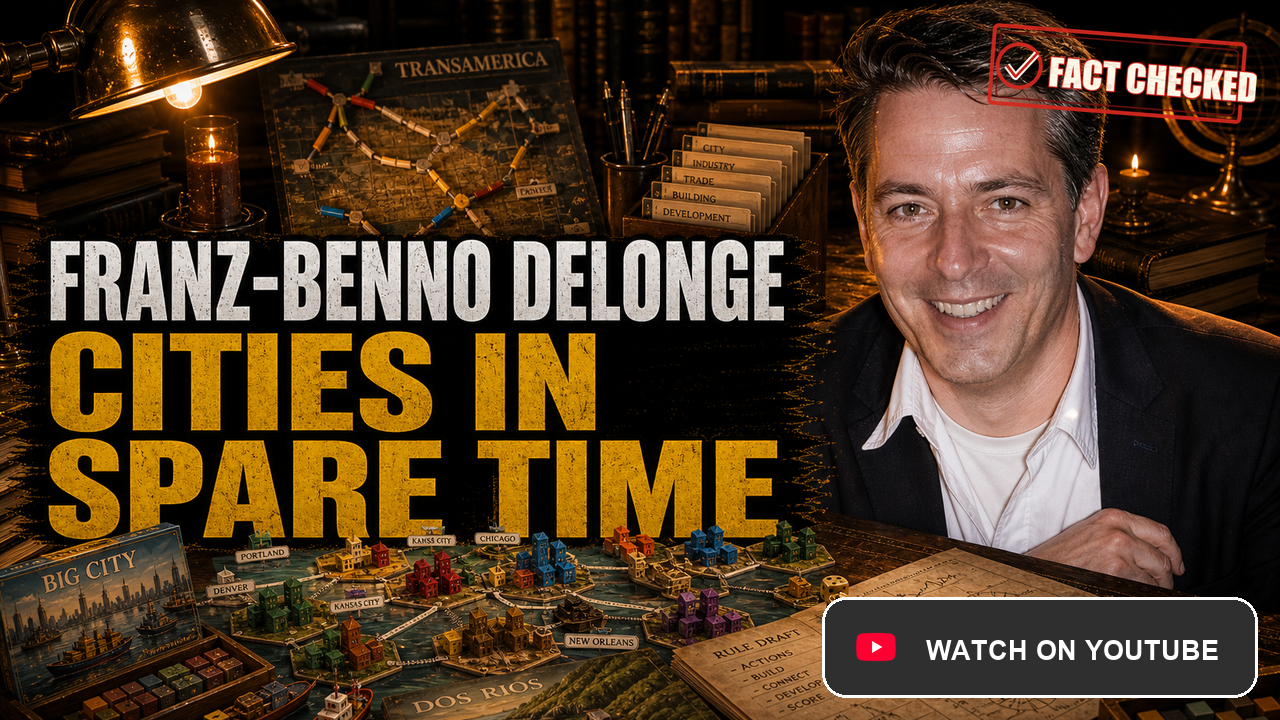
Franz-Benno Delonge designed games as if every rule had to survive cross-examination.
That is not just a cute line. Delonge was a professional judge in Munich. His game design career happened in the hours left over after the law was done with him. He was not a full-time publisher, studio head, convention personality, or professional game-industry fixture. He was a judge who somehow found time to build some of the cleanest Eurogames of his era.
That matters because his best games feel judicial in the best sense.
They are clear. They are restrained. They do not argue longer than they need to. They put the relevant facts on the table and trust the players to see the consequences.
Big City gives you neighborhoods and buildings.
TransAmerica gives you cities and shared rail.
Manila gives you ships, cargo, risk, and a harbor.
None of those premises needs a heavy rules lecture. Delonge’s gift was finding the small rule shape that let the decision carry the weight.
The Judge’S Other Courtroom
Delonge’s published career was painfully short.
Big City appeared in 1999. TransAmerica followed in the early 2000s and became his best-known design. Dos Rios, Manila, TransEuropa, Fjorde, and related work filled out a catalog that was still young when he died on September 2, 2007.
He was fifty.
That is the shadow over the whole profile. Most designers spend years getting to their mature work. Delonge reached a recognizable voice quickly, then ran out of time. His catalog is not large enough to let us talk about a long arc. It is large enough to show a pattern.
Spatial clarity.
Low rules overhead.
Shared systems where other players’ moves matter without turning the table into a fight.
Accessibility without emptiness.
That last phrase is the important one. Delonge’s games are not impressive because they are simple. A lot of games are simple and forgettable. His better designs are impressive because the simplicity leaves room for judgment.
Big City
Big City was Delonge’s first major published design, and it still explains him well.
The game is about building a city from modular neighborhoods. Players collect cards tied to lots, then use those cards to place buildings onto a growing shared space. Residences, businesses, streetcars, parks, factories, and other structures score according to where they land and what surrounds them.
That sounds straightforward because it is.
The decisions are not hidden in special powers or exception chains. They are visible on the board. You can see the neighborhood. You can see the lots. You can see what somebody else is setting up, or at least what you think they are setting up. A good move is not a trick. It is a placement that reads the future a little better than the other players do.
Big City also understands timing.
You may have the card you need, but not the board state. You may have the board state, but not enough space. You may want to build the civic structure that unlocks bigger opportunities, but doing so might help someone else more than it helps you.
That is a very Delonge problem.
Simple to explain. Harder to judge well.
The game earned enough affection that a 20th Anniversary Jumbo Edition appeared in 2019, long after Delonge’s death. That does not happen to every clever game from 1999. It happens when players still remember the shape of the decisions.
Transamerica
TransAmerica is the design most people associate with Delonge.
The rules are almost disarmingly small. Each player has cities to connect across a map of the United States. On your turn, you add track. The first player to connect their assigned cities ends the round. The twist is that rail networks are shared. Track you build can help you, but it can also become part of someone else’s solution.
That one idea makes the game.
Most train games make ownership central. Your rail is yours. Your route is yours. Your empire is yours. TransAmerica loosens that grip. The network becomes common ground, and suddenly the table has to read intent through placement. Are you helping yourself? Are you accidentally helping me? Should I join that network now, or wait one more turn? Did I just save another player two moves?
The game teaches quickly because there is so little to teach.
It plays quickly because the system has almost no friction.
But the decisions are not empty. The pleasure comes from seeing how little structure Delonge needed to create tension. A few city cards, a shared map, and rails that refuse to belong entirely to one person.
TransAmerica received a Spiel des Jahres nomination in 2002 and Mensa recognition soon after. Those honors fit the design. This is not a game that wins attention through density. It wins attention by making the whole table understand the problem within minutes.
Then it makes them care.
There is a generosity in that structure.
Many route games punish the new player for not seeing the whole map three turns ahead. TransAmerica still rewards better reading, but it lets everyone participate in the same visible problem. A beginner can place track and feel useful. An experienced player can see when useful turns dangerous. The same line of rail can be charity, trap, shortcut, and mistake, depending on who needed it most.
That is why the design travels well.
It gives the table enough room to be clever without asking anyone to become an accountant.
Manila, Dos Rios, And Fjorde
Delonge kept returning to clean spatial systems.
Dos Rios used river movement and resource collection to create a board state that players could redirect. The game has a tactile appeal: rivers shift, farms matter, placement changes value. It is not one of his most famous titles, but it belongs to the same design family because the board itself is the argument.
Manila moved into risk and betting.
Cargo ships try to reach port. Players invest in positions, push probability, and watch the harbor turn into a small drama of timing and odds. It is louder than TransAmerica, but it is still clean. The players understand what they are hoping for. The fun comes from choosing how much to believe in the ship before the dice answer.
Fjorde narrowed the frame to two players and tile-laying territory. It is compact, positional, and direct. Again, the rule load is not the point. The point is what happens after the rules get out of the way.
That is the thread through the catalog.
Delonge was not chasing maximal novelty. He was chasing playable clarity.
What He Actually Built
Franz-Benno Delonge did not invent route-building games. He did not invent tile-laying. He did not create the Eurogame movement, and he did not have time to build a vast catalog.
What he built was a small body of designs that showed how much depth can live inside clean procedure.
Big City turns cards and lots into city-planning tension.
TransAmerica turns a shared rail network into social deduction without ever becoming a deduction game.
Manila turns probability into theater.
Dos Rios and Fjorde show the same instinct at different scales: make the board readable, make the consequences visible, then let the players make decisions that feel fair even when they lose.
That is why his work still feels fresh.
The games are not dependent on a fashion cycle. They do not need a paragraph of historical context before someone can understand why they work. You can put TransAmerica on a table today, teach it quickly, and watch the same little realization happen: the track belongs to everyone.
That is good design.
It is not flashy. It does not need to be.
That restraint may be the part that aged best.
Design fashion changes. Components get bigger. Rulebooks get glossier. Player aids improve. But clean interaction still holds. A board that tells the truth, a rule that does not need a footnote, and a decision that can be understood after it hurts you are all durable things. Delonge’s games understood that before durability became a marketing word.
Where To Find His Work
Franz-Benno Delonge died in 2007, so this is a legacy trail.
TransAmerica remains the easiest entry point. It continues to circulate through editions, used copies, rules references, and the broader TransAmerica / TransEuropa family. Big City is harder to find in its original form, but the 20th Anniversary Jumbo Edition proved that the design still had enough affection behind it to justify a return. Manila, Dos Rios, and Fjorde remain the deeper shelf for players who want to see how consistent Delonge’s instincts were.
The career is short.
That is the ache.
Eight years of published design. A handful of games. A judge in Munich making spare-time systems that still read cleanly decades later.
Time is the resource no designer gets to allocate.
Delonge used his with unusual precision.
The games still clearly show the work.
Fact Check Notes
Publication notes
This site is AI-assisted and human-reviewed. We use artificial intelligence to help gather research, organize source material, and draft profile content. Human editors then read, revise, and check each profile before it goes live. Most profiles are built through deep AI research and two separate rounds of fact-checking.
Leave a Reply
You must be logged in to post a comment.