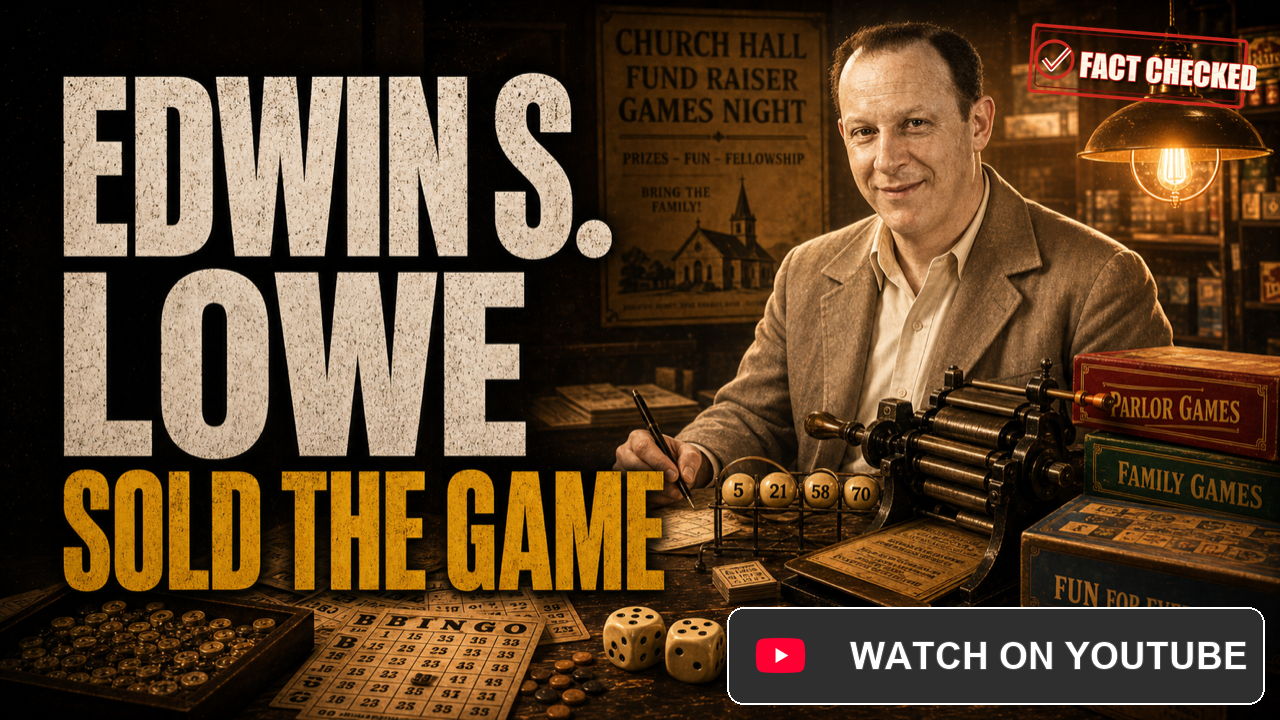
He did not invent Yahtzee.
That sounds like a strange way to begin a profile of the man whose company made both names famous, but it is the only honest way to start. Lowe’s importance is real. His influence is enormous. His name sits on two of the most recognizable mass-market games of the twentieth century. But the thing he was great at was not designing games from nothing.
He was great at recognizing games that were already alive.
That is a different gift. Not smaller. Different. Lowe could walk past a carnival booth, see strangers leaning forward over cardboard cards and dried beans, and understand that the energy around the table could become a national habit. He could listen to a Canadian couple describe a dice game they played with friends on a yacht and see a product that could sit on family shelves for generations.
The designer makes the engine. Lowe heard the engine running and knew how to put it on every road in America.
The Game With The Beans
The Bingo story begins before Lowe.
Games built around called numbers and marked cards go back centuries. By the early twentieth century, versions had reached American carnivals. In the early 1920s, Hugh J. Ward began running a version around Pittsburgh and western Pennsylvania. The Library of Congress credits Ward with helping spread the game as a carnival attraction, and with registering a 1933 rulebook for Bingo once the home version had become commercially useful.
When Lowe encountered the game in 1929, it was being played at a Georgia carnival under the name Beano. The name made sense. Players marked their cards with beans. The caller drew numbers. The first person to complete the pattern won. It was simple, noisy, visible, and social.
That last part mattered.
Lowe was a salesman. He understood the difference between a clever product and a contagious one. Beano did not require explanation once people watched one round. A crowd could understand the stakes in seconds. The rules were thin enough for anyone to enter, but the emotional rhythm was strong: listen, scan, wait, mark, almost win, miss, groan, try again.
Lowe took the game back to New York. The familiar story says that a player at one of his home sessions got excited and shouted "Bingo" instead of "Beano." Whether that moment happened exactly that way is less important than the business move that followed. Lowe began printing and selling Bingo cards under the new name.
He did not change the basic game. He changed its reach.
The Scale Problem
Bingo has a problem once it leaves the carnival booth.
At a small table, a handful of cards is enough. In a church hall, a lodge room, or a crowded fundraiser, duplication becomes a problem. If too many players have the same or similar cards, too many people win at once. The drama collapses into bookkeeping.
Lowe’s real contribution to Bingo was not the rule. It was the machinery around the rule.
He pushed the game toward mass production. The Lowe company sold card sets, equipment, instructions, and a complete way to run the event. The old source material credits Lowe with working with a mathematics professor, Carl Leffler, to produce thousands of card combinations. Different accounts tell that story with different levels of certainty, and the more dramatic versions should be handled carefully. The safe point is simpler: Lowe understood that Bingo needed enough card variety to scale from parlor play to large public rooms.
That is not game invention in the usual sense. It is production architecture.
But production architecture can change a game’s life. A game that works only in a booth stays a booth game. A game that can be packed, shipped, taught, and repeated in thousands of locations becomes a ritual.
By the 1940s, Bingo had spread widely across the United States. Churches and nonprofit groups became part of its infrastructure. Fundraising gave it a reason to happen every week. The game became less like a product and more like a community appointment.
Ward had made and formalized the game as carnival practice. Lowe made it a national habit.
The Yacht Game
Yahtzee is the cleaner test of Lowe’s place in design history, because the design attribution problem is harder to hide.
The commercial game appeared under the Yahtzee name in the mid-1950s. The widely repeated origin story credits an anonymous Canadian couple with creating the dice game they called the Yacht Game because they played it with friends on their yacht. They approached Lowe about making sets. Lowe saw the commercial possibility and acquired the rights. The usual account says the price was one thousand gift sets.
The names of that couple did not survive in the public record.
That absence matters. Yahtzee is not a trivial design. Five dice. Up to three rolls. Keep some, reroll others. Fill a score sheet one category at a time. Decide whether to chase the high-value result or settle for a useful score before the turn is gone. The genius is not that any one element is strange. The genius is that the system teaches tension with almost no friction.
A player can understand the turn structure in a minute. The scoring sheet creates the strategy. Every category used is a door closed. Every bad roll becomes a question: protect the total, or gamble for the combination that would make the whole game swing.
That is design work.
It was not Lowe’s design work.
Lowe renamed it, packaged it, and sold it. When early advertising struggled to communicate the appeal, he leaned into the social experience. Yahtzee parties let people learn by doing. That was classic Lowe. He did not need to explain the product if he could get people to feel the table.
Once players felt it, the game traveled by word of mouth. Families taught families. Friends taught friends. The score sheet became familiar. The dice cup became familiar. The word Yahtzee became the kind of word people could shout without needing to know who first made the game.
The Businessman At The Table
There is an easy version of this article that turns Lowe into a villain.
That would be too simple.
He did not steal Bingo out of Ward’s hands in the cartoon sense. He found a public carnival game, renamed and mass-produced it, and built the business system that made it spread. He did not secretly copy Yahtzee from an unwilling inventor. The reported story says he acquired the rights from the couple who brought it to him. If the deal looks painfully lopsided from a distance, that is partly because we know what the game became and they did not.
Still, the pattern is worth naming.
The tabletop industry has always had people who create games, people who package them, people who market them, people who manufacture them, and people who end up remembered. Those are not always the same people. In Lowe’s case, they were usually not the same people.
His genius was commercial and cultural. He knew when a game had a human hook. He knew how to turn that hook into an object a store could sell. He knew how to make a game feel public, social, and repeatable. Bingo became a fundraiser. Yahtzee became a party. Both needed more than rules to become what they became.
But if this series is asking what a person designed, Lowe is a boundary case.
He built the road, not the engine.
What He Actually Built
Lowe built access.
That sounds modest until you remember how much of game history depends on it. A brilliant design that never leaves a small circle remains a private pleasure. A simple design with the right distribution can become part of everyday life. Lowe lived in that second space. He did not seem drawn to mechanical authorship. He was drawn to the moment when a crowd gathered.
Bingo gave him a social machine. He gave it cards, supply, publicity, and a fundraising identity. Yahtzee gave him a compact dice design. He gave it a name, a box, demonstrations, retail placement, and the E.S. Lowe Company behind it.
He also built a company valuable enough that Milton Bradley bought it in 1973. The reported sale price was twenty-six million dollars. That number says something about the commercial power of the catalog he assembled. It also says something about the difference between game authorship and game ownership.
Lowe owned and promoted famous games. He did not necessarily make the creative systems that made them famous.
This distinction is not a technicality. It is the point.
Game design history gets muddy when every name on a box is treated as the designer. Publishers matter. Marketers matter. Developers, manufacturers, licensors, mathematicians, artists, editors, and demonstrators matter. A game is rarely one person’s magic trick. But design credit still means something. It is the credit for making the play work.
On Bingo, Ward deserves the stronger design claim. On Yahtzee, the anonymous Canadian couple deserves the stronger design claim. On mass popularity, Lowe stands at the center.
That is his real legacy.
The Hall Of Fame Question
In 2024, The Toy Association announced Lowe as a posthumous inductee into the 2025 Toy Industry Hall of Fame. That recognition makes sense. It honors industry impact, and Lowe’s impact on the business of play is undeniable. Bingo and Yahtzee are not obscure hobby footnotes. They are household names. They outlived his company, his era, and nearly every marketing campaign that first carried them.
But a toy industry honor does not turn marketing into authorship.
If anything, it helps clarify the case. Lowe belongs in a hall of fame for the toy business. He belongs in the story of American mass-market games. He belongs in any honest account of how play moved through churches, department stores, family tables, and postwar consumer culture.
He does not need to be inflated into the designer of games he did not design.
Where To Find Him
Edwin S. Lowe died in Manhattan on February 23, 1986.
You can still find him almost anywhere games are treated as ordinary life. In the folding tables at a Bingo night. In the dice cup at a kitchen table. In the shelf copy of Yahtzee that outlasted three moves and somehow still has all five dice. In the idea that a game does not have to be complex to become permanent.
Lowe’s gift was not invention. It was recognition.
He saw that people wanted to gather around a number caller. He saw that five dice and a score sheet could carry a room. He saw that some games do not need to be explained from the outside. They need to be placed in front of people and allowed to catch.
The designers made the play.
Lowe made sure the world got to play it.
Fact Check Notes
Publication notes
This site is AI-assisted and human-reviewed. We use artificial intelligence to help gather research, organize source material, and draft profile content. Human editors then read, revise, and check each profile before it goes live. Most profiles are built through deep AI research and two separate rounds of fact-checking.
Leave a Reply
You must be logged in to post a comment.