Fact-Checked Icon
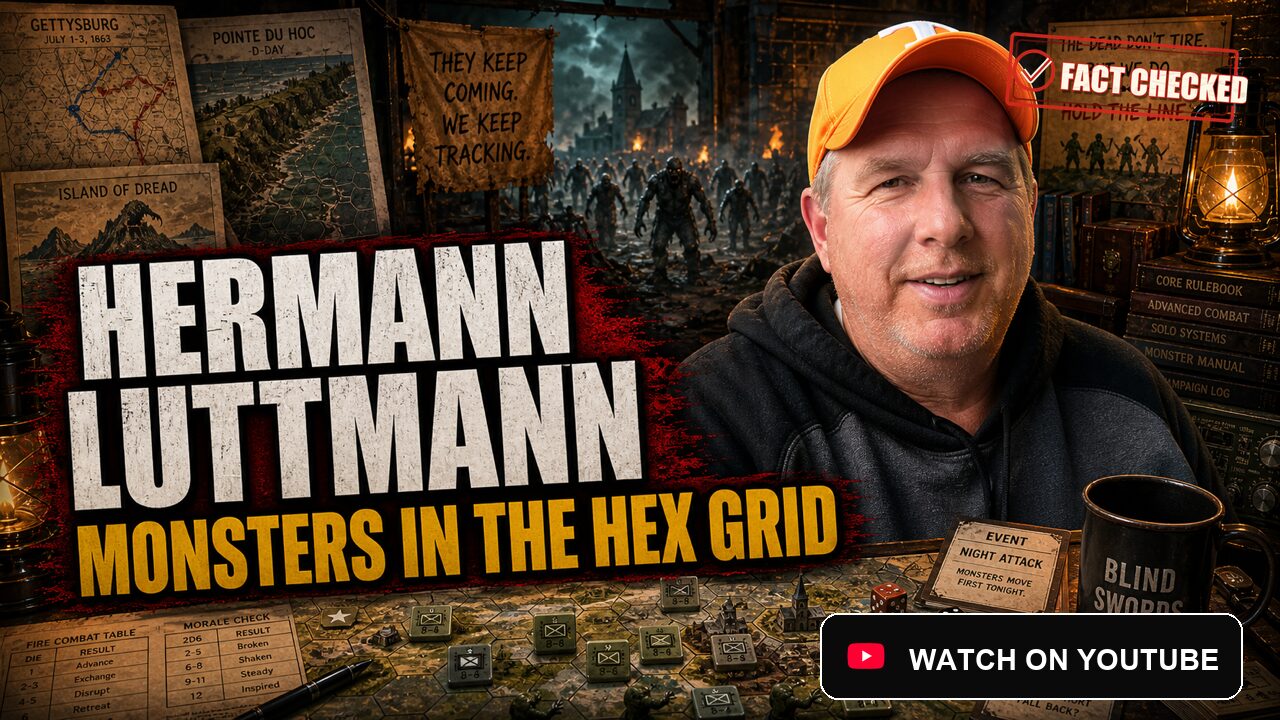
Hermann Luttmann
Wargame Designer Who Let Monsters Into The Hex Grid
Not just a flowchart.
Not just a pile of modifiers.
An opponent.
That opponent can be Pickett’s Charge moving uphill into fire. It can be Rangers climbing Pointe du Hoc. It can be command friction inside a Civil War battlefield. It can also be zombies at the edge of town, because Luttmann figured out something useful about wargaming’s toolkit:
The hex grid does not care whether the thing coming toward you is history or horror.
If the pressure is real, the system can carry it.
That is the thread running through his catalog. Luttmann’s games often take familiar wargame materials, chits, maps, tracks, tables, cards, and activation uncertainty, then use them to create narrative pressure for one player or a small table. He is not trying to make wargames look less like wargames.
He is trying to make them feel alive.
The Late Start That Did Not Look Late
Luttmann’s published design career began later than many hobby stories.
His first credited design appeared in the early 2010s, with Gettysburg: The Wheatfield through Victory Point Games. From there, the pace accelerated quickly. His name began showing up across publishers that understand historical games, solitaire games, and the kind of hybrid designs that sit between strict simulation and story pressure.
Victory Point Games. Flying Pig Games. GMT Games. Worthington. Legion. Tiny Battle. Revolution. Hollandspiele. Blue Panther.
That range matters.
Wargame publishers do not all want the same thing. Some want lean magazine-style designs. Some want deluxe monster-box energy. Some want solitaire systems. Some want old-school hex-and-counter feel. Some want historical specificity. Some want a game that can teach itself to a broader audience.
Luttmann kept finding doors.
That says something about reliability.
It also says something about range.
Blind Swords And Friction
The Blind Swords system is Luttmann’s most recognizable historical contribution.
Chit-pull activation did not begin with him, and the public article should not pretend it did. Wargames had used random activation and draw systems before. Luttmann’s contribution is in how he tuned that uncertainty into battlefield friction.
Blind Swords is not random chaos for its own sake.
It is a way to make command feel unstable without making the player feel irrelevant. You can plan. You can position. You can prepare. Then the cup speaks, and the battlefield refuses to behave like a spreadsheet.
That is what the system is chasing.
Historical combat is full of timing problems. Orders arrive late. Units hesitate. Local commanders act before the whole line is ready. A chance appears and disappears. One flank moves while another waits. A general thinks the attack is unfolding one way and discovers it is already becoming something else.
A deterministic turn structure can model some of that.
A good chit-pull system makes the player live with it.
That is the difference.
Dawn Of The Zeds
Dawn of the Zeds is the game that pushed Luttmann beyond the usual wargame wall.
The premise is blunt: a town is under siege by zombies, and the player has to hold the line as the dead keep coming.
But the reason it works is not blunt at all.
Dawn of the Zeds borrows from wargame language: routes, zones, event pressure, limited resources, activation, crisis management, and a map that turns movement into dread. The zombie theme does not replace the wargame structure. It gives that structure a new kind of emotional skin.
That is why the game found an audience.
A military-history player could recognize the machinery. A horror player could recognize the story. A solitaire player could feel the system pushing back. The town became a front line, and every lane into town became a decision.
The zombies do not need sophisticated tactics.
They need inevitability.
The system provides that. Pressure increases. Events interrupt plans. Resources thin out. Survivors become stories because the map keeps asking who gets saved, who gets left exposed, and which problem has to wait one turn too long.
That is narrative wargame design.
The monsters sold because the machinery worked.
In Magnificent Style
In Magnificent Style shows Luttmann’s solitaire design instinct in a tighter historical frame.
The subject is Pickett’s Charge at Gettysburg, which means the player is not asking whether the situation is dangerous. The player knows it is dangerous before the first decision. The design question is how to make that danger playable without turning it into a scripted march toward disaster.
The answer is pressure and nerve.
Advance, risk, hesitate, push, absorb punishment, and keep wondering whether the next step is courage or foolishness. The game turns a famous historical moment into a solo decision space where the player feels the awful attraction of going one more time.
That is not the same kind of pressure as Dawn of the Zeds, but it comes from the same design instinct.
The player is alone with a system that keeps asking for commitment.
Crowbar And Plum Island
Crowbar! The Rangers at Pointe du Hoc brings Luttmann’s interest in friction and narrative pressure to D-Day.
The subject is physical, brutal, and immediate: Rangers climbing cliffs, assaulting positions, and trying to turn an impossible assignment into a foothold. A good design here cannot only count steps and losses. It has to make the player feel the shape of the operation: the climb, the confusion, the exposed moments, the difference between a plan on paper and a unit under fire.
The Plum Island Horror returns to the genre door that Dawn of the Zeds opened.
Here the wargame frame carries B-movie monster chaos. The result is not a joke pasted on a combat system. It is another example of Luttmann’s comfort with the idea that hexes, events, and unit pressure can serve non-historical fiction if the stakes are built honestly.
That is the important part.
A horror wargame still has to be a game.
The monsters need rules.
The rules need teeth.
What He Actually Built
Hermann Luttmann did not invent chit-pull activation. He did not invent solitaire wargames. He did not prove by himself that wargames can handle horror.
What he built was a body of work around friction, pressure, and solo narrative tension.
His games often give the player a map, a crisis, and a system that refuses to be perfectly obedient. The player has agency, but not control. That distinction is the heart of good solitaire design. A puzzle can be solved. A living situation has to be managed while it changes.
Luttmann keeps designing living situations.
Sometimes they wear uniforms.
Sometimes they have claws.
Sometimes they shuffle toward town in rotting crowds.
The throughline is not the monster or the musket. It is the pressure curve. A Luttmann design wants the player to make decisions under friction, then remember the story those decisions created.
The Hex Grid Opens
The useful thing about Dawn of the Zeds and The Plum Island Horror is that they make wargame language less narrow.
For decades, many players associated hexes, counters, and event tables with military history. That is natural. The form grew there. But forms can travel. A zone-control problem can be a zombie siege. A map can be a town. A unit can be a survivor. A combat result can be the moment the barricade breaks.
Luttmann did not make that migration alone, but he gave it some memorable proof.
The same tools that model command friction can model panic.
The same track that marks time can mark dread.
The same cup that makes a battle uncertain can make a monster story breathe.
That is why his genre work matters even to players who do not care about zombies. It shows that wargame design is not trapped inside its oldest subjects.
The tools can fight monsters.
It also gives solo players a wider emotional menu. Some nights, a player wants a battle. Some nights, they want a siege. Some nights, they want a town full of survivors and a deck that keeps finding new ways to make the situation worse. Luttmann’s catalog understands that those are related experiences. They all ask the player to make decisions under pressure and live with the next draw.
Where To Find Him
Luttmann’s current public trail is active and easy to follow through publisher pages and BoardGameGeek. Dawn of the Zeds continues to have a life through later editions and reprint campaigns, including current Designer’s Edition activity. The Plum Island Horror has also continued through GMT’s catalog and reprint channels. His historical catalog remains broad, with Blind Swords titles, Gettysburg designs, Crowbar!, In Magnificent Style, At Any Cost: Metz 1870, and other games spread across multiple publishers.
The right starting place depends on what you want.
If you want monsters at the barricades, start with Dawn of the Zeds.
If you want historical pressure in a compact solo form, look at In Magnificent Style.
If you want combat friction through his signature historical system, follow the Blind Swords line.
The chits are still in the cup.
The zombies are still at the gates.
The hex grid is wider than it used to be.
Fact Check Notes
Publication notes
This site is AI-assisted and human-reviewed. We use artificial intelligence to help gather research, organize source material, and draft profile content. Human editors then read, revise, and check each profile before it goes live. Most profiles are built through deep AI research and two separate rounds of fact-checking.
Leave a Reply
You must be logged in to post a comment.