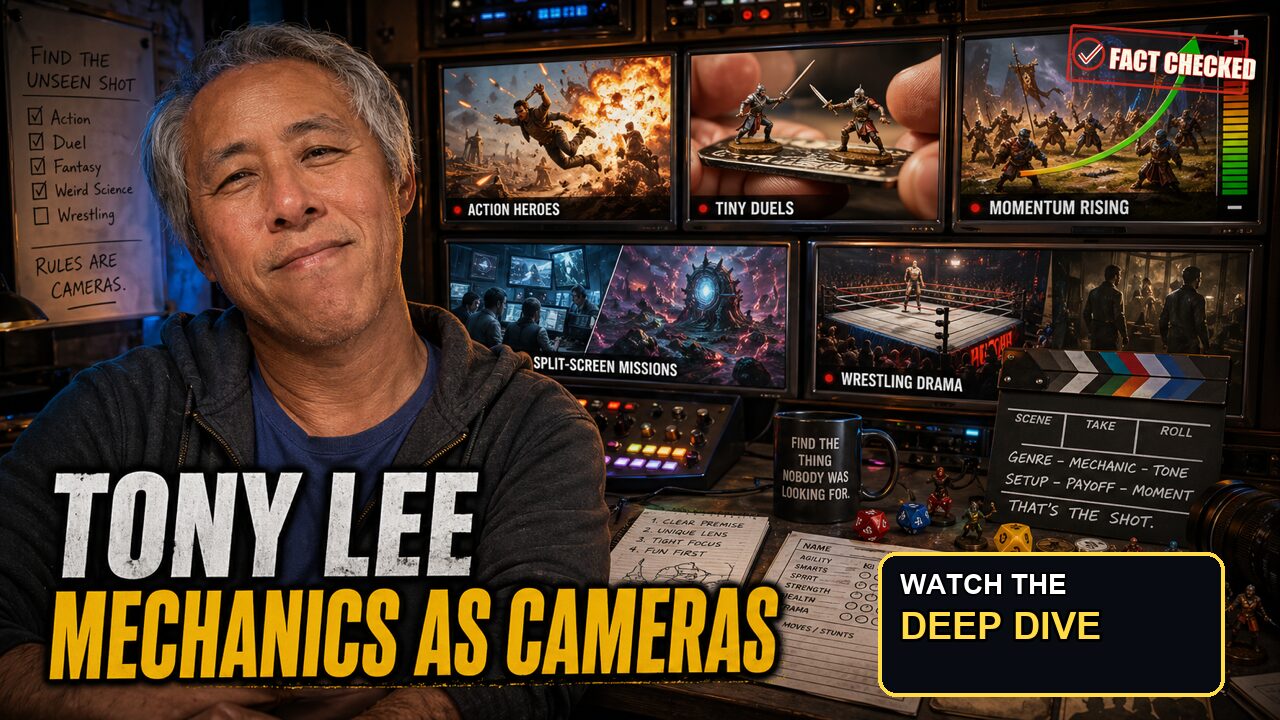
Not literal cameras. Game cameras. Rules that decide what kind of story the table is allowed to see.
Extreme Vengeance sees the world through an action-movie lens. Warchon narrows the shot until only two warriors remain. Chronicles of Ramlar tracks the rising pressure of combat across rounds. Odyssey Prime splits the screen between multiverse exploration and damage control. Wild World Wrestling cuts between ring action, crowd heat, backstage reinvention, and the strange truth of a fake fight that still has to feel real.
That is the pattern.
Lee was never trying to build one universal engine for every possible story. He kept building systems that knew exactly what they were watching.
That precision is why his work is interesting.
It is also why most of it stayed niche.
The Rough Doorway
Lee entered the RPG industry through one of the roughest possible doors: Traveller 4th edition.
Marc Miller’s Traveller was one of the foundational science-fiction role-playing games. Traveller 4, published by Imperium Games in 1996, had the weight of legacy on it and the pressure of a rushed production cycle underneath it. Lee worked on the project as part of the editorial and development orbit.
It was not the clean start any designer would choose.
Traveller 4 became a cautionary object in parts of the hobby, respected by some for what it tried to restore and criticized by many for execution problems. For a new designer, that kind of project could have been a dead end.
For Lee, it became the first public scar.
The next thing he made was not cautious.
The Action Movie Rpg
Extreme Vengeance arrived in 1997 from Archangel Entertainment and felt like someone had thrown a lit firecracker into a serious RPG meeting.
The premise was ridiculous in exactly the right way. Players did not simply play action heroes. They played action-movie actors who were playing action heroes across a career of films. The GM became the Director. Advancement was tied to Popularity. Catch phrases, one-liners, dramatic slow motion, and other action-movie behaviors became things the system cared about.
That was not a normal design priority in 1997.
The game was not trying to model physics. It was trying to model the camera. It cared less about whether a stunt made physical sense and more about whether it belonged in the movie.
The stat line made the argument even clearer. Extreme Vengeance reduced the actor’s capabilities to Guts and Coincidence. Guts handled the proactive, high-energy things action heroes do. Coincidence represented the weird plot protection that lets movie heroes survive impossible odds until the story decides their luck has run thin.
Two stats.
Not because people are that simple.
Because action movies often are.
The Action Matrix pushed the idea further. The Director judged how entertaining, exciting, or genre-appropriate an action description was, and that judgment affected the mechanics. Better action-movie narration meant better odds. The game rewarded players for performing the genre, not just declaring a move.
That idea sits close to what later designers would describe through fictional positioning, narration-first play, and genre-emulation rules. Extreme Vengeance was not the first rules-light or meta-aware RPG. Over the Edge, FUDGE, Amber Diceless, and other early 1990s designs had already opened parts of that territory.
Lee’s synthesis was still specific and bold.
Actor playing character. Popularity as advancement. Coincidence as plot armor. Guts as narrative intensity. Director as Director, not just gamemaster.
It was rough.
It was also alive.
The Bookmark Duel
Warchon showed another side of Lee’s design mind.
Where Extreme Vengeance was loud, Warchon was compressed almost to the point of disbelief. It was a tactical combat game printed in a bookmark-sized format, part of Z-Man Games’ Playmark line. Two warriors. A short duel. A game small enough to look like a novelty and sharp enough to win the Origins Vanguard Award.
That award matters because it recognized format innovation.
Most designers would not look at a bookmark and see a complete tactical game. Lee did. He reduced the frame until the game had almost nowhere to hide. No sprawling setting. No long character build. No shelf of sourcebooks. Just the duel.
That is not the same talent as writing a cinematic RPG.
It is the opposite movement.
Extreme Vengeance explodes outward into genre parody, actor identity, movie logic, and table performance. Warchon collapses inward into a tiny competitive object. Both designs show the same underlying habit: define the camera, then cut away everything outside the shot.
That kind of reduction is hard.
It looks easy only after someone else does it.
The Momentum Game
Chronicles of Ramlar is where Lee’s craft looks more mature.
Published by White Silver Publishing in 2006, the game was built in a fantasy world created by John Prescott, with Lee credited as the rules mind behind the system. The A/B System, commonly described around Armor and Body values, used percentile resolution and hit-location combat to give physical conflict a crunchy frame.
The more interesting piece was Momentum.
Momentum allowed success in one combat round to carry forward and shape the next. A fighter who pressed an advantage did not simply reset to zero when the next round began. The fight could build. The previous beat mattered. Combat became less like a series of disconnected exchanges and more like rising action.
That is a very Tony Lee idea.
The rules are not only asking, "Did you hit?"
They are asking, "What does that hit do to the shape of the scene?"
The Demeanor and Theme advancement system moved in the same direction. Instead of treating experience only as a reward for bodies dropped or treasure collected, the game asked what kind of story the character was telling and how play expressed that theme.
That is not a small difference.
It says advancement should care about arc.
For a designer who began by making action-movie actors into RPG characters, that makes sense. Lee kept returning to the idea that the fiction’s shape should matter mechanically. Not in a vague inspirational way. In the rules.
The Split Screen
Odyssey Prime, co-designed with Steven Trustrum, took on a different structural problem.
The premise was big: Earth faces extinction, and teams travel through a portal to other worlds while another side of the operation keeps the public from knowing how bad things are. The player is not only dealing with adventure. The player is dealing with the cover-up.
That is the dual-world problem.
Many RPGs have a public story and a hidden story, but they often leave the tension between them to the gamemaster. Odyssey Prime pushed that split into character structure. Players handled the explorers and the people managing damage control back home.
That is not just setting.
It is form.
The game asks the table to think in parallel tracks: discovery and containment, wonder and lies, survival and public order. Whether every part of the execution lands is a separate question. The structural ambition is clear.
Lee was still designing cameras.
This time, he built split screen.
The Wrestling Machine
The wrestling work may be Lee’s most precise niche.
WWE: Know Your Role, published in 2005 by Comic Images, gave him a licensed wrestling RPG platform. Later, Wild World Wrestling let him keep working the design space on his own terms through Timeout Diversions.
Professional wrestling is hard to model because it is both contest and performance. The audience knows the match is staged. The wrestlers are characters, but also performers playing characters. The crowd reaction matters. A heel turn can matter more than a win. A gimmick change can revive a career. Heat can be more important than damage.
Lee understood that the rules had to care about those things.
Heat became a resource. Face, heel, and tweener alignment mattered in wrestling terms. Repackaging gave character reinvention a place in the system. Custom maneuvers let the table create wrestling moves instead of only choosing from a fixed list.
That is smart because wrestling is not only a list of holds.
It is identity under lights.
Lee’s wrestling games did not become giant commercial machines. The audience for tabletop RPGs about professional wrestling is small. Maybe painfully small. But inside that small target, the work is unusually confident. It knows what the genre needs because it knows what the camera is pointed at: not combat in the abstract, but performance under crowd pressure.
That is the best-at-something-nobody-was-looking-for problem.
If the market had been larger, more people might talk about the design.
The market was not larger.
The design still counts.
The Small-Press Years
Lee’s later publishing life moved through Timeout Diversions and related small-press work.
He worked on Wild World Wrestling, Sovereign Stone material, Chronicles of Ramlar updates, and other niche releases. The Sovereign Stone Pathfinder Kickstarter raised modest but real support and delivered books to backers. This was not mass-market success. It was small-press survival: licenses, conversions, supplements, PDFs, print runs, backer management, and the long grind of making niche games exist.
Then the output slowed.
By the mid-2010s, Lee’s public publishing trail had mostly gone quiet. That leaves the career with a strange shape. He never became a household name. He did not create the next Dungeons & Dragons, the next Vampire, or the next Fate. His systems did not become a shared language for later designers.
But he kept getting better.
The line from Extreme Vengeance to Warchon to Chronicles of Ramlar to Wild World Wrestling is not a flat line. It is a designer learning how to turn big ideas into cleaner structures. The early work has rough edges. The middle work has sharper control. The wrestling work finds a niche and fits it almost too well.
That is mastery of a particular kind.
Not universal mastery.
Niche mastery.
What He Actually Built
Tony Lee built games that model ways of watching.
That is the hidden pattern across the career. The rules usually do not begin with physics. They begin with genre. What does an action movie feel like? What does a duel need if the whole game fits on a bookmark? How does a fantasy fight build momentum? What happens when the table has to play both the mission and the cover-up? What does a wrestling match need besides moves?
Lee’s answer was almost always mechanical.
Give action heroes Guts and Coincidence. Give a duel only the space it needs. Let combat carry Momentum. Split the campaign into two kinds of characters. Give wrestlers Heat, alignment, and repackaging.
The work did not propagate widely. That matters. Great design history is not only about the good ideas people had. It is also about which ideas other people used, copied, refined, and taught. Lee’s best ideas mostly stayed inside his own books.
That is the limit.
The contribution is still real.
He made specific machines for specific genres, and some of those machines solved problems most designers never bothered to name.
Where To Find Him
Start with Extreme Vengeance if you want the loudest statement. It is rough, funny, excessive, and very clear about wanting RPG rules to behave like action cinema. Look at Warchon if you want the opposite: a tiny tactical design stripped down to a duel. Chronicles of Ramlar shows the mid-career craft, especially the Momentum idea. Wild World Wrestling is the niche machine, the game that knows exactly what kind of performance it wants.
The lasting image is a production truck full of monitors.
One screen shows an action hero diving through an explosion. One shows two warriors locked in a bookmark-sized duel. One tracks a fantasy fight gathering force. One splits Earth from another world. One cuts from the wrestling ring to the crowd to the backstage interview.
Tony Lee’s rules are not trying to film everything.
They are trying to get the shot.
Fact Check Notes
Publication notes
This site is AI-assisted and human-reviewed. We use artificial intelligence to help gather research, organize source material, and draft profile content. Human editors then read, revise, and check each profile before it goes live. Most profiles are built through deep AI research and two separate rounds of fact-checking.
Leave a Reply
You must be logged in to post a comment.