Most fantasy role-playing games tell the players what they can do by filling the character sheet with permission slips.
Davis Chenault helped build one that asked a cleaner question.
What are you trying to do?
That question sits under Castles & Crusades. You can feel it in the SIEGE Engine. You can see it in a lot of Troll Lord Games publishing, from early Erde adventures to Aihrde sourcebooks to the long work of keeping a small RPG company alive without handing its steering wheel to someone else.
Chenault is not the loudest name in tabletop history. He is not the convention-stage version of a designer. His work comes across more like a table covered in maps, notebooks, old wargames, archaeological notes, and a pencil that has been sharpened too many times.
The thing he built was not just a rules system.
It was a way to make old adventure move at modern speed.
It trusted the table to make a call and keep going.
The Pizza Table Company
Troll Lord Games began in Little Rock, Arkansas, in 1999, the way a lot of small RPG companies start. Friends, too many notes, and the nerve to print something big enough to become a real line.
Davis Chenault, Stephen Chenault, and Mac Golden wanted to publish fantasy material. The early dream was big, physical, and probably impractical: a large campaign setting book with the weight of a serious artifact. Reality pushed the company toward smaller adventures and setting primers first.
That was the better move.
The first Troll Lord Games products came out at exactly the moment the tabletop RPG business was changing again. Wizards of the Coast had released the third edition of Dungeons & Dragons and opened the d20 System to third-party publishers. The market wanted compatible material. Troll Lord Games had adventures ready.
So the company moved fast.
Early works like After Winter’s Dark, The Mortality of Green, and Vakhund: Into the Unknown gave Troll Lord Games a public shape. They also showed the split in Davis Chenault’s design instincts. One side came from old fantasy adventure. The other came from wargames, anthropology, and a habit of treating places like they had histories before the player characters arrived.
That mattered.
Many fantasy adventures are built like containers. Rooms, monsters, treasure, exits.
Chenault’s best material feels more like a disturbed site. Something lived here. Something ruled here. Something failed here. Now the players are walking through the consequence.
The Engine After The Boom
The d20 boom helped Troll Lord Games grow, but it also exposed a problem. If a publisher’s entire future depends on another company’s rules and another company’s license, then the publisher is not fully in control of its own house.
Davis Chenault and Mac Golden answered that problem with Castles & Crusades.
Released in 2004, Castles & Crusades did something clever. It did not simply clone early Dungeons & Dragons. It did not try to outdo third edition by adding more rules. It reached backward for pace and forward for clarity.
The center of that design is the SIEGE Engine.
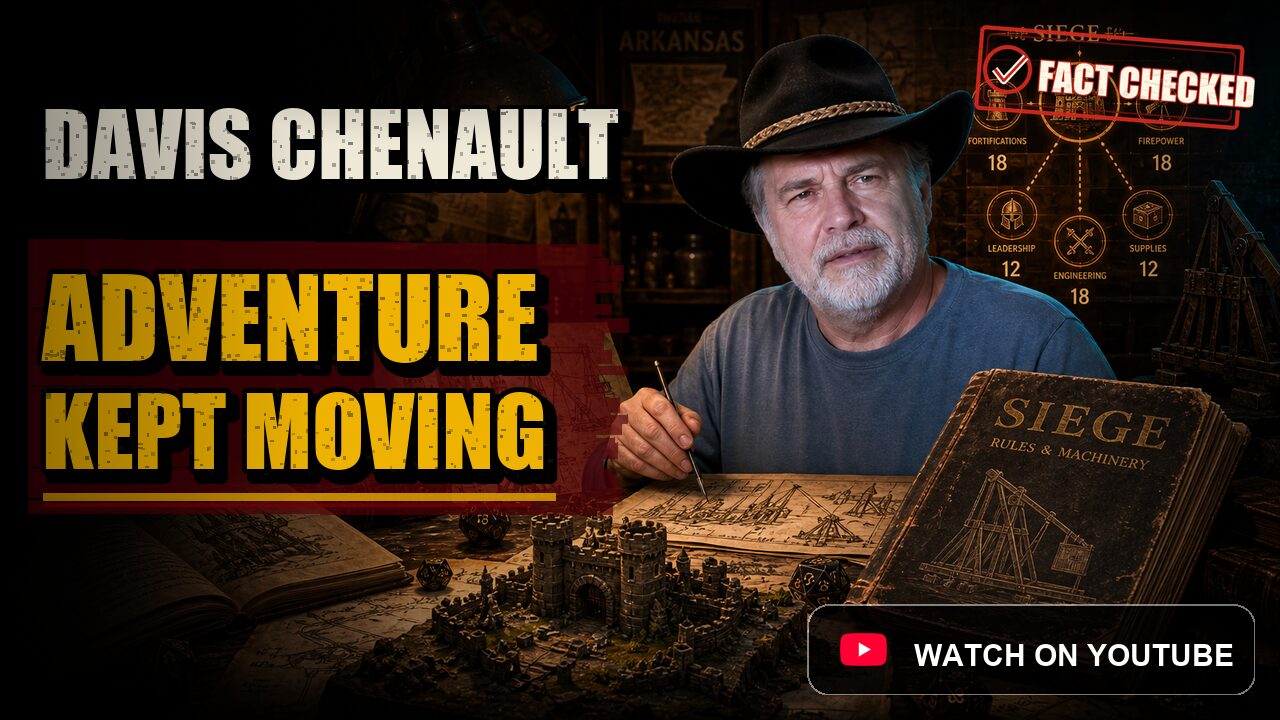
The basic idea is easy to explain. A character has attributes. Some are Prime, meaning they are central to that character’s training and nature. Some are not. A Prime attribute starts from a lower target number, usually 12. A non-Prime attribute starts from a higher one, usually 18. The Castle Keeper adds difficulty. The player rolls a d20, adds the right modifiers, and the table knows whether the attempt works.
That may sound small.
It is not small at the table.
It means the game does not need a separate machine for every kind of action. Climbing, resisting poison, reading an old inscription, forcing a gate, sneaking past guards, wrestling with a spell, or improvising a plan the rulebook never predicted can all go through the same door.
The player is not trapped by a missing skill entry.
The Castle Keeper is not trapped by a paragraph written years before this exact moment of play.
The rules give the table a handle, then get out of the way.
That is the real design move.
Gary Gygax And The Old Rhythm
Troll Lord Games’ relationship with Gary Gygax gave the company a kind of historical voltage that most young publishers never get.
Their early Troll Lord Games supplements were at Gen Con 33 in 2000. Gygax reached out afterward, and the conversation grew into a publishing relationship that included Gygaxian Fantasy Worlds material and work toward the Castle Zagyg project.
That relationship mattered for business, but it also clarified the design problem Castles & Crusades was trying to solve.
Gygax’s style of play did not need a heavy rules cage. It needed speed, judgment, danger, discovery, and enough structure to keep the shared fiction honest. The modern d20 engine could do many things, but it often made the table stop and consult machinery at the exact moment adventure should have been moving.
Castles & Crusades became a bridge.
It gave old-school play a cleaner modern chassis. It preserved classes, levels, monsters, treasure, dangerous exploration, and the familiar grammar of fantasy role-playing. Then it reduced the number of places where the system could interrupt the table.
That is why so many players have described it as the version of third edition that felt emotionally closer to first edition.
The point is not whether that phrase is literally true. It is a feeling, and feelings at a game table are data.
Castles & Crusades felt like somebody remembered what the older games were trying to do.
A World With Bones Under It
Chenault’s design signature is not only mechanical.
It is also archaeological.
Public material around him shows a long interest in anthropology, archaeology, and material culture. That helps explain why his settings and adventures often feel layered rather than merely decorated.
Erde, later expanded and reframed through Aihrde, is not just a backdrop for quests. It is a world that carries damage. Kingdoms, ruins, dark woods, old roads, broken powers, and recovering lands all suggest that history has pressure.
That pressure shows up in adventure design.
A dungeon is not just a map. It is an argument about who built it, who used it, who came later, and what the place became after its first purpose failed. A frontier problem is not just a monster nest. It can be the result of a distant war, an absent army, a weakened settlement, or a road that no longer holds.
That kind of logic does not make play slower. When handled well, it makes play easier because the world starts answering questions before the Castle Keeper has to invent everything.
Why are the goblins here?
Why does this ruin matter?
Why is the village exposed?
Why does the old road still pull danger toward it?
Chenault’s better work remembers that fantasy worlds are not theme parks. They are places where the past keeps sending bills.
Reforging The House
The 2023 OGL crisis forced many publishers to ask how much of their work they actually owned. It reminded small publishers how quickly the ground can shift under them.
Troll Lord Games answered with a wave of Reforged cleanups and a push toward greater independence from OGL dependencies. That was not a cosmetic decision. It meant combing through years of text, cleaning terminology, replacing license-tied material where possible, and keeping the game compatible enough that longtime players did not feel abandoned.
That move fits the larger Chenault pattern.
Build the system so the table can act.
Build the company so the publisher can act.
Troll Lord Games has long valued practical independence. The company developed in-house and domestic printing capacity, maintained direct community channels, and kept its central fantasy game in continuous use without forcing players through a parade of incompatible editions.
There is a design lesson in that.
Rules sovereignty and publishing sovereignty are not separate ideas. A game that trusts the Castle Keeper and a company that trusts its own production spine come from the same place. Both resist unnecessary permission structures.
That does not make Troll Lord Games immune to mistakes. It does not make every book perfect. Small publishers carry the marks of small publishing: uneven editing, shifting schedules, and the occasional product that shows its seams.
But the line held.
Castles & Crusades is still here.
What He Actually Built
Davis Chenault did not invent fantasy role-playing. He did not create the OSR by himself. He did not single-handedly preserve Gary Gygax’s legacy, build Troll Lord Games, or design every important Castles & Crusades book alone.
What he built was more specific.
He helped give traditional fantasy adventure a durable mechanical frame at a time when the hobby was being pulled toward heavier character engineering. He helped build a system where the Castle Keeper could resolve almost anything without opening six books. He helped shape a publishing house that survived the d20 crash, worked with one of the hobby’s founders, kept a flagship game alive for decades, and later rewrote its legal foundation rather than waiting for permission from a larger company.
His work is architectural.
Not flashy architecture. Load-bearing architecture. When it works, nobody notices it. They just play.
The SIEGE Engine works because it is simple enough to disappear. Aihrde works because it treats fantasy as accumulated history rather than wallpaper. Troll Lord Games works because it learned, again and again, that independence is not a slogan. It is a system of habits.
That is Chenault’s contribution.
He made room for adventure to happen.
Where To Find Him
Davis Chenault remains publicly connected to Troll Lord Games, where his company bio still sits alongside the rest of the Troll Lord Games team. The official Troll Lord Games site is the best current doorway into his work, especially Castles & Crusades, Aihrde material, Reforged core books, and new releases tied to the company’s ongoing fantasy lines.
For credit lists, RPGGeek and BoardGameGeek remain useful public indexes. For current product activity, Troll Lord Games’ own store, news posts, and the Troll Dens updates are safer than scattered secondhand summaries.
The cleanest way to understand Davis Chenault is still to sit down with Castles & Crusades and watch what happens when a player asks to do something strange.
The system will not panic.
It will ask for an attribute.
Then the adventure keeps moving.
Fact Check Notes
Publication notes
This site is AI-assisted and human-reviewed. We use artificial intelligence to help gather research, organize source material, and draft profile content. Human editors then read, revise, and check each profile before it goes live. Most profiles are built through deep AI research and two separate rounds of fact-checking.
Leave a Reply
You must be logged in to post a comment.