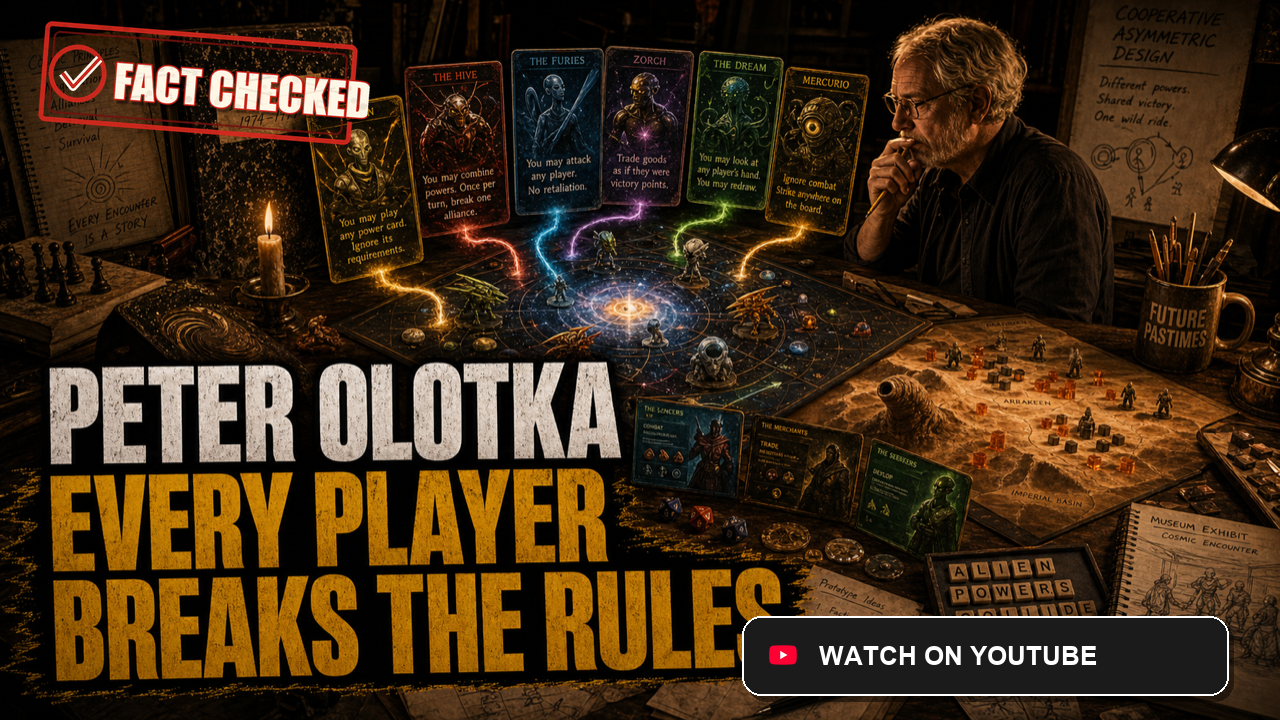
Before it, most games still assumed that everyone at the table should operate under the same rule set. You might start in a different position. You might draw different cards. You might make better or worse decisions. But the rules themselves usually belonged equally to everyone.
Cosmic Encounter broke that assumption open.
One alien could bend negotiation. Another could alter combat. Another could rewrite the meaning of losing. The game did not simply give players different advantages. It gave them different identities. Each power changed the way the table behaved around it.
Peter Olotka was one of the people who built that machine.
He was not a lone inventor in a room. That matters. Cosmic Encounter came from a cooperative: Olotka, Bill Eberle, Jack Kittredge, and Bill Norton. The group shared credit deliberately, and any clean attempt to isolate one person’s exact invention inside that collaboration becomes guesswork.
Olotka’s role was still distinct.
He became the president, organizer, public steward, rights holder, and long-haul keeper of the flame. If Cosmic Encounter was the alien table where everyone played by different rules, Future Pastimes was the design table where everyone brought a different piece of the system.
Olotka helped keep that table together.
Before The Encounter
Olotka’s path into games did not start as a straight line toward publishing.
He served in the Peace Corps in the Marshall Islands. He studied history at the University of Colorado, then earned a master’s degree in mass communications from Emerson College. That combination feels unusually relevant to the games he later helped make: history, culture, communication, and the problem of how people understand one another when they do not share the same assumptions.
In 1972, he joined Eberle, Kittredge, and Norton to form Future Pastimes. The group worked for years before publishing anything. They were not chasing a quick product. They were making strange systems, testing them, arguing over them, and discovering what could happen when rules were treated as personalities instead of neutral background machinery.
When Eon Products formed in 1977, Cosmic Encounter became the game that introduced that thinking to the wider hobby.
It is easy now to use the phrase variable player powers as if it were always sitting on the shelf. It was not. Cosmic Encounter made asymmetry the foundation. It treated unequal rules not as a problem to solve, but as the reason to play.
That was the leap.
Aliens At The Table
Cosmic Encounter works because the alien powers are not just bonuses.
They are arguments.
Every alien says something about what a game can permit. The Mind can see another player’s hand. The Loser can invert victory and defeat. The Zombie refuses to die in the usual way. The Machine keeps going when everyone else is done. Each power creates a local exception, and the table has to reorganize around that exception.
That is why the game still feels alive.
The board is not the whole system. The deck is not the whole system. The negotiation is not the whole system. The system is the collision between powers, deals, timing, threats, alliances, and temporary trust.
Cosmic Encounter did not simply add variety to a traditional conquest game. It made identity combinatorial. Change the aliens, and the social shape of the game changes with them.
Olotka’s later career makes that part feel especially fitting.
He kept returning to games as communication systems: who knows what, who can say what, who can promise what, who can break the usual rule, and what happens when a group has to make meaning out of unequal positions.
Dune And Factional Power
Dune, published by Avalon Hill in 1979, took the cooperative’s ideas into a licensed universe that was almost built for asymmetry.
The Atreides, Harkonnen, Fremen, Emperor, Guild, and Bene Gesserit are not skins on the same faction. They are political machines with different economies, advantages, information flows, and paths to victory. The game understands Frank Herbert’s universe as a struggle between incompatible forms of power.
That is the key.
The factions do not just fight over territory. They fight through different kinds of leverage. Spice, prophecy, shipping, betrayal, hidden knowledge, and military force all matter. The simultaneous battle dial forces commitment before certainty. Players make choices under partial information, then watch the table punish overconfidence.
Dune proved that the Future Pastimes style could scale.
Cosmic Encounter was explosive, social, and endlessly recombinant. Dune was longer, heavier, and more political. The shared principle held: give players identities that reshape the system, then let those identities collide.
That design has aged better than many games from the same period because the architecture is not only about balance. It is about tension. The game survives because imbalance is part of the fiction.
The Cooperative Catalog
The rest of the Eon and Future Pastimes catalog kept testing adjacent ideas.
Hoax played with accusation, bluffing, and hidden identity. Quirks pushed biological and evolutionary themes through a strange card-game lens. Borderlands built a resource and territory game around pressure at the edges of expanding control. Runes experimented with letter pieces, a design thread that would return decades later in the word games Decipher and Wordsmith.
Not every title became a landmark.
That is normal. Most catalogs have a few games that change the conversation and many that reveal what the designers kept worrying at. With Olotka and Future Pastimes, the pattern is easy to see: powers, hidden information, communication, identity, negotiation, and systems where the rules of interaction are as important as the pieces on the table.
The famous near miss fits that pattern too.
Olotka has long been connected to an early description of what later sounds like a collectible card game: cards with different powers, collected and combined by players into personal decks. The idea reportedly surfaced in the late 1970s, long before Magic: The Gathering made that structure into a commercial earthquake.
No shipped game came from it.
That boundary matters. Game history belongs to what people make, not only what they imagine. Still, the story has value because it shows where Olotka’s mind was working. He was thinking about games as modular identities before the industry had the product category that would later make that idea enormous.
The Museum Years
When the original cooperative’s peak period faded, Olotka did not stop building interactive systems.
With his son Greg, he moved into educational and museum work through Creative Consultants. Future Pastimes describes that work as science museum exhibits and programs, but the important design idea is broader than the client list. Olotka kept working on systems where people learn by doing.
That is not the same thing as tabletop design.
A museum kiosk is not a board game. An educational installation is not Cosmic Encounter. A science program has different constraints, different audiences, and different success measures. It should not be scored as if it were another boxed hobby release.
But it does tell us something.
Olotka did not treat games as cardboard only. He treated them as interactive structures. Give people a situation. Give them choices. Let the system respond. Let the lesson emerge from participation instead of lecture.
That instinct connects the museum work to the tabletop work, even when the medium changes.
The Long Return
Cosmic Encounter did not vanish into nostalgia.
Fantasy Flight Games brought it back in 2008, and Olotka remained part of the public life of the design. New editions, anniversary releases, expansions, and Cosmic Encounter Duel kept the alien engine moving into a new century. The game continued to generate powers because the original architecture was built to accept new exceptions.
Dune had its own long return.
Gale Force Nine republished the classic game in 2019. The reprint won an Origins Award, and new expansions followed. Dune: A Game of Conquest and Diplomacy streamlined the system for a shorter, sharper version. Arrakis: Dawn of the Fremen, published in 2022, reworked ideas from Borderlands into the Dune universe.
That kind of revival does not happen by accident.
It requires rights, relationships, stewardship, patience, and a willingness to let old designs speak to new audiences without sanding off the parts that made them matter. Olotka spent decades doing that work.
He was not merely a designer whose old games stayed famous. He was one of the people who kept the doors open for those games to return.
What He Actually Built
Peter Olotka did not build his legacy alone. That is the honest sentence.
The most important tabletop designs in his career are cooperative achievements. Cosmic Encounter and Dune belong to a group. Their brilliance comes from shared invention, shared argument, and shared willingness to let asymmetry become the central premise.
What Olotka built was the cooperative structure around that brilliance.
He helped found Future Pastimes. He led Eon Products. He stayed attached to the rights, revivals, expansions, adaptations, word games, and public story of the work. He moved into museum and educational systems when the tabletop catalog no longer told the whole story.
Some designers build monuments alone.
Olotka helped build an ecosystem.
That ecosystem gave board games one of their most durable modern ideas: players can follow different rules and the game can become richer, not weaker, because of it.
Where To Find Him
Future Pastimes remains the public home for Peter Olotka’s design legacy. The site presents the continuing family of Cosmic Encounter, Dune, Cosmic Encounter Duel, Arrakis: Dawn of the Fremen, and the later letter-piece games Decipher and Wordsmith.
Cosmic Encounter was inducted into the BoardGameGeek Hall of Fame in 2025. Dune continues to find new players through Gale Force Nine’s revival. The alien powers still multiply. The factions still make their impossible bargains. The old cooperative work is still alive on modern tables.
That is the quiet achievement.
Olotka helped make games where difference was not a balance problem. It was the engine.
Every player could see the universe through a different rule.
Then the table had to deal with it.
Fact Check Notes
Publication notes
This site is AI-assisted and human-reviewed. We use artificial intelligence to help gather research, organize source material, and draft profile content. Human editors then read, revise, and check each profile before it goes live. Most profiles are built through deep AI research and two separate rounds of fact-checking.
Leave a Reply
You must be logged in to post a comment.