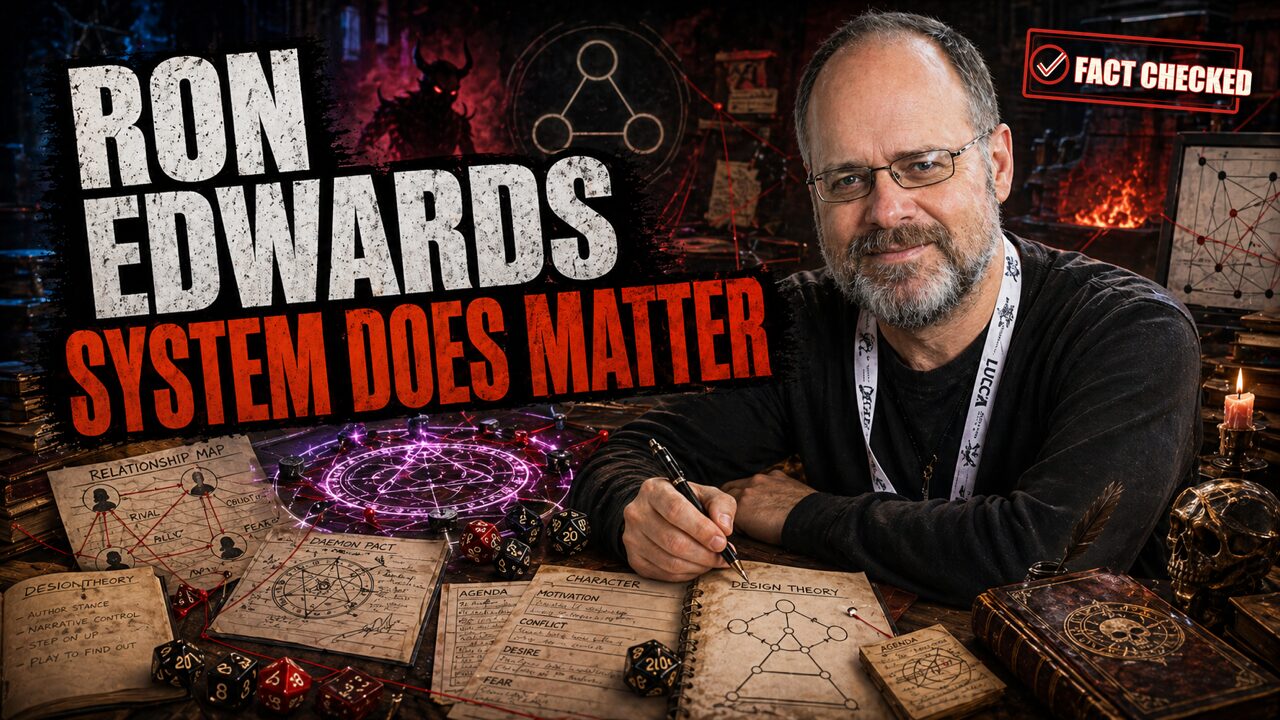
Ron Edwards did not ask whether a role-playing game could tell a good story.
He asked why so many games kept hoping one would appear.
That is the difference.
For decades, tabletop role-playing games carried a strange contradiction. The books promised drama, horror, morality, politics, tragedy, romance, myth, or personal transformation. Then the actual procedures often handed the table a combat engine, a skill list, a stack of setting lore, and a quiet expectation that the game master would somehow make the promised story happen.
Edwards attacked that gap.
His argument was blunt, irritating, useful, and impossible to unhear once you understood it: system does matter.
Not setting alone. Not good intentions. Not the GM secretly fixing the weak parts behind the screen. Not "roleplay it out" as a universal patch.
System.
The procedures at the table shape what the group actually does. If you want moral pressure, build procedures that create moral pressure. If you want protagonists making hard choices, make those choices unavoidable. If you want a game about a dangerous bargain, do not write a paragraph saying the bargain is dangerous and then let the rules drift back to generic adventure.
Make the bargain bite.
That is what Sorcerer did.
The Demon Was The Engine
Sorcerer began as an independent role-playing game before independent role-playing had a stable marketplace to stand on.
Edwards self-published it in the 1990s, first as a creator-owned project moving through the early internet and convention scene, then through Adept Press. The 2001 hardcover edition won the 2002 Diana Jones Award for Excellence in Gaming, with the award going to both Edwards and Sorcerer.
The game itself was not large in the way traditional RPG lines were large.
It did not need to be.
Sorcerer is about people who bind demons. That premise could have become another occult combat game. Add demon stats, add spell lists, add a setting chapter, and let the GM supply the moral weight.
Edwards went at it differently.
The sorcerer-demon relationship is not decoration. It is the engine. The game’s Humanity measure is not a mood label. It is a pressure point. The rules ask the group to define what Humanity means in that particular game, then put the character’s choices under that light.
Power has a cost because the procedures make cost matter.
That was the lesson. You did not merely perform the theme. You handled it through play.
In Sorcerer, the demon is not a monster waiting at the end of a corridor. The demon is bound to the character’s ambition, need, hunger, fear, or self-deception. The more the character uses that power, the more the table has to look at what the power is doing to the person using it.
That is not flavor.
That is design.
The Forge
The game would have mattered on its own.
The argument mattered more because Edwards built a place for it to fight.
The Forge became one of the central online spaces for independent RPG design in the early 2000s. It was not just a fan forum. It was a workshop, argument pit, publishing support network, theory lab, and pressure cooker.
Designers brought games there. People tore them apart. Sometimes usefully. Sometimes harshly. Sometimes both in the same paragraph.
The community cared about creator ownership, actual play, design intent, and whether the procedures of a game really supported the experience the designer claimed to want. That sounds normal now because the conversation won more ground than people remember. At the time, it could feel like someone had turned the lights on in a room full of inherited habits.
The Forge did not create every important indie RPG of the 2000s. It did not own the movement. It did not contain every good designer. It was not always kind, and it was not always right.
But it gave a generation of designers a shared place to ask better questions.
What is this game actually about?
What do the rules make players do?
Where does authority sit?
What kind of choices does the system reward?
What are we pretending the GM will fix?
Those questions changed people.
Vincent Baker, Luke Crane, Clinton R. Nixon, Paul Czege, Emily Care Boss, and many others worked in or around the conversations The Forge made visible. Dogs in the Vineyard, Burning Wheel, My Life with Master, Breaking the Ice, and the wider indie RPG boom of the 2000s did not all come from one theory or one man. That would be too simple.
They came from a charged design culture.
Edwards helped charge it.
Gns And The Fight Over Categories
The most famous theory associated with Edwards was GNS: Gamism, Narrativism, Simulationism.
The short version was that role-playing groups often pursue different creative agendas, and that games become confused when they try to serve incompatible agendas without admitting the conflict. A group interested in strategic challenge, a group interested in dramatic premise, and a group interested in exploring a fictional situation may all be playing "an RPG," but they may not want the same thing from play.
That idea made some people furious.
The anger was not only about the categories. It was about the tone. Edwards wrote like someone trying to cut through fog with a crowbar. The Forge could sound certain when the subject deserved more humility. The vocabulary could become insider language. GNS could feel reductive, especially when people treated it as a personality test or a purity ladder instead of a rough tool for talking about play.
Those criticisms are not side issues. They are part of the story.
The theory was controversial because it named things people cared about and then organized them in a way many people did not accept. Some players felt misread. Some designers felt boxed in. Some critics thought The Forge mistook a local design culture for a universal map.
Fair.
But even many critics absorbed the larger point.
Mechanics are not neutral.
Procedures teach habits. Reward systems shape attention. Authority structures change the fiction. A game that says one thing in its introduction and another thing in its rules will eventually make the table choose which text to believe.
That insight outlived the argument over labels.
The Bigger Model
GNS was never the whole of Edwards’ thought, even if it became the part everyone fought about.
The Big Model tried to place creative agenda inside a larger structure: social contract, exploration, techniques, ephemera, and the real moment-to-moment acts of play. That shift mattered because it moved the conversation beyond "what type of gamer are you?" and toward a more complete question:
What is actually happening at this table?
That question still cuts.
A role-playing game is not just a book. It is people talking, deciding, imagining, checking procedures, assigning authority, accepting outcomes, making meaning, and deciding whether to come back next week. The written rules are only one layer. But they are a real layer. They can support the activity or fight it.
Edwards kept returning to that point from different angles.
In Trollbabe, the scale of conflict can shift from one person to a whole community, and the game makes that shift part of its structure. In Elfs, he used crude comedy to expose player desire and character selfishness. In It Was a Mutual Decision, relationship horror becomes the point rather than an excuse for monster rules. In S/Lay w/Me, two-player sword-and-sorcery intimacy is built around direct procedure instead of campaign sprawl.
These games are not huge catalogs. They are focused instruments.
That is part of their strength.
Edwards’ game designs often feel like experiments with teeth. Each one asks what happens when the rules stop apologizing for the subject and start enforcing it.
What He Actually Built
Ron Edwards did not invent indie RPGs. He did not invent story-focused play. He did not discover that rules affect experience. Designers before him had already pushed against generic systems and traditional authority structures.
What Edwards built was a public discipline around those facts.
He gave designers a vocabulary, a fight, a set of examples, and a community where the central question could not be dodged:
Does your system actually do what you say your game is about?
That question is his legacy.
Not because every answer he gave was right. Not because every term aged well. Not because The Forge was perfect. It was not. The community could be abrasive, insular, and too confident in its own maps.
But the question was good enough to survive the room where it was asked.
You can see its descendants everywhere now. Focused RPGs with narrow premises. Games where safety, authority, reward, and scene framing are explicit. Designer notes that talk about what play is supposed to produce. Mechanics that push emotional, moral, or narrative decisions instead of waiting for the GM to improvise them.
Not all of that belongs to Edwards.
But a lot of modern RPG design speaks in a world he helped make louder.
Where To Find Him
The Forge is closed now.
That matters. It keeps the story honest. The old forum ran its course, became an archive, and stopped being the live center of the conversation.
Edwards did not disappear with it.
His current public home is Adept Play, which he describes as an academy and community for roleplaying. The site is built around actual play, coursework, workshops, consulting, game sales, and discussion. It is not The Forge restarted under a new name. It is a later-phase version of the same obsession: people at tables, procedures in motion, and play as something worth studying from the inside.
Public Adept Play material places Edwards in Norrköping, Sweden, and recent posts show him still writing, teaching, running workshops, commenting on convention play, and pushing back against lazy assumptions about what role-playing is for.
That is the clean line from Sorcerer to now.
First he made the demon cost something.
Then he made designers explain what their systems were doing.
Now he keeps asking people to look at the actual play in front of them.
The phrasing changed. The room changed. The argument moved.
The sentence still stands.
System does matter.
Fact Check Notes
Publication notes
This site is AI-assisted and human-reviewed. We use artificial intelligence to help gather research, organize source material, and draft profile content. Human editors then read, revise, and check each profile before it goes live. Most profiles are built through deep AI research and two separate rounds of fact-checking.
Leave a Reply
You must be logged in to post a comment.