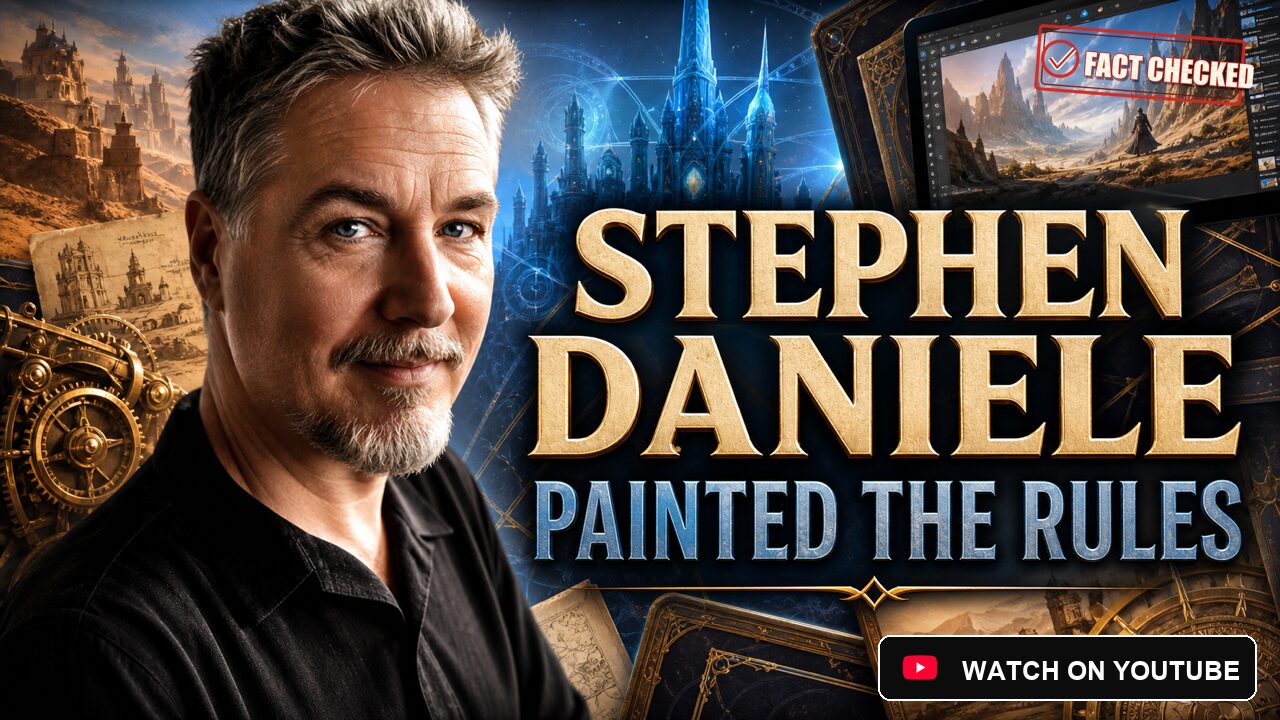
The Academy That Broke The Table
There is a kind of game art that simply decorates the page. It gives the reader a mood, a monster, a handsome object to look at before the rules begin again.
Stephen Daniele’s best work does something more specific. It explains what the game is doing.
Look at Tolarian Academy, one of the most infamous cards in Magic: The Gathering. Mechanically, it is a land that turns artifacts into an avalanche of blue mana. Historically, it helped power the era players remember as Combo Winter, when certain decks could generate absurd resources and end games before opponents had really begun to play. Daniele’s art does not just show a school. It shows a machine for thought: towers, gears, conduits, laboratories, and a sense that knowledge has become industrial pressure.
Then look at Stroke of Genius, another card from that same dangerous period. Its rule text turns mana into forced card draw. In play, it could become a weaponized flood of information, enough to make an opponent draw an empty library and lose. Daniele painted the idea not as bookkeeping, but as mental overload. The card’s effect becomes an event.
That is his gift. He takes rules and gives them a visible body.
This is why Daniele belongs in the story of game design even though his primary tools are image, composition, light, and visual concept. He is not usually credited as a rules designer, and that line matters. He did not write Dungeons & Dragons. He did not build Magic. But for more than three decades, he has helped players understand what those games feel like before they ever touch a die, shuffle a deck, or press a button.
The Dark Sun Years
Daniele entered the tabletop field during the 1990s, a period when role-playing games were becoming more visually demanding. The books needed more than monsters in action poses. They needed worlds.
His early Dungeons & Dragons work shows how quickly he understood that job. Dark Sun was never standard fantasy. Athas was a dying world of bone, heat, scarcity, and predatory power. The setting took familiar fantasy pieces and burned away the comfort. Metal was rare. Magic had ruined the world. Survival was not an introduction to adventure. It was the whole premise.
Daniele’s work for Windriders of the Jagged Cliffs and the revised Dark Sun Campaign Setting helped make that premise visible. The cliff societies of Athas required a different fantasy vocabulary from castles, taverns, and green fields. They needed height, danger, exposed stone, and the feeling that every route through the world could kill you. Daniele gave Dungeon Masters something they could describe at the table: not just a place, but a pressure system.
He could also move inward. Den of Thieves asked for a different mood entirely: urban shadow, criminal density, and the sense that a city has hidden rooms behind its public face. Daniele handled that shift with the same instinct for playable space. A good game illustration is not only a picture of what happened. It is a prompt for what players might do next.
That skill carried into his magazine work. In Dungeon and Dragon, he supplied images for encounters that had to be readable at a glance: abyssal beings, dangerous clergy, supernatural traps, demons in impossible spaces. The best of those pieces helped a referee understand how to stage a scene. Where is the threat? What kind of fear is this? Is the danger physical, magical, social, or all three at once?
Daniele’s art answered those questions before the boxed text did.
The Magic Card As Machine
Magic: The Gathering gave Daniele a smaller canvas and a harder assignment.
A role-playing book can use pages to create mood. A Magic card has a tiny art window, a title, a rules box, and the burden of being handled again and again by players who care about exact function. A card illustration has to survive repetition. It has to carry story, color identity, and mechanical suggestion inside a rectangle barely larger than a postage stamp.
Daniele proved especially good at abstract effects, which are often the hardest cards to illustrate. Counterspell is not a creature. It is refusal. Contamination is not simply decay. It is a rule change that corrupts how every land produces mana. Arcane Laboratory is not only a room. It is restraint, a place where spellcasting is limited by structure. Tolarian Academy is not just a location. It is a resource engine.
That ability made him useful during one of Magic’s strangest and most powerful eras. The Tempest and Urza blocks were full of cards that did not merely represent fantasy actions. They bent the game’s systems: resource production, draw engines, recursion, denial, acceleration. Daniele’s images gave those invisible pressures an emotional surface.
His portfolio also shows tonal range. In green, he could paint muscle, scale, tooth, and instinct. In black, he could turn rot and pressure into atmosphere. In blue, he could make intellect feel physical. His Magic work is not unified by one subject. It is unified by a habit of translation.
The most playful proof came later with Ambiguity from Unhinged. The card is a joke about rules confusion, but the assignment was serious craft: an image designed to read one way upright and another way upside down. That kind of optical problem is not just illustration. It is engineering by composition. It also shows that Wizards of the Coast trusted him with images that were about the act of reading the game itself.
The Artist As Worldmaker
Daniele’s tabletop career did not stay inside TSR and Wizards of the Coast.
Sovereign Stone, built around the creative gravity of Larry Elmore, Margaret Weis, and Tracy Hickman, needed a visual identity that could stand near Dragonlance without becoming a copy of it. The setting asked fantasy art to move through different cultural inspirations, different magical assumptions, and a different sense of social order. Daniele’s interior work helped give those books continuity and weight.
Hollow Earth Expedition asked for another turn. Instead of desert survival or arcane machinery, it needed pulp velocity: lost worlds, dangerous expeditions, 1930s technology, dinosaurs, strange ruins, and action scenes that look like they are already in motion. Daniele could do that too. The point is not that every piece looked the same. The point is that each piece understood what kind of play it was inviting.
That may be the cleanest way to describe his tabletop contribution. Daniele is a visual designer of play promises.
Dark Sun promises that survival will hurt. Magic promises that hidden math can become spectacle. Hollow Earth Expedition promises speed, peril, and discovery. Shroud of the Avatar promises a world the players are watching come into being. His images do not sit outside those promises. They help make them legible.
The Digital Turn
Daniele’s career also tracks the broader shift from printed books and cards into interactive media.
That transition is not automatic for fantasy artists. A painting can cheat. A concept for a video game cannot cheat in the same way. It has to be modeled, textured, lit, animated, navigated, and understood by teams who may be working in different tools on different schedules. The artist has to think in surfaces, silhouettes, camera movement, collision, player readability, and production limits.
Daniele made that turn. His professional record includes concept art, visual development, level and environment work, 3D modeling, and art direction across console, PC, and mobile games. The credits associated with his career move through projects such as Dark Void, Murdered: Soul Suspect, Tomb Raider, Starhawk, Crimson Skies: High Road to Revenge, NBA 2K social spaces, Disney Mirrorverse, and other interactive productions.
The digital work matters because it shows that his underlying skill was not tied to one medium. He was never only a painter of fantasy covers. He was a designer of readable imaginary systems. Once the systems became playable in 3D, he followed them there.
That makes his Shroud of the Avatar work especially revealing.
The Wolf At The Drawing Table
In the Shroud of the Avatar community, Daniele became known as Caravaggio’s Wolf. The name fit the public role he took on: part artist, part teacher, part visible maker inside a crowdfunded game whose audience wanted to see the process.
Through the Pen of the Avatar broadcasts, players watched Daniele create concept art live. That may sound ordinary now, when streaming and process videos are common, but in the early 2010s it was still a bold inversion of normal game production. Most studios protected concept work until marketing was ready. Shroud invited backers into the room.
Daniele designed and discussed dungeon entrances, monsters, armor, elementals, buildings, symbols, and world objects while the community watched. The act of drawing became part of the game’s public life. Players were not only waiting for finished assets. They were watching the visual language of New Britannia develop in real time.
His work on Shroud included the Sigil of Magic, the Oracle’s visual world, Watchers, elementals, player housing concepts, maps, and other pieces that helped define how the setting felt. Just as important, he modeled a kind of creative transparency that matched the project’s backer-driven identity. The concept artist was no longer invisible behind the final product. He became a guide to the making of the world.
That is a different kind of influence than a famous cover. It changes the relationship between artist and player.
The Claim That Should Be Left Out
There is one caution worth naming because it protects the real work.
Some research summaries connect Daniele to early physical-to-digital gaming patents, the kind of ideas that resemble later toys-to-life systems. The public patent records for the two cited patents list different inventors. That means those patents should not be treated as confirmed Daniele credits.
The correction does not weaken his career. It clarifies it.
Daniele’s verified contribution is already substantial: tabletop worldbuilding, Magic images tied to major mechanical history, digital concept and environment work, and public process leadership on a crowdfunded online world. He does not need borrowed patents to matter.
What Remains
Stephen Daniele’s career is a reminder that games are not made only out of rules.
They are made out of signals. A card has to tell you what kind of force it represents. A monster has to tell you how it threatens the table. A city has to tell you how players might move through it. A game world has to become visible before it can become playable.
Daniele has spent his career building those signals.
He gave Athas heat and height. He gave Magic’s most volatile resource engines a face. He made abstract rules feel like physical pressure. He shifted from printed fantasy to digital worlds without losing the central habit of his work: make the system readable, make the feeling immediate, make the image do more than decorate.
That is why Tolarian Academy still matters as art even after all the tournament history has been told. The card is not merely powerful. It looks powerful in exactly the right way. It looks like a place where knowledge has become infrastructure, where every artifact feeds the next impossible thought.
That is Stephen Daniele’s lane.
He painted the rules.
Fact Check Notes
Publication notes
This site is AI-assisted and human-reviewed. We use artificial intelligence to help gather research, organize source material, and draft profile content. Human editors then read, revise, and check each profile before it goes live. Most profiles are built through deep AI research and two separate rounds of fact-checking.
Leave a Reply
You must be logged in to post a comment.