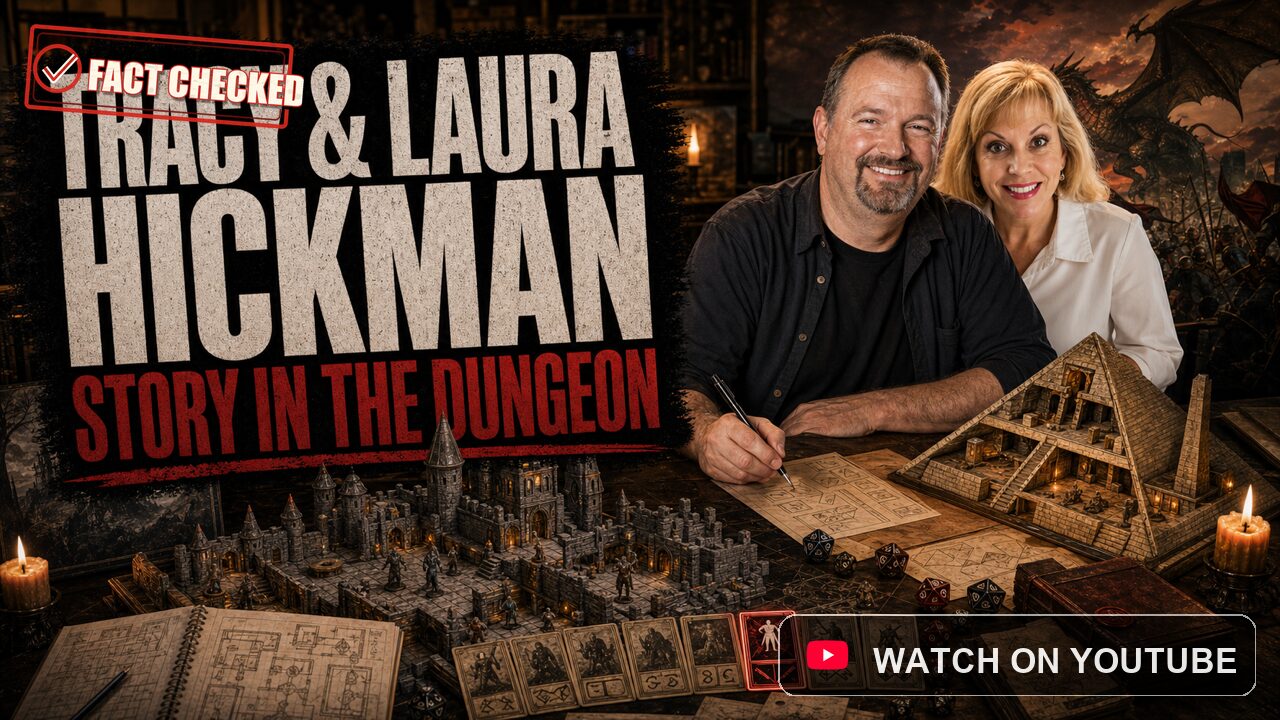
Tracy and Laura Hickman helped change what a Dungeons & Dragons adventure was expected to do.
Before the Hickmans, a published dungeon could be a map with monsters in rooms. That is not an insult. Many of those early adventures were wonderful machines for exploration, danger, treasure, and improvisation.
But Tracy and Laura Hickman wanted something else.
They wanted a reason to go in.
They wanted the dungeon to make sense as a place.
And they wanted the adventure’s story to be part of play itself, not something stapled on as boxed text.
That sounds obvious now because forty years of adventure design has trained us to expect it. In the late 1970s and early 1980s, it was not obvious at all. Together, the Hickmans helped make it normal to expect that a module could be more than a location to loot.
It could be a dramatic structure.
The Kitchen Table Manifesto
The origin story is almost painfully practical.
Tracy and Laura Hickman were young, broke, and designing adventures under the DayStar West Media name. They self-published early versions of Rahasia and Pharaoh in small numbers. The line was called Night Ventures, and it carried a design philosophy that would become famous among people who care about the shape of RPG adventures.
The principles were simple.
The players should have a worthy objective beyond killing and pillaging.
The story should be woven into the play itself.
The dungeon should have architectural sense.
The adventure should have an attainable and honorable conclusion.
Those ideas are sometimes called the Hickman Manifesto, but Tracy has repeatedly credited Laura as essential to the shift, and that matters. The early modules were not the product of a lone man receiving the future on stone tablets. They came from a partnership.
Laura introduced Tracy to D&D. Laura co-created the early work. Laura’s story instincts shaped the thing that became the revolution.
That attribution does not reduce Tracy’s importance.
It makes the history more honest.
There is also something quietly human about where this particular revolution started.
Not in a corporate design lab. Not as a committee decision. It started at a kitchen-table scale, with two people trying to write an adventure that felt like it belonged in the world. That intimacy shows in the work. The modules do not just ask, "Can you survive this?" They ask, "Why are you here, and what does it mean if you succeed?"
The Pyramid With A Purpose
Pharaoh matters because it shows the new idea in motion.
The adventure still has plenty of old-school DNA. There is a desert. A tomb. Rooms to explore. Dangers to survive. But the center of the adventure is not just extraction. The pyramid has a moral problem inside it. The players are not merely raiders looking for treasure. They are drawn into the consequences of greed, curse, and release.
That was the difference.
The dungeon had a reason to exist. Its spaces pointed toward a story. Its objective was not only to survive long enough to haul gold out of the ground.
When TSR hired Tracy and acquired the Hickmans’ early modules, that design philosophy came with him. It did not take over the company overnight. No design movement ever works that neatly. But the ideas he carried into TSR had been formed in a partnership, and that changed the argument.
What should a module be?
After Pharaoh and Rahasia, there was a stronger answer available:
It should mean something.
Castle Ravenloft
Ravenloft, published in 1983 and written by Tracy and Laura Hickman, is where the argument became unforgettable.
The premise is pure Gothic horror: a vampire lord, a doomed land, a castle under storm clouds, and a villain whose tragedy is part of the machinery.
The design is what made it last.
Castle Ravenloft is not just a stack of combat encounters. It feels like a place. The rooms have functions. The castle has verticality. The maps, famously isometric, help the Dungeon Master understand the structure as a physical building instead of a flat maze.
Then there is the Fortunes of Ravenloft.
Before play begins, cards determine key elements of the adventure: where important treasures are hidden, where Strahd can be found, and what forces shape the confrontation. The exact details have changed across editions, but the idea has endured from the original module through Curse of Strahd.
That was not randomization for its own sake.
It gave the same adventure a shifting spine. The players could return to Castle Ravenloft and not walk the same exact dramatic path. Even the Dungeon Master could feel a little uncertainty.
And Strahd mattered because he was not just a monster in a room.
He had desire. History. Obsession. Tactics. A reason to haunt the place beyond “the module needs a boss.” The Hickmans treated the villain as a character, and the hobby noticed.
Ravenloft did not invent Gothic horror. It did something harder inside D&D. It made Gothic horror playable as architecture.
Project Overlord
Dragonlance began as a much larger dream.
The internal code name was Project Overlord. Hickman wanted dragons to matter again in a game with dragons in the title. Harold Johnson helped push the idea inside TSR. Jeff Grubb, Larry Elmore, Carl Smith, Douglas Niles, Margaret Weis, and many others became part of the team that turned the idea into a line.
The result was one of the most important transmedia projects in tabletop history.
Laura’s role in the public record is clearest in the early DayStar work, Rahasia, Pharaoh, and Ravenloft. Tracy’s formal TSR role made him the visible spearhead of Dragonlance. Those are not the same kind of credit, and they should not be blurred. But they belong in one story. The design values that made Dragonlance possible had already been tested at the Hickmans’ table: story with purpose, places with logic, and adventures with emotional direction.
Dragonlance was not just a setting. It was modules, novels, art, calendars, wargame material, characters, and an epic war story moving through all of them. The adventures and the novels did not merely sit beside each other. They fed the same saga.
That was the leap.
Earlier D&D modules could connect. Dragonlance tried to serialize a campaign as an epic narrative. Players moved through a story with recurring characters, rising stakes, revelations, war, dragons, betrayal, faith, and apocalypse.
The commercial effect was real. Dragonlance became one of TSR’s defining brands and helped prove that game fiction could be a major publishing category. The creative effect was just as large. Once TSR saw that a game line could become a fiction engine, later settings and lines were built with that lesson in mind.
Forgotten Realms novels. Ravenloft novels. Dark Sun novels. Shared-world fiction as product strategy.
Dragonlance showed one path that later publishers kept exploring.
The Cost Of Story
The revolution had a price. Any time you pull story tight enough to feel like a novel, you risk squeezing the players’ room to breathe.
The tighter a designer writes the story, the harder it is for players to walk somewhere else.
That tension is the central argument around the Hickmans’ legacy. Their work helped make adventures more meaningful, but it also helped create the thing later players would call railroading: the sense that the story is already written and the party is being moved through it.
Dragonlance made the tension visible because the story was so big and the characters were so defined. The modules often wanted players to hit key dramatic beats that matched the broader saga. Pre-generated heroes were part of the intended experience. Death, deviation, and player invention could rub against the needs of the plotted epic.
This is not a gotcha.
It is the price of pioneering.
When designers try something at a scale nobody has handled before, they discover the flaws in public. The Hickmans helped establish the power of story-driven adventure design. They also exposed the core problem of story-driven adventure design:
Who owns the story at the table?
The designer?
The Dungeon Master?
The players?
The answer has been debated ever since.
The Work That Kept Echoing
Tracy left TSR in the late 1980s, but the things the Hickmans helped set in motion kept expanding.
Ravenloft became a campaign setting, then a long-running horror brand, then returned again in Curse of Strahd, with Tracy and Laura brought back as contributors. Chris Perkins publicly described revisiting Barovia with the original creators as a highlight of his professional career.
Dragonlance kept going through novels, supplements, editions, relaunches, arguments, nostalgia, and new readers. Its influence on RPG fiction is difficult to separate from the history of TSR itself.
And the adventure path model became one of the strongest commercial formats in role-playing. Paizo’s Adventure Path line did not copy Dragonlance mechanically, but it inherited a familiar promise: a serialized campaign delivered in installments, meant to carry characters through a major arc.
Modern D&D hardcovers also live downstream from this shift. They are not all Hickman-style adventures. Some are sandboxes. Some are anthologies. Some are hybrids. But the expectation that a major D&D campaign book should have theme, villainy, structure, and an arc owes a debt to the path the Hickmans helped open.
What They Actually Built
Tracy and Laura Hickman built narrative architecture.
Not a universal game system. Not a new dice engine. Not a standalone RPG framework that other publishers licensed and reused.
Their great work was adventure form.
They helped move the published module from “place full of challenges” toward “place where a story happens.” They helped make villains psychological. They helped make dungeons care about their own architecture. Tracy, working inside TSR with a larger team, then helped prove that a campaign could be serialized across modules and novels.
The limitation is real. The story-first revolution sometimes pushed player agency into a narrower lane. The Dragonlance modules are loved, but they are also part of the origin of a debate that still divides tables.
That is why the legacy is interesting.
The Hickmans did not solve the tension between story and freedom.
They made it unavoidable.
Where To Find Them
You can find Tracy and Laura Hickman in Pharaoh, Rahasia, Ravenloft, and the later return to Barovia in Curse of Strahd.
You can find Tracy’s later TSR-era public role in Dragonlance, Dragonlance Adventures, the original DL modules, and XDM: X-Treme Dungeon Mastery.
You can also find the Hickmans in a question every adventure designer still faces.
Does this room exist only because the map needed another room?
Or does it tell the players something?
Does this villain wait in the final chamber because the module needs a fight?
Or does the villain want something?
Does the adventure end when the treasure is carried out?
Or when the story has changed the people who entered?
Tracy and Laura Hickman put those questions on the table.
The dungeon has never been the same.
Fact Check Notes
Publication notes
This site is AI-assisted and human-reviewed. We use artificial intelligence to help gather research, organize source material, and draft profile content. Human editors then read, revise, and check each profile before it goes live. Most profiles are built through deep AI research and two separate rounds of fact-checking.
Leave a Reply
You must be logged in to post a comment.