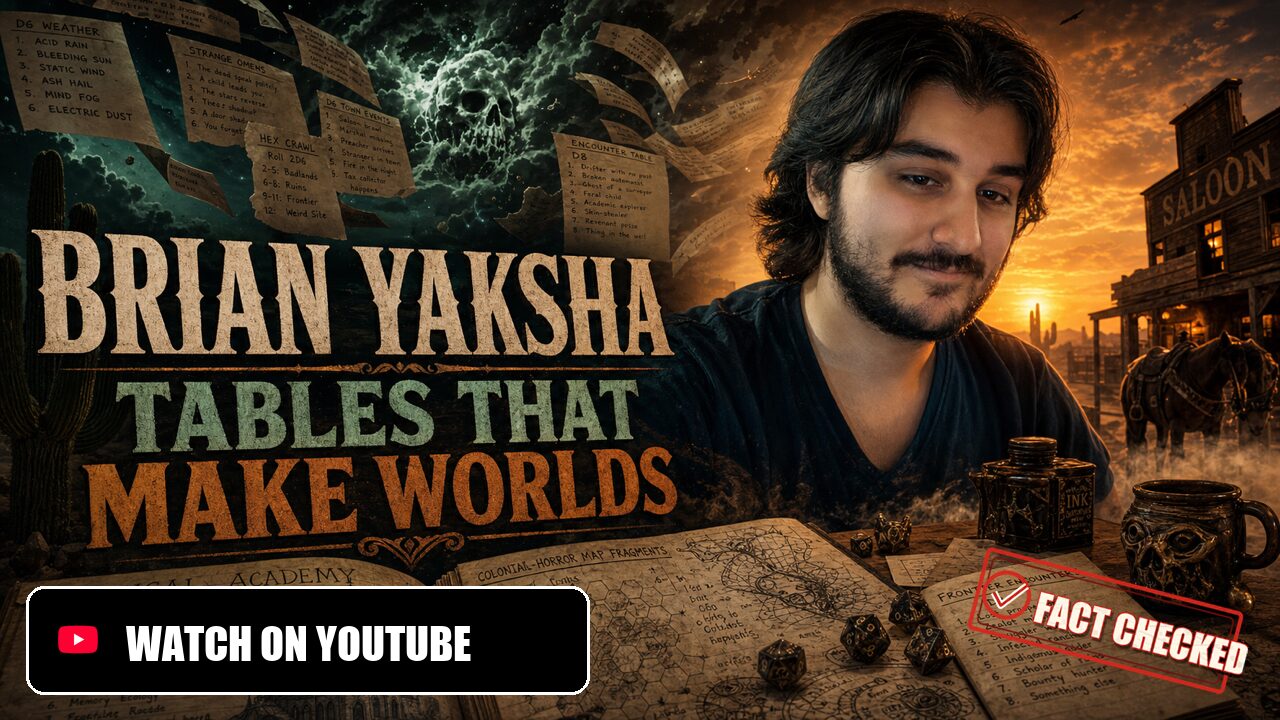
Brian Yaksha does not usually build games from the foundation up.
They build weather systems.
A Yaksha project often begins with someone else’s engine. Mork Borg. Troika!. Best Left Buried. Knave. Vaesen. The chassis is already there.
Then Yaksha changes the air.
A table becomes a rumor system. A background list becomes a civilization in collapse. A hexcrawl tool becomes a way to make the map feel hungry. A western becomes infected with acid, rot, dust, and doomed poetry.
Yaksha works through Goatman’s Goblet, a small independent imprint that puts out zines, supplements, random tables, setting material, maps, and other procedural tools for the indie RPG scene.
The important word is ecosystem.
Yaksha’s career so far is not the story of a standalone system taking over the field. It is the story of a writer-designer who enters other people’s games and makes the random tables sound like dispatches from a dying world.
The Table As Voice
Random tables are everywhere in tabletop roleplaying.
Most are functional. Roll a die, get a thing. Weather. Encounter. Treasure. Tavern rumor. Odd corpse. Strange potion.
Yaksha’s tables are doing something more literary.
They do not merely answer a question. They teach the reader how the world thinks. The entries are specific, barbed, and atmospheric. The roll result is not just content generation. It is tone delivery.
“Procedural generation as prose” fits because it names the real craft. Yaksha’s best work treats randomness as a writing instrument. The table is not behind the setting. The table is how the setting speaks.
At a good table, that matters more than people admit. Before anyone has rolled initiative, before the party even agrees on a plan, the language on the page tells them what kind of world they are walking into. Yaksha’s tables push that feeling into the room fast.
This makes the work feel larger than its mechanical footprint.
It also explains the boundary.
If a designer’s main tool is voice inside borrowed systems, then the design contribution is harder to measure by traditional rules-engine standards. The table may be brilliant, but it still sits inside someone else’s game.
The Frontier
Frontier Scum is the clearest Yaksha object.
Published by Games Omnivorous and Peregrine Coast Press, it is an acid western RPG descended from the Mork Borg design world. The rules are light. The atmosphere is not.
Frontier Scum does not matter because it invented a new resolution system. It matters because it demonstrates Yaksha’s ability to re-skin a familiar indie RPG engine until the borrowed structure almost disappears beneath the voice.
The west in Frontier Scum is not heroic frontier myth. It is a bad trip at sundown. The landscape feels diseased. The people feel doomed. The humor comes with blood on it.
It is the kind of setting that changes the way players speak. They stop making clean plans. They start making bargains. They start looking for exits that do not exist.
That tonal conversion is real design work.
It is not the same as building a new mechanical architecture, but it is not mere decoration either. In RPGs, tone changes behavior. A table of dead towns, cursed weapons, filthy jobs, and ruinous omens teaches the group what kind of choices belong in the world.
The game tells you what it wants by the kinds of accidents it makes possible.
The Rot Spreads
Tides of Rot, co-authored with Karl Druid, pushes the Frontier Scum world further into splattercrawl territory.
Whatever someone thinks about awards, ENNIE nominee lists are a decent visibility signal for small-press RPG work. Tides of Rot appeared on the 2025 nominee list in multiple categories.
This does not prove a huge commercial machine.
It does suggest continued presence.
Yaksha is not a disappeared one-zine designer. The work keeps moving through the scene, keeps getting talked about, and keeps finding readers who care about the texture of small-press RPG books.
The Academy
Academies of the Arcane is one of Yaksha’s most substantial single supplements.
Published by Melsonian Arts Council for Troika! Numinous Edition, it is a toolkit for magical schools: backgrounds, spells, academy generation, strange academic disasters, and the social weather of magical education.
This is where Yaksha’s table craft moves from grim frontier into surreal academia.
The same pattern holds. Troika! provides the foundation. Yaksha fills the halls with strange departments, overloaded spells, student identities, calamities, and institutional weirdness.
The book’s strength is not that it proves Yaksha can design a universal magic system.
It proves they can take a familiar fantasy premise and make it procedurally usable without sanding off the weirdness.
A magical school can become cozy very quickly.
Yaksha keeps it unstable.
The Duchy
Throne of Avarice moves into horror and colonial violence.
Built for Best Left Buried and published by SoulMuppet, it presents a duchy shaped by extraction, oppression, greed, and the misery that power leaves behind. The tables generate citizens, victims, regions, rulers, and the social machinery of a rotten state.
This is one of the clearer examples of Yaksha’s political table work.
The emotional trick here is that the horror is not a monster. It is a system. You can roll on a table and watch the consequences land, and it feels like the world has already made up its mind about who gets hurt.
Procedural generation can be lazy. It can turn suffering into flavor if the writing is careless. Throne of Avarice tries to use the table as indictment. The point is not only that the place is dangerous. The point is that it has been made dangerous by systems of power.
That is design, even if it is not a rules engine.
It tells the referee what pressure to apply. It tells players what kind of horror they are entering. It makes the setting’s politics operational at the table.
The Toolbox
Yaksha’s catalog is full of tools that live between “setting” and “procedure.”
Hexcrawl material, encounter generators, NPC lists, cursed artifacts, expedition frameworks, grim little jobs, and specific weather that changes how a table plays. A referee can pick up one booklet and feel the world’s tone snap into place.
This is also where layout, maps, and usability matter. In this corner of the hobby, the book as an object is part of the experience. The page is part of the system.
The Borrowed Stages
The pattern is remarkably consistent.
Yaksha keeps choosing borrowed stages, then rewriting the air.
This is not a dismissal.
It is the career shape.
Yaksha has become a trusted voice for supplement work, procedural content, setting dressing, and small-press atmosphere. Collaborators seem to know what they are buying: tables that do not sound generic, locations with teeth, and prose that makes the game feel grimy before a die hits the table.
The Honest Boundary
The boundary is simple.
Yaksha has not yet built the theater.
There is no major standalone system that belongs to them from floor to roof. There is no rules engine that other designers are adopting. There is no universal mechanical vocabulary that says, this is how a Yaksha game works, regardless of setting.
What exists instead is a strong voice inside other systems.
That is valuable. It is also limited.
This phase of professional visibility is still early. The output is real, the publishers are credible, the awards visibility is meaningful, and the aesthetic is already identifiable.
What is missing is a foundation that does not need another game underneath it.
What Remains
For now, what remains is atmosphere with teeth.
Frontier Scum, the acid western where the borrowed chassis disappears under dust and bad omens.
Academies of the Arcane, the magical school toolkit that understands education as calamity.
Throne of Avarice, the horror setting where colonial power becomes a table of consequences.
Tides of Rot, the splattercrawl extension that kept the Frontier Scum world visible in awards season.
Yaksha’s work asks an interesting question for tabletop design.
How much of a game can be made from voice?
Not rules alone. Not layout alone. Not setting lore alone. Voice. The repeated pressure of phrasing, table entries, small choices, and procedural images until the referee starts thinking in that world’s weather.
That is Yaksha’s current gift.
The stage is rented.
The weather is theirs.
And for the readers and referees who love this corner of tabletop gaming, that is not a small claim. It is the difference between a book that sits on a shelf and a book that changes the mood of a whole campaign.
Where To Find Them
Goatman’s Goblet remains the easiest public index of Yaksha’s current work.
Official site: goatmansgoblet.com
Itch catalog: goatmansgoblet.itch.io
Fact Check Notes
Publication notes
This site is AI-assisted and human-reviewed. We use artificial intelligence to help gather research, organize source material, and draft profile content. Human editors then read, revise, and check each profile before it goes live. Most profiles are built through deep AI research and two separate rounds of fact-checking.
Leave a Reply
You must be logged in to post a comment.