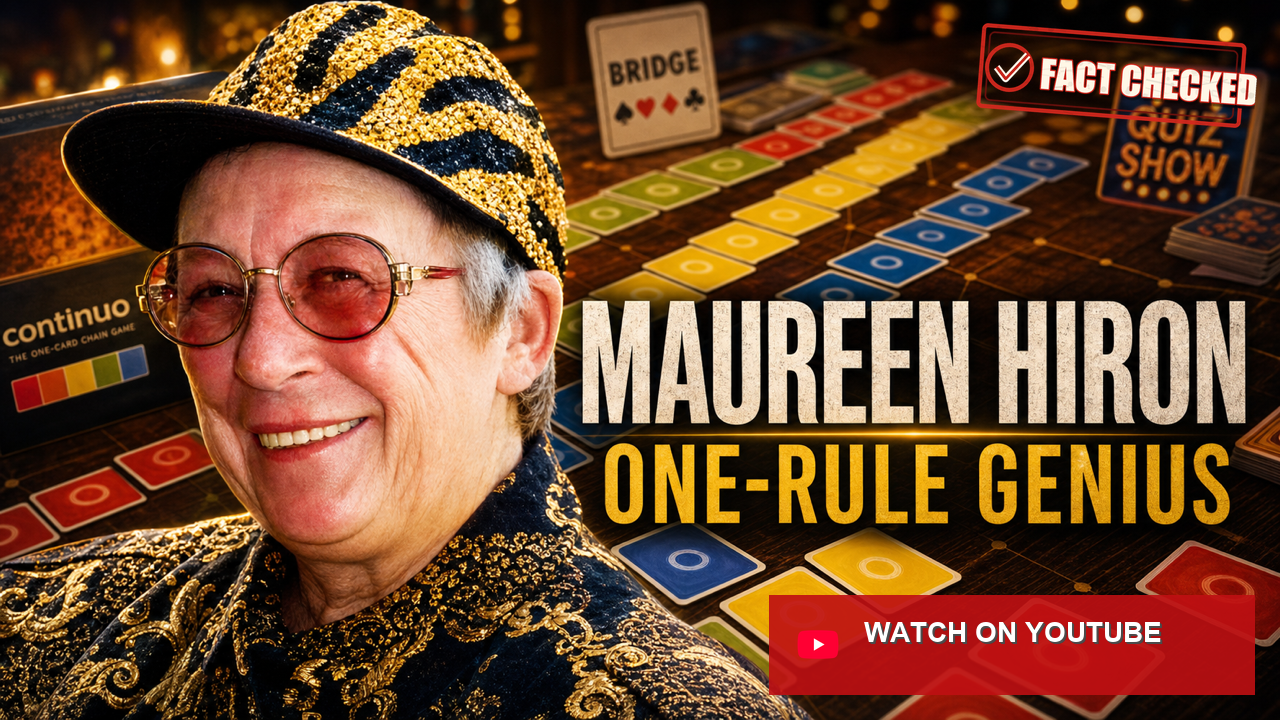
Maureen Hiron said she invented Continuo in about two seconds.
Then she spent the next two hours cutting up cornflake packets, drawing colored squares, and turning the flash into something people could actually play.
That was the method in miniature. The idea arrived fast. The craft came next. Continuo looked almost too simple to matter: square cards printed with colored blocks, placed so matching colors formed longer and longer chains across the table. The rules could be understood in seconds. Children could play it. Adults could still get caught in the decisions. It worked as a family game, an abstract strategy game, and a solo patience puzzle.
No lore. No long setup. No pile of exceptions.
Just color, placement, and the little sting of seeing a better move after your hand has already left the card.
Continuo went on sale in Britain on September 1, 1982. Within six weeks, Hiron later recalled, it was the country’s bestselling game. By Christmas it had sold 205,000 sets in the United Kingdom. Over time, Continuo and its related versions passed six million sets across more than fifty countries.
Most designers spend a career trying to make one game that travels that far.
For Hiron, it was the beginning.
The Teacher Who Had To Start Again
Before game design, Hiron was a games mistress in the older British sense of the phrase: head of physical education at an Inner London comprehensive school. She had been a serious games player since childhood, especially at cards, and she became an international bridge player who represented England and Britain.
Then part of the school fell on her head.
The story sounds too blunt to be real, but Hiron told it herself. At thirty-two, after a serious head injury, she was pensioned off from teaching. The life she had trained for closed early.
Bridge gave her one way forward. Not because bridge is relaxing. It is not. Bridge is a ruthless little machine for memory, inference, partnership, probability, and nerve. Hiron had spent years inside that machine. She understood the strange power of games that have simple procedures and impossible depth.
That matters because Continuo is often described as a one-rule game, which can make it sound like a novelty. It is not. It is a bridge player’s understanding of elegance moved into a visual abstract. The rule is simple enough to explain to a child. The table state keeps changing. Every placement leaves traces. You are never just asking, "Where can this fit?" You are asking what the next person might do with the shape you leave behind.
That is Hiron’s design instinct in its cleanest form.
Make the entrance wide.
Make the room deeper than it looks.
Continuo
Continuo’s brilliance is not that it has colored squares. Many games have colors. The brilliance is how little friction sits between seeing the possibility and making the move.
Each card is a small grid. The player places it against cards already on the table. Matching colors extend chains. Longer chains are better. The board grows in odd directions, shaped by everyone who has touched it. A new player can understand the action before the kettle boils, but the decisions are not empty. Placement creates opportunity. It also creates danger. A generous opening for yourself may become a gift for someone else.
The game is language-independent in the most literal sense. It does not need text on the cards. It does not need cultural references. It does not need a player to know the habits of modern hobby games. That helped it travel, but travel alone does not explain the durability. Plenty of simple games vanish.
Continuo stayed because the object and the action fit each other. The components tell you what to do. The table teaches the rule again every turn. The visual feedback is immediate. The game does not ask players to admire its cleverness. It just gives them a small decision, then another, then another.
Hiron and her husband Alan formed Hiron Games Ltd. to manufacture and market the game. Alan, a world-class bridge player and later bridge correspondent for The Independent, became her tester, editor, and steady opposite. Maureen was fast, restless, volcanic. Alan was calmer. Their partnership gave her ideas a practical counterweight.
It also gave her a company at a moment when British game making was still strongly shaped by mass-market instincts. This was not the later hobby-game world of thick rulebooks, convention demos, and online crowdfunding. A game had to sit on a shelf, explain itself quickly, and survive a family table. Hiron understood that world from the inside.
Sixty Ways To Be Simple
Continuo was not a one-game accident.
Hiron went on to publish more than sixty games, and by her own later telling more than seventy. The catalog sprawls across abstract games, card games, dice games, word games, memory games, quiz games, and party games. Some were published under different names in different countries. Some became small international fixtures. Some are now remembered mostly by collectors and family-game specialists. That is what prolific design looks like when it is real: not every title becomes the monument, but the habit keeps producing playable things.
7 Ate 9 turned a playground joke into a speed arithmetic game. The title is the joke: Why is 6 afraid of 7? Because 7 ate 9. The mechanism is quick and clean. Players throw cards by adding or subtracting from the current number. It makes arithmetic physical, noisy, and competitive without making it feel like schoolwork.
Grabolo works in another register: memory, speed, and recognition. Players search for color-number matches, grab the right card, and then have to remember who took what when later rolls call cards back into question. Again, the premise is not complicated. The play is in the pressure.
Duo, Quadwrangle, Quizwrangle, Cosmic Cows, Qwitch, Tripolo, Brainwaves: The Wise Whale, and many others show the same recurring interest. Find the hook. Strip the rules until the hook is visible. Let the players supply the energy.
That approach is easy to underrate because it does not look like heavy engineering. Hiron was not building simulation engines. She was not asking players to inhabit a world for a hundred sessions. She was designing short, bright games that had to survive the unforgiving test of ordinary people opening a box and deciding, quickly, whether they wanted to keep playing.
That is a serious test.
The Other Tables
Hiron’s life around games was not limited to published boxes.
She and Alan wrote quiz books, including The Ultimate Trivia Quiz Game Book, which she said reached No. 2 on the British bestseller list. She worked on television quiz programs, including Fifteen to One and The Krypton Factor. She wrote bridge columns after Alan’s death in 1999, taking over his role at The Independent and later writing for the Irish Independent as well.
Even illness became a design table. After being diagnosed with cancer in the 1980s, Hiron developed Chip In while an in-patient at the Royal Marsden Hospital, using fellow patients as playtesters. The game was used to support the hospital’s appeal under Princess Diana’s presidency. Hiron later told the story of involving the Daily Star, Prime Minister Margaret Thatcher, and a campaign far larger than the game itself.
There is a temptation to turn all this into legend and let the facts blur into sparkle. Hiron did some of that herself. She was a natural storyteller, and the stories are big: the falling air conditioner, the BBC documentary, the hospital playtests, the prime minister at the table, the bridge columns, the music with Sheyla Bonnick of Boney M.
But the games do not need the legend to justify them.
The work is clear enough. She kept finding small rules that people could enter quickly. She made family games without treating families as dull. She made children’s games without assuming children wanted thin play. She made quick games for adults who still enjoyed pressure, pattern, memory, and bluff.
The scale of the catalog matters because accessible design is often mistaken for lesser design. Hiron’s career argues the opposite. Accessibility was not a lack of ambition. It was the ambition.
What She Actually Built
Hiron did not create a grand game system. She did not found a school of heavy strategy design. She did not reshape the modern hobby market in the way a designer of a dominant rules framework might.
What she built was a career around radical approachability.
That sounds softer than it is. To make a game easy to enter and still worth returning to, the designer has to know what to remove. Too little structure and the game evaporates. Too much and the audience never arrives. Hiron’s best games live in that narrow space where the table understands the rule before it understands why the rule is interesting.
Continuo is the purest example. One rule. Colored squares. A shifting table. The whole thing can be explained faster than most games can be unwrapped, yet it sold across decades and countries because the decisions are visible, immediate, and just sharp enough.
Her bridge background shows in that discipline. Bridge is full of hidden information, partnership inference, memory, and timing. Hiron did not simply reproduce bridge mechanisms. She carried its respect for compact rules and large consequences into mass-market forms.
Her work also matters because she was a woman building a long professional design career in a business that rarely made room for women as credited inventors. She founded a company, licensed games internationally, worked across formats, and remained visible enough that the Academy of Adventure Gaming Arts and Design inducted her into its Hall of Fame in 2021.
Not every title in a catalog that large will be essential. That is true for any prolific designer. The pattern is what counts. Hiron returned again and again to the same creative challenge: how little can the player learn before the game begins, and how much fun can that small rule carry once the game is moving?
Where To Find Her Legacy
Maureen Hiron died in June 2022 at the age of eighty. Mojo Nation’s notice remembered her as the designer of Grabolo, Continuo, 7 Ate 9, and many others. The Academy of Adventure Gaming Arts and Design lists her among the Hall of Fame class of 2021, alongside Bruno Cathala, Uwe Rosenberg, Carcassonne, and the Pokemon Trading Card Game.
Continuo remains the best doorway into her work. It is the thesis in a box: simple enough for a five-year-old, clean enough to cross languages, sturdy enough to become a modern classic. 7 Ate 9 shows her speed-game instincts. Grabolo shows the memory-and-reflex side. The broader catalog shows a designer who kept moving from format to format without losing her central faith in clarity.
The injury closed one life. She opened another with colored squares.
Then she kept opening doors.
More than sixty games. Four decades of design. One rule, when one rule was enough.
Fact Check Notes
Publication notes
This site is AI-assisted and human-reviewed. We use artificial intelligence to help gather research, organize source material, and draft profile content. Human editors then read, revise, and check each profile before it goes live. Most profiles are built through deep AI research and two separate rounds of fact-checking.
Leave a Reply
You must be logged in to post a comment.