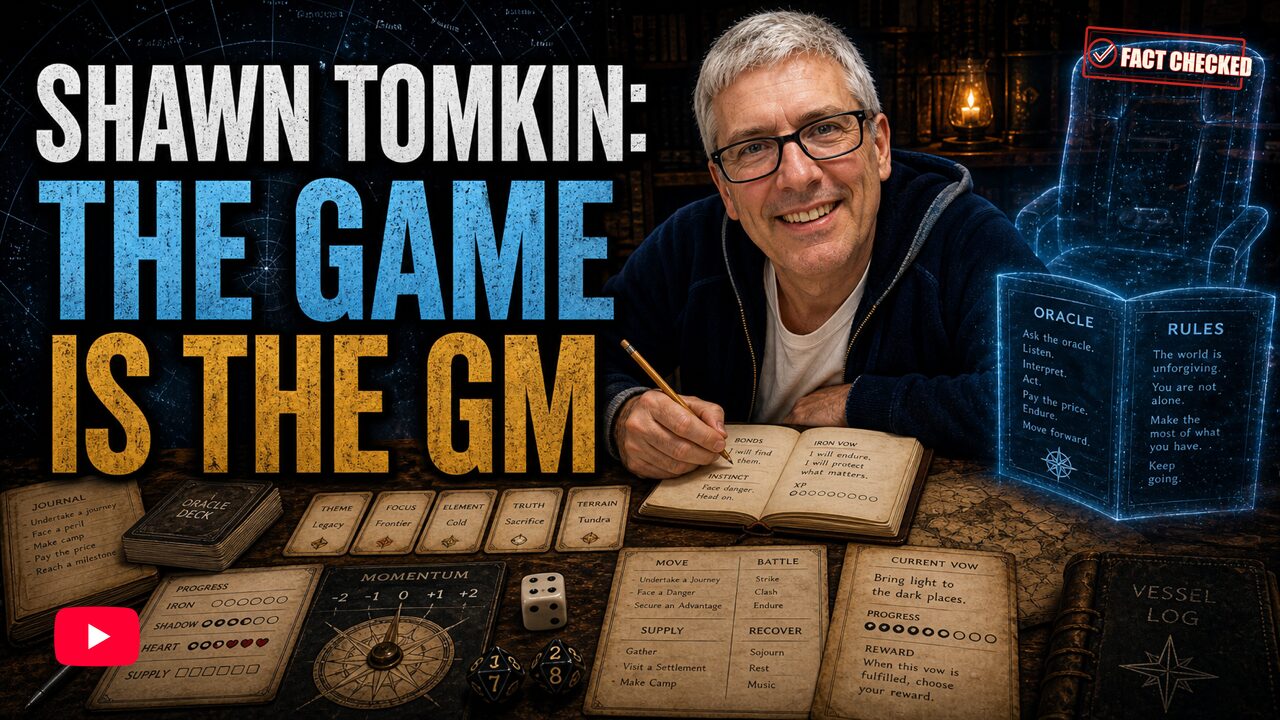
Before Shawn Tomkin published Ironsworn, solo role-playing often felt like a clever workaround.
You could do it. People had been doing it for decades. Tunnels & Trolls had solo modules. Gamebooks turned fantasy adventure into branching passages. Mythic Game Master Emulator gave players a way to ask questions when no human referee was present. Scarlet Heroes made old-school adventuring more practical for one player.
But most solo RPG play still felt assembled from parts.
You took a game written for a group, added an oracle, asked the oracle a question, interpreted the result, went back to the game, and repeated the process. The tool worked. The joint was visible.
Ironsworn, released in 2018 as a free PDF, did something different. It treated solo play as a primary design condition rather than a fallback. The game did not ask a lone player to bolt a separate referee tool onto an existing RPG. It built the referee function into the rules.
The game became the Game Master.
The Solo Engine
Ironsworn is a dark fantasy RPG about vows, dangerous journeys, fragile communities, and characters who survive by committing themselves to hard promises. It can be played with a GM, with a group sharing authority, or alone. The important point is that solo play is not an afterthought.
The whole engine expects the table may contain one person.
The player describes what happens. A move triggers when the fiction demands it. The dice decide whether the outcome is clean, costly, or dangerous. Oracle tables answer the questions a GM would normally answer. Progress tracks measure long-term pressure. Momentum rises and falls, giving the player a rhythm of tension, release, and recovery.
That is the breakthrough.
Tomkin did not invent solo role-playing. He did not invent random tables. He did not invent fiction-first moves. What he built was an integrated loop where those things talked to each other without a second human mind at the table.
The result feels less like pausing a game to consult a tool and more like having the tool inside the game already.
The Dice That Make Trouble
Ironsworn’s core roll is simple enough to explain quickly and strange enough to change the feel of play.
You roll one six-sided Action Die, add the relevant stat and bonuses, then compare that total against two ten-sided Challenge Dice. Beat both challenge dice and you score a strong hit. Beat one and you get a weak hit. Beat neither and you miss.
The weak hit is the heart of the game.
In many RPGs, a middling result can feel like a compromise the GM must invent under pressure. In Ironsworn, that compromise is the system’s steady pulse. You succeed, but something costs you. You arrive, but the journey drains your supply. You make progress, but a danger appears. You get what you want, but the world pushes back.
For solo play, that matters enormously.
A lone player can run out of opposition if the rules hand over too many clean wins. The Action-Challenge system keeps producing friction. Not arbitrary cruelty. Story fuel.
The rare match on the Challenge Dice adds another spark. When both challenge dice show the same number, the result becomes more dramatic. On a miss, that can mean a twist, a complication, or the moment when the world reveals teeth.
Tomkin’s dice do not only answer yes or no.
They ask, "What goes wrong next?"
Vows, Tracks, And Momentum
Ironsworn’s most elegant move may be the progress track.
A vow, a journey, a fight, a bond, or another long-term effort can be represented by boxes. You mark progress through action. When you decide the time has come to resolve the matter, you roll against the track.
That changes pacing.
A human GM often decides when a quest has reached its end. In Ironsworn, the player feels that decision as risk. Do you push to finish early with only a few boxes filled? Do you wait, invest more scenes, and make the resolution safer? Do you keep pressing forward while resources fall apart?
The track becomes a pacing device, a danger meter, and a promise to the fiction.
Momentum does related work. It rises when things go well and falls when things go badly. When the number is high enough, you can burn it to cancel a challenge die and improve a roll. Then momentum resets lower, forcing you to rebuild.
That gives solo play a breathing pattern.
Without a GM, somebody still has to decide when the hero catches a break and when the pressure returns. Momentum mechanizes that rhythm without making it feel automatic. The player earns the break, spends it, and then lives with the trough afterward.
Health, Spirit, and Supply complete the survival loop. A bad journey can cost supplies. Low supplies make recovery desperate. Desperation damages morale. Low morale makes everything feel thinner and more dangerous.
Ironsworn is not only asking whether you win.
It is asking what the vow costs.
From Ironlands To The Stars
Tomkin’s first public version of the engine was generous and rough in the way a one-person project can be.
Ironsworn had a clean grayscale look, an evocative setting, strong procedures, and some obvious pressure points. Certain stats carried more practical weight than others. The tone could feel grim to players expecting heroic momentum. The system’s abstraction delighted some people and frustrated others.
Then the craft sharpened.
The 2020 dungeon-focused expansion showed that the engine could handle discovery and site exploration without a drawn map. Ironsworn: Starforged, released in 2022, was the larger leap: science-fiction exploration, stronger onboarding, better production, expanded oracles, reworked advancement, cleaner structure, and a professional visual identity.
Starforged did not abandon Ironsworn. It clarified it.
The same core ideas were still there: vows, progress, moves, oracles, challenge dice, momentum, and player-authored discovery. But the engine felt more confident, less like a survival experiment and more like a mature framework for long-form solo or co-op play.
Sundered Isles followed in 2024, bringing the engine into seafaring adventure, cursed voyages, fantasy islands, horror, and swashbuckling play. Its Cursed Die is a tiny but revealing piece of design: one added die that lets supernatural trouble rise through play when the table wants that tone.
That is Tomkin’s craft arc in miniature.
Not bigger for the sake of bigger.
Sharper procedures for generating the kind of story the player came to find.
The Publishers Came Calling
The strongest sign of Tomkin’s impact is not only the Ironsworn community. It is that other publishers began hiring him to translate solo play into their own games.
Free League Publishing brought Tomkin, often alongside collaborators, into solo rules and adventures for games such as The One Ring and Dragonbane. Those games do not run on Ironsworn’s dice engine. That matters. It shows that publishers are not only buying a mechanic. They are buying a way of thinking about how an RPG can function when no human referee is available.
The Ironsworn ecosystem also spread through open licensing and community creation. The "built on Ironsworn" label became recognizable among indie and solo RPG players. Hacks, supplements, setting conversions, and fan-made tools appeared because the engine was legible enough to adapt.
John Harper, designer of Blades in the Dark, publicly called Ironsworn "a masterpiece." Actual-play shows, solo RPG channels, reviewers, and online communities helped teach players that solo play could be more than a substitute for a missing group.
It could be the main event.
What He Actually Built
Shawn Tomkin did not invent solo role-playing.
He did not invent oracle tables. He did not invent fiction-first moves. He did not invent progress clocks, meta-currency, or the idea that a player can ask the dice what happens next.
What he built was a complete solo-first architecture.
Ironsworn distributes the GM’s job across moves, oracles, progress tracks, challenge dice, momentum, and player interpretation. Each piece hands the next piece something useful. The dice create friction. The oracle creates surprise. The track creates pacing. Momentum creates release. The player’s vow gives the whole system a reason to move.
That integration is the achievement.
There are limits. The original game can feel punishing. The abstraction can flatten combat for players who want tactical detail. Some players miss the personality of a human GM. Some will always prefer a traditional table where surprise comes from another person rather than a procedure.
Those limits do not erase the design.
They define it.
Tomkin made a game that could sit across from one player and keep answering back.
Where To Find Him
Shawn Tomkin remains active through Tomkin Press and the Ironsworn line.
The official Tomkin Press and Ironsworn sites point players toward Ironsworn, Starforged, Sundered Isles, community licensing, digital editions, print editions, Discord, and newsletter updates. His work continues to move through indie solo play and through publisher-backed solo modes for larger RPG lines.
That is the strange success of the whole project.
Ironsworn began as a free PDF for players willing to sit alone with dice, vows, and a question. It became a design language for solo-first play.
Not a patch.
Not a workaround.
A table for one, built as if one player was enough.
Fact Check Notes
Publication notes
This site is AI-assisted and human-reviewed. We use artificial intelligence to help gather research, organize source material, and draft profile content. Human editors then read, revise, and check each profile before it goes live. Most profiles are built through deep AI research and two separate rounds of fact-checking.
Leave a Reply
You must be logged in to post a comment.