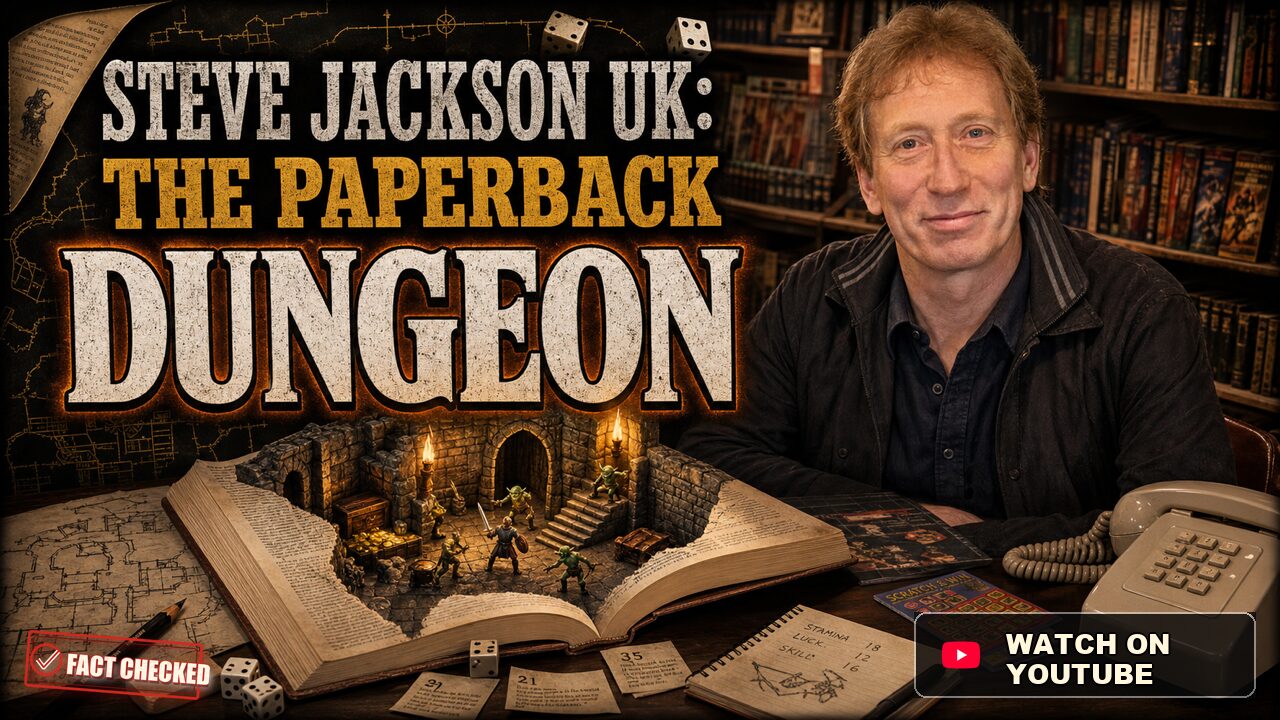
There are two famous tabletop game designers named Steve Jackson.
That fact has created decades of confusion.
The American Steve Jackson, born in 1953, founded Steve Jackson Games and designed GURPS, Car Wars, Ogre, and Munchkin. The British Steve Jackson, born in 1951, co-founded Games Workshop, co-created Fighting Fantasy, and wrote Sorcery!, Creature of Havoc, House of Hell, Appointment with F.E.A.R., and other gamebooks that taught millions of readers how to play alone with a book, pencil, and dice.
The confusion gets worse because the American Steve Jackson also wrote several Fighting Fantasy books. Those are his. The rest of this story belongs to the British Steve Jackson.
That distinction matters because the UK Jackson’s achievement is easy to hide under someone else’s shadow. He did not build GURPS. He did not design Munchkin. He did not create Warhammer Fantasy Battle or Warhammer 40,000. His most important design act was quieter and more radical:
He compressed the dungeon crawl into a paperback.
Before Fighting Fantasy, a role-playing game usually needed a rulebook, a referee, dice, friends, and time. After The Warlock of Firetop Mountain, a child could buy a paperback, borrow two dice from a board game, and discover that reading could also be playing.
That was not a small shift. It was a doorway.
Manna From Heaven
Jackson met Ian Livingstone at Altrincham Grammar School for Boys in the late 1960s. They shared interests in science fiction, comics, games, and the kind of argument that only Diplomacy can teach. At Keele University, Jackson is often credited with founding an early UK board games club, and by the mid-1970s he was writing about games professionally.
Then Dungeons & Dragons arrived.
The route was almost accidental. Jackson, Livingstone, and John Peake published Owl and Weasel, a small games newsletter. A copy reached TSR’s Brian Blume, who sent them D&D in return. Jackson later described the arrival of that game as manna from heaven. It was exactly the kind of interactive structure he had been waiting for.
In 1975, Jackson, Livingstone, and Peake founded Games Workshop from Livingstone’s flat. At first, the company was not the miniatures empire the world later came to know. It imported American games. It distributed D&D in Britain. It launched White Dwarf. It built Games Day. It made the UK a real home for role-playing culture.
That part of Jackson’s career is infrastructure rather than direct design. It still matters. Games Workshop gave British players access to games that would otherwise have been difficult to find. It made the hobby visible. It created a publishing surface for a national gaming culture.
But the design breakthrough came when Jackson and Livingstone were asked to write an interactive fantasy book.
The Format
The Warlock of Firetop Mountain, published in 1982, did not invent every part of the gamebook.
Branching storybooks already existed. Solo adventures already existed. Tunnels & Trolls had solo scenarios. Choose Your Own Adventure had branching narrative. What did not exist in the same mass-market form was the complete package: character creation, stats, combat, branching choice, fantasy adventure, and all of it inside one paperback that needed no separate rulebook.
That was the genius of Fighting Fantasy.
The system was brutally simple. Roll SKILL. Roll STAMINA. Roll LUCK. Fight by comparing attack strengths. Test luck when you dare, knowing the resource will fall each time you use it. Turn to another numbered section. Mark damage. Keep going.
It was not a full tabletop RPG. It was not trying to be. It was the entrance ramp. Jackson and Livingstone stripped the experience down until there was almost no barrier left between ordinary reading and interactive play.
The collaboration was practical. Livingstone wrote the first part of The Warlock of Firetop Mountain. Jackson wrote the second part, then revised the earlier material for consistency. Jackson pushed for the simpler combat approach, while Livingstone helped shape the brand and shared the foundational concept. Puffin editor Philippa Dickinson also mattered in getting the book into the children’s publishing channel where it could reach the audience that made it explode.
The result was not a hobby-store artifact. It was a paperback.
That changed everything.
Fighting Fantasy books could live beside ordinary children’s books. They could be bought by readers who had never heard of role-playing games. They could be played on a bus, in bed, during lunch, or anywhere a reader could hide a pencil. The format did not ask the reader to join a subculture first. It met the reader where they already were.
That is accessibility as architecture.
The Laboratory
Ian Livingstone became the great dungeon-builder of Fighting Fantasy. Steve Jackson became the experimenter.
Jackson rarely used the format the same way twice.
The Citadel of Chaos added magic to the basic Fighting Fantasy frame. Starship Traveller moved the structure into science fiction and asked the reader to manage a ship and crew. House of Hell pushed into horror and added fear as a pressure system. Appointment with F.E.A.R. built a superhero gamebook around powers and identity. Creature of Havoc turned the format against the reader, beginning with a character who cannot understand language and forcing the player to piece together identity through structure, confusion, and hidden logic.
That willingness to mutate the format is Jackson’s signature.
Many gamebooks give the reader a map of choices. Jackson kept asking what the book itself could make the reader feel. If the character was a wizard, could the reader’s own memory become part of spellcasting? If the character was a monster, could the reader experience not knowing what words mean? If the story was horror, could fear become a number that might kill you before the monster did?
The mechanics are often tiny. A new stat. A false code. A hidden reference. A scratch-off panel. A phone input. But the idea underneath is consistent:
Make the player do the thing the character is doing.
Sorcery!
Sorcery! was Jackson’s masterpiece in the format.
Published from 1983 to 1985, the four-book series followed one continuous journey through the dangerous land of Kakhabad. The player carried a character across volumes, made choices that could echo later, and faced a much larger structure than a single paperback dungeon could hold. The final book, The Crown of Kings, reached 800 sections, which the official Fighting Fantasy site still notes as unmatched within the series.
The spell system is the heart of it.
Instead of simply choosing "cast fireball" from a list, the player had to learn three-letter spell codes. ZAP. HOT. FOF. GOB. Some needed special components. Some were traps. Some choices offered false codes that punished sloppy memory. The printed spellbook existed, but the experience was strongest if the reader memorized it and then entered the adventure as if their own mind were the wizard’s mind.
That is a brilliant collapse of distance.
Most RPGs separate player knowledge from character knowledge. Sorcery! made the reader’s memory part of the fiction. If you forgot the code, your wizard forgot. If you remembered under pressure, the character felt powerful because you had done the work.
The later Inkle digital adaptation understood that strength. Jon Ingold described Jackson as a personal game-design hero and wrote about adapting the series into a modern interactive form. Across four digital games, Inkle turned Jackson’s books into a fluid mobile and PC RPG experience, and the work helped feed the development of ink, Inkle’s narrative scripting language.
The paperback dungeon had become software, and the old design still held.
The Structural Cracks
Fighting Fantasy’s core system is famous, elegant, and flawed.
SKILL matters too much. A high-SKILL character can cut through combat with ease. A low-SKILL character can feel doomed before the adventure has truly begun. Because SKILL drives so many tests and fights, the opening roll can shape the whole book more than later choices should.
LUCK is the better piece. It is a diminishing resource. Each use lowers it, so every test asks a real question: spend safety now or preserve possibility for later? That is clean design. The trouble is that high-SKILL characters often need LUCK less, while low-SKILL characters burn it just to survive.
The Fighting Fantasy introductory RPG had similar limits. It was wonderfully approachable, but too thin for long campaign play. Three core stats and a simple resolution structure are enough to teach the idea of role-playing. They are not enough to carry a hundred sessions without help.
But those weaknesses have to be judged against the real purpose.
Fighting Fantasy was not built to replace D&D. It was built to make the first step possible. It turned passive readers into active players. It let children and adults taste dungeon play without organizing a table, buying a box set, or learning a large rules system.
The system did not need to be deep forever. It needed to be deep enough to make someone want more.
The Media Hopper
Jackson kept chasing the same problem through new media.
F.I.S.T., his late-1980s interactive telephone game project, turned choice-driven fantasy into a phone experience. BattleCards used scratch-off technology for combat. He later worked in digital games, co-founding Lionhead Studios with Peter Molyneux, Mark Webley, and Tim Rance, and taking on business and creative roles as the studio produced titles such as Black & White and Fable through its extended creative orbit.
He also moved into education, becoming an Honorary Professor at Brunel University and helping build academic pathways for game design. In 2022, he returned to Fighting Fantasy with Secrets of Salamonis, released for the series’ 40th anniversary, while he and Livingstone also revisited early Games Workshop history through Dice Men.
The pattern is plain. Jackson was not loyal to paper alone. He was loyal to accessible interactive fantasy.
Paperback. Telephone. Scratch card. Mobile app. University program. The delivery system changed. The ambition stayed steady.
What He Actually Built
Steve Jackson UK did not design Warhammer. He did not design the American Steve Jackson’s games. He did not create every Fighting Fantasy book that carried the Jackson and Livingstone brand line. He did not build the deepest RPG system of the 1980s.
What he built was the paperback dungeon.
He helped create a format that put role-playing procedures into ordinary bookshops. He made solo fantasy adventure cheap, portable, and immediate. Then he used that format as a laboratory: magic, horror, science fiction, superheroes, hidden identity, memory-based spellcasting, and long-form linked campaigns.
His best mechanics are not impressive because they are mathematically complex. They are impressive because they disappear into the reader’s hands. The reader rolls. The reader chooses. The reader maps. The reader remembers the spell. The reader becomes the wizard, the survivor, the monster, the hero.
That is the real architecture.
Jackson evaporated the distance between reader and player.
Where To Find Him
Steve Jackson is still part of the Fighting Fantasy story. The official Fighting Fantasy site lists Secrets of Salamonis among the 40th anniversary titles and notes that it was Jackson’s first new Fighting Fantasy title in decades. The same site keeps Sorcery! visible through its book pages, print history, app adaptations, and role-playing offshoots.
The Inkle Sorcery! adaptations remain one of the clearest modern ways to see why Jackson’s design still works. They are not museum pieces. They are living translations of a paperback structure into digital play.
The name confusion will probably never fully go away. There will always be another Steve Jackson in the search results.
But the UK Steve Jackson’s legacy is not hard to find. It is in every reader who opened a paperback and realized the page was not just telling a story.
It was waiting for a move.
Fact Check Notes
Publication notes
This site is AI-assisted and human-reviewed. We use artificial intelligence to help gather research, organize source material, and draft profile content. Human editors then read, revise, and check each profile before it goes live. Most profiles are built through deep AI research and two separate rounds of fact-checking.
Leave a Reply
You must be logged in to post a comment.