Mailing lists. Fanzines. Envelopes. Postal games moving one turn at a time through the Royal Mail. Players who knew one another by handwriting before they ever shared a table.
Don Turnbull lived at the center of that network.
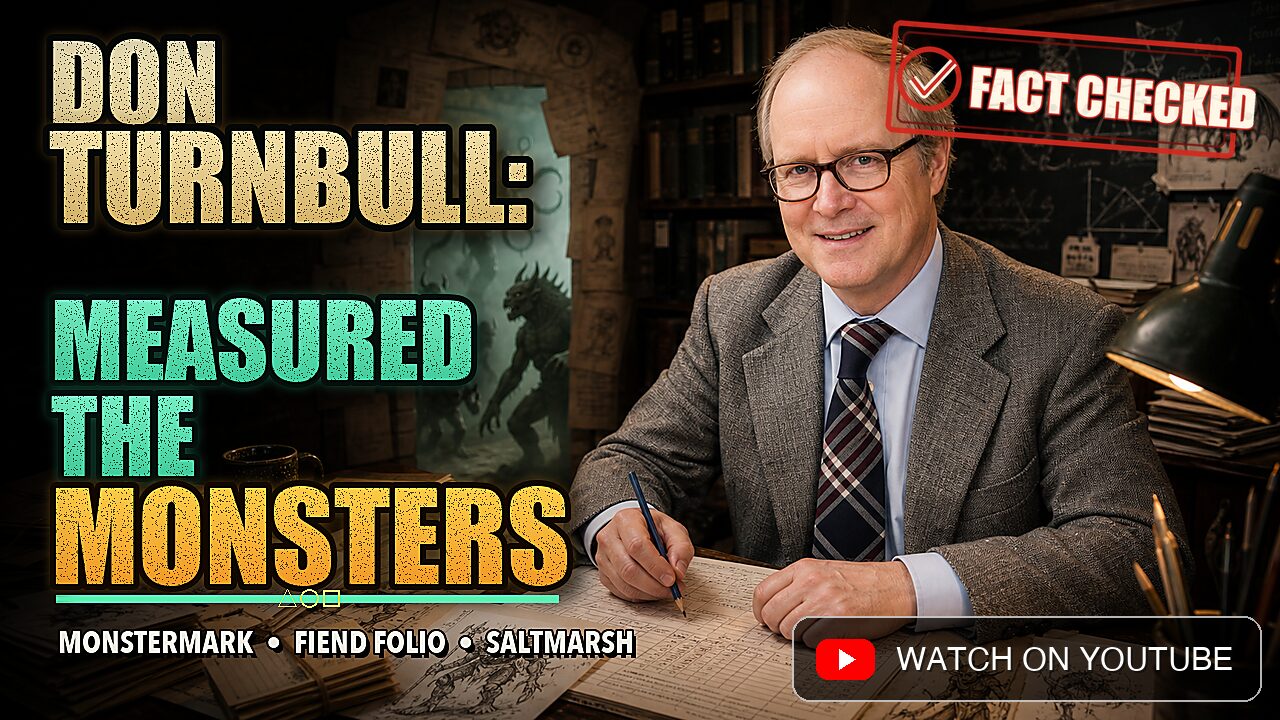
He was a mathematics teacher, a postal Diplomacy organizer, a fanzine editor, a rules thinker, and eventually the man Gary Gygax trusted to run TSR UK. His work is hard to measure if the only question is who invented which mechanic. Turnbull’s gift was often stranger than invention. He identified the useful thing in other people’s chaos and gave it a door into the hobby.
That is why his legacy keeps appearing in places where his name is not the first one spoken.
Games Workshop’s first audience. White Dwarf’s early monster culture. The Fiend Folio. Saltmarsh. TSR UK’s Cambridge office. A generation of British adventure design.
Turnbull did not create all of it.
He made much of it possible.
The Subscriber List
Turnbull launched Albion in 1969, when postal gaming was still one of the major ways serious hobbyists found each other.
That sounds quaint now. It was not quaint then. A fanzine editor in that world was not just publishing opinions. He was managing a network. He was tracking players, adjudicating turns, sharing variants, introducing people, and keeping the conversation alive between issues.
Albion ran for years and gave Turnbull a position in the British games community before role-playing games arrived in force.
When Ian Livingstone and Steve Jackson began their own early publishing effort, Owl and Weasel, Turnbull’s subscriber list helped give them an audience. Those early readers became part of the foundation under Games Workshop.
It is a small detail with large consequences.
The British hobby did not begin as a storefront. It began as a mesh of enthusiasts, and Turnbull was one of the people holding the mesh together.
The Monstermark
Turnbull’s most original design idea was also the one that reveals his mind most clearly.
In the first issues of White Dwarf in 1977, he published the Monstermark system, an attempt to calculate how dangerous a Dungeons & Dragons monster actually was.
The problem was real. Early D&D had monsters, hit dice, dungeon levels, treasure, and referee judgment, but no clean way to compare threats across wildly different abilities. A creature that paralyzed, drained levels, struck many times, or resisted ordinary attacks could be far more dangerous than its simple numbers suggested.
Turnbull asked a mathematical question:
Can fantasy danger be measured?
His answer was a formula. Estimate how long a monster lasts against a standard attacker. Multiply by how often it hits. Multiply by average damage. Add weight for special abilities. Produce a number that expresses the creature’s malignity.
There is something beautiful about the attempt.
It is also imperfect. The Monstermark depended heavily on judgment calls, especially around special abilities and aggression. The algebra looked precise, but some of the inputs remained subjective. That meant a carefully calculated result could still produce an answer that felt wrong at the table.
But the important part was not that Turnbull solved encounter balance forever.
The important part was that he asked the question in public.
Decades later, D&D would have Challenge Ratings, encounter budgets, monster math, and endless arguments about whether any of them actually work. Turnbull was already standing in that doorway in 1977, chalk in hand, trying to quantify wonder without killing it.
Fiend Factory
Starting in White Dwarf, Turnbull edited the Fiend Factory column.
The idea was simple: readers sent in monsters, and Turnbull selected, standardized, and published the ones worth sharing. That sounds like a magazine feature. It became something larger.
Fiend Factory turned the audience into a design pool.
Teenagers, hobbyists, writers, and home referees mailed in creatures from their own campaigns. Some were strange. Some were rough. Some were brilliant. Turnbull’s job was not to invent them all. His job was to notice which ones had life.
That is a creative act, even if it is not the same as authorship.
One of those contributors was Charles Stross, then a young gamer long before he became a major science fiction writer. His Githyanki would become one of the defining creations associated with the Fiend Folio. Other reader submissions entered D&D’s bloodstream in different ways: the Githzerai, Slaad, Death Knight, Flumph, and many more.
The range was wild.
That was part of the point.
The Fiend Folio
The Fiend Folio, published in 1981, is Turnbull’s most famous credit.
It is also the credit most likely to be misunderstood.
Turnbull was the editor. The monsters had individual creators. The book is a curated object: a collection of British magazine energy, reader invention, older TSR material, and strange fantasy impulses gathered into official D&D form.
That origin explains both its strengths and its weaknesses.
The Fiend Folio is uneven. Some creatures feel mythic. Some feel like living traps. Some are atmospheric, funny, eerie, or absurd. The same book that gave D&D the Githyanki also gave it entries people still joke about.
But uneven does not mean unimportant.
The Folio changed the texture of D&D. It brought a different current into the official monster canon, less smooth than the Monster Manual and more openly eccentric. It carried the feel of British fanzines into hardcover permanence. Its best creatures kept moving forward through editions, video games, and campaign worlds long after many cleaner designs vanished.
That is editorial impact at a high level.
Turnbull did not create the Githyanki.
He opened the door they walked through.
Saltmarsh
Turnbull’s strongest direct adventure credit is the Saltmarsh trilogy, especially U1: The Sinister Secret of Saltmarsh and U2: Danger at Dunwater, credited to Dave J. Browne with Don Turnbull. U3: The Final Enemy gives Turnbull development credit.
Those distinctions matter.
Browne was the primary authorial force. Turnbull was not the lone designer of Saltmarsh. But his involvement belongs to a larger pattern in TSR UK design: adventures that cared about investigation, situation, and player decision more than simple room-to-room slaughter.
The Sinister Secret of Saltmarsh begins like a ghost story and turns into a smuggling mystery. The haunted house is not really haunted. The players have to investigate, infer, and discover the human crime under the supernatural rumor.
That was fresh.
The Final Enemy asks for reconnaissance inside a sahuagin fortress, which means the obvious solution, charging in and fighting everything, is the wrong one. The adventure rewards observation, mapping, stealth, and judgment.
When Wizards of the Coast returned to Saltmarsh decades later, it was not because the original modules were just nostalgic artifacts. It was because the structure still worked.
The Cambridge Office
In 1980, Turnbull became managing director of TSR UK.
This may be his most important role, and again it is not cleanly visible as a design credit.
TSR UK produced a run of adventures with a distinct voice. The UK modules often avoided the most obvious dungeon clichés. They valued situation, atmosphere, and problem solving. They were not all written by Turnbull. The key names include Graeme Morris, Jim Bambra, Phil Gallagher, and others.
Turnbull’s achievement was managerial and editorial.
He hired good people. He gave them space. He maintained standards. He helped build an office where British RPG design could develop its own flavor inside the larger TSR machine.
B10: Night’s Dark Terror is often remembered as one of that tradition’s strongest adventures. Turnbull did not design it. But it came from the environment he helped create.
That matters.
The Cambridge office was not merely a branch office. It was a design culture.
Imagine magazine extended that culture in print. It lasted only a few years, but it gave British gaming another professional forum and published early work by writers who would matter far beyond gaming.
Turnbull’s career keeps returning to the same shape.
He did not always write the thing.
He created the conditions where the thing could appear.
What He Actually Built
Don Turnbull built channels.
His direct design work is real but limited. The Monstermark was original, ambitious, and flawed. Saltmarsh matters, but the credits make clear that Dave Browne was central. The Fiend Folio matters enormously, but it is a work of selection and editing more than personal monster design. TSR UK’s best adventures were largely designed by other people.
That is the honest boundary.
Turnbull was not the single author of British D&D.
He was one of its essential editors, organizers, and door-builders.
He helped a scattered postal hobby become an audience. He tried to bring mathematics to monster danger before the game had a mature vocabulary for balance. He turned reader submissions into official canon. He helped shape the office that produced some of TSR’s strongest adventure work.
His genius was not simply invention.
It was recognition.
Where He Remains
Don Turnbull died in 2003, but his fingerprints remain all over the game.
Find him in every argument about encounter balance, where a referee wants danger to be more than a guess.
Find him in the Fiend Folio monsters that still walk through D&D’s official worlds.
Find him in Saltmarsh, where investigation and infiltration proved that an adventure could be more than a fight map.
Find him in the British RPG tradition that passed through White Dwarf, TSR UK, Imagine, and on into later design cultures.
Most of all, find him in the act of selection.
A thousand ideas arrive in the mail.
Someone has to know which ones belong in the book.
Fact Check Notes
Publication notes
This site is AI-assisted and human-reviewed. We use artificial intelligence to help gather research, organize source material, and draft profile content. Human editors then read, revise, and check each profile before it goes live. Most profiles are built through deep AI research and two separate rounds of fact-checking.
Leave a Reply
You must be logged in to post a comment.