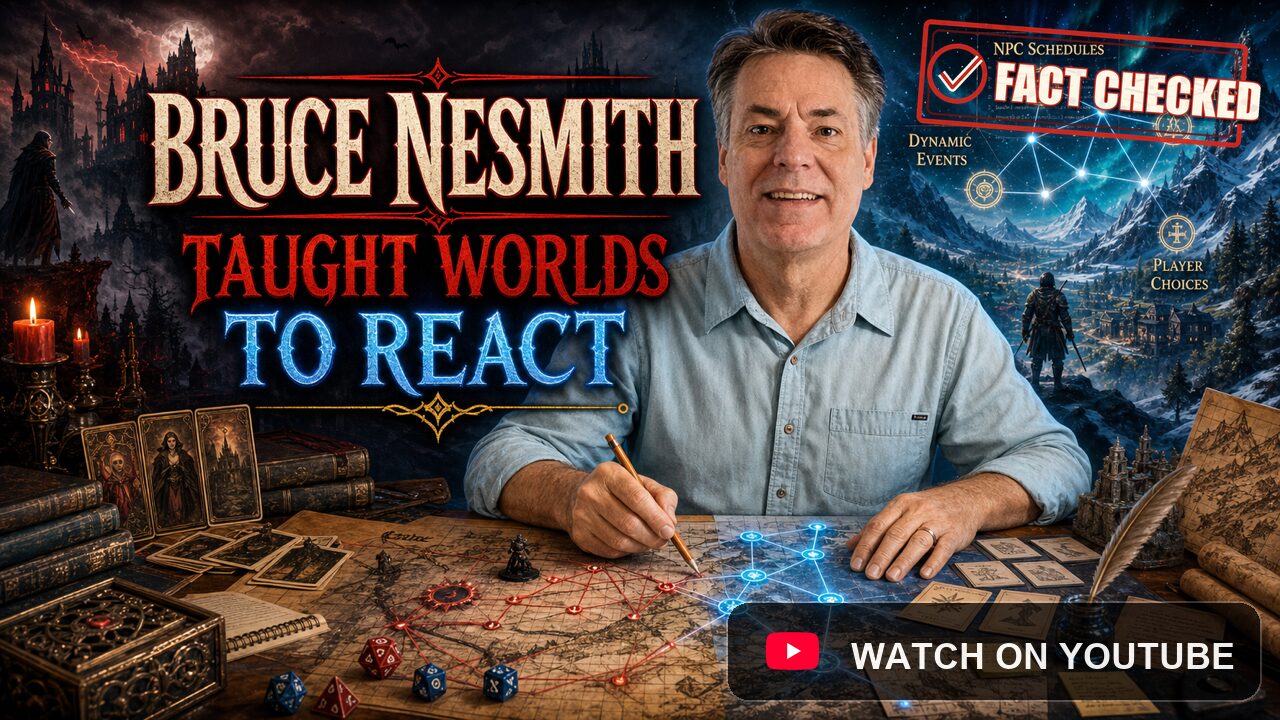
Bruce Nesmith kept returning to the same problem, even when the props changed.
How do you make a game answer the player in a way that feels like a world, not a trap?
In tabletop, that meant horror rules that did more than decorate Dungeons & Dragons with fog and castles. It meant teaching tools that helped new players understand role-playing before they were buried under rulebooks. In video games, it meant NPC schedules, quest conditions, skill growth through use, and open worlds that tried to respond without turning the player into a debugger.
The throughline is not that he made one famous thing.
It is the kind of respect his work keeps showing the player.
If you ask someone to live inside your world for hours, the world has to notice them. It has to react enough to feel awake. But it can’t overreact. It can’t punish curiosity. It can’t make the player afraid to touch anything because the simulation will explode into consequences that feel petty or arbitrary.
That tension is where Nesmith lived.
The Programmer At The Table
Nesmith didn’t come into games as only a writer or only a tabletop designer.
He came in through computers.
In interviews, he has described writing early games on a Hewlett-Packard system in high school, back when the “screen” was a printer and the map came out on paper. That origin matters because it explains the career. He was already thinking across the table and the machine. A dungeon wasn’t only a map. It was a system that could present information, hide information, reward choices, and punish assumptions.
In the early 1980s, TSR hired him to work on computer games and he soon moved into tabletop writing and design work as well. Over time, he moved across different TSR roles and eras, including work connected to D&D products in the Ravenloft line.
The Fog Became A System
Ravenloft didn’t begin with Nesmith.
Tracy and Laura Hickman’s original I6 Ravenloft adventure had already shown that D&D could hold Gothic horror if the scenario had enough pressure, personality, and theatrical control. Strahd wasn’t just another villain in another dungeon. He was the emotional center of the place.
Nesmith’s major contribution was helping turn that kind of premise into a campaign architecture.
Ravenloft: Realm of Terror, designed with Andria Hayday, took the mood of Gothic horror and built rules around it. Domains. Darklords. Fear and horror checks. Altered magic. Fortune-telling. Moral pressure. A geography made of punishment, obsession, and story logic.
This wasn’t just a list of features.
It was a decision about how a player should feel at the table. Not “you are in a spooky castle.” More like, “the world has a way of pushing back on your courage and your cruelty.” The setting had teeth, and the teeth were in the system.
The On-Ramp Mattered
Nesmith’s tabletop work wasn’t only about mood. It was also about entry.
DragonStrike is easy to mock from a distance because of its training video. That misses the design problem it was trying to solve. TSR needed a way to show people what role-playing was. Not define it. Show it. A board game with a Dragon Master, simplified combat, and a tutorial video was a blunt instrument, but it aimed at a real barrier.
People who already knew how role-playing worked did not need DragonStrike.
The people who did not know needed something they could watch, touch, and try.
First Quest pushed that idea further. The audio component wasn’t a gimmick in the abstract. It was an attempt to teach tone and pacing when the designer couldn’t sit at the table. The product tried to let newcomers hear what a game sounded like and understand the rhythm through example instead of instruction alone.
Build the framework that helps the player enter.
The False Size Of A World
When Nesmith moved into Bethesda’s orbit, the medium changed, but the problem did not.
Daggerfall was enormous. That was the selling point, and it was also the lesson. Nesmith later described that kind of procedural scale as falsely large. Size can be a lie. A world can be huge and still feel like the same street repeated a thousand times.
If that’s the experience, the player learns the wrong lesson.
They learn the world is indifferent.
That’s why later Bethesda design leaned so hard on behavior. NPC “packages” sound dry, but they’re where a world starts pretending to live. A person eats, sleeps, works, walks, reacts, and occupies time. The player may never see the full machinery, but the world feels less like a diorama.
The machinery can’t become the point.
Nesmith has talked about that boundary directly. A system can be reasonable in the real world and still feel bad in a game. If every dropped object makes half a town rush over, the simulation has become noise.
Skyrim And The Responsive World
Skyrim is Nesmith’s most visible video-game credit.
As lead designer, he helped shape a philosophy that reads like the mature version of his earlier instincts. Get the interface out of the player’s way. Let skills improve through use. Don’t ask players to manage complexity that doesn’t improve the experience. Make the world react enough to feel aware, but not so much that the system exposes itself as a machine.
Radiant Story sits at the center of that.
The idea wasn’t simply “endless procedural quests.” The stronger version is more careful: use data about the player, places, factions, relationships, and prior actions to shape where a quest goes and who can deliver it. If a quest-giver dies, maybe someone else inherits part of the role. If the player hasn’t visited a place, the game can send them there. If the player has built a history, the world can bend content around that history.
If you do it well, the world feels awake.
If you do it badly, the world feels like a vending machine.
Nesmith has been frank about the limit. Push the system too far and the result feels flat. Use it just because it exists and the hand of design disappears in the wrong way. Sometimes the crafted scene is better. Sometimes the writer needs to choose.
The world should react.
It should not abdicate.
What He Actually Built
Bruce Nesmith didn’t invent Gothic horror in D&D.
He didn’t create the original Ravenloft adventure. He didn’t single-handedly create Bethesda’s open-world style. Radiant Story wasn’t his alone, and Bethesda’s major games were built by large teams under Todd Howard and many other leads, designers, programmers, writers, artists, and producers.
What Nesmith built was connective tissue.
He helped turn Ravenloft from a brilliant adventure premise into a campaign structure. He helped make teaching products that tried to show role-playing to people who didn’t yet speak the language. He helped push Bethesda systems toward worlds that schedule, react, assign, and remember, while keeping the player’s attention on the experience instead of the knobs.
His career isn’t a monument to one invention.
It’s a pattern of translation.
Atmosphere became rules. Role-playing became an on-ramp. Procedural size became a cautionary lesson. NPC behavior became world texture. Quest assignment became responsiveness. Character growth became doing the thing instead of accounting for the thing.
That’s why the tabletop and video-game halves belong together.
Both are about making the world answer.
Where To Find Him
Nesmith left Bethesda in 2021. Since then, public interviews and publisher listings show him active as a novelist and as a public commentator on the design lessons behind TSR and Bethesda.
Aethon Books lists his Glory Seeker LitRPG series, including Sins of the Flesh, and describes him as a former senior game designer for Bethesda Game Studios, a creative director for D&D, and lead designer on The Elder Scrolls V: Skyrim. In 2026, long-form interviews and reporting continued to pull him back into public view to talk about TSR, Daggerfall, Skyrim, and what open-world RPGs still get wrong when they confuse “more systems” with “more meaning.”
That is a fitting later chapter.
The designer who spent decades building worlds that respond is now explaining what made those responses work, where they broke, and why the player still matters more than the machinery.
Fact Check Notes
Publication notes
This site is AI-assisted and human-reviewed. We use artificial intelligence to help gather research, organize source material, and draft profile content. Human editors then read, revise, and check each profile before it goes live. Most profiles are built through deep AI research and two separate rounds of fact-checking.
Leave a Reply
You must be logged in to post a comment.