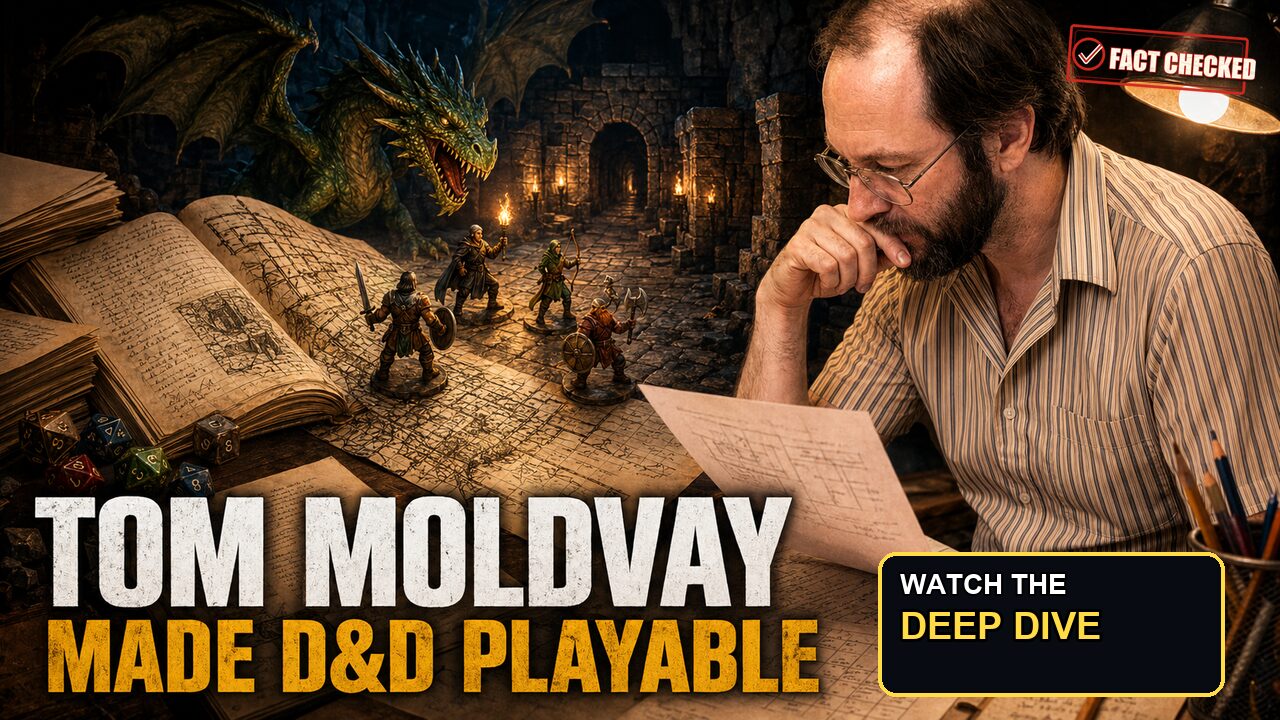
He did something almost as difficult.
He made it readable.
In 1981, TSR published a revised Dungeons & Dragons Basic Set with Moldvay as editor. The book was only sixty-four pages. It covered characters from levels 1 to 3. It came in a box with dice, a crayon, and B2: The Keep on the Borderlands. The cover showed a fighter and a magic-user facing a green dragon, Erol Otus turning the first lesson into a dare.
For a generation of players, that box was not a starter product.
It was D&D.
The achievement was not loud. Moldvay did not announce a new theory of role-playing. He did not bury the reader under designer commentary. He took a game that had already changed everything, then organized it so a twelve-year-old could sit down, roll abilities, choose a class, buy equipment, and walk into a dungeon.
That is harder than it sounds.
The Sixty-Four Page Door
Early D&D was brilliant, strange, alive, and not always easy to learn from the text.
The original game had grown out of miniatures, wargaming, private tables, newsletters, supplements, house rulings, and conversations between people who already understood the assumptions. Advanced Dungeons & Dragons moved toward density and authority. It wanted to cover cases. It wanted to settle arguments. It had the ambition of a reference library.
Basic D&D needed a different job.
It had to teach.
Moldvay’s Basic rulebook starts where a new player starts. What is this game? What do the players do? What is a Dungeon Master? How do you make a character? What does Strength mean? What happens when the door opens and something is waiting on the other side?
The book does not ask the reader to understand the whole machine before touching it. It creates a path.
Page by page, the reader moves from character creation into spells, equipment, time, movement, encounters, combat, monsters, treasure, and dungeon mastering. Examples appear where the reader needs them. Procedures sit close to the moment of use. The famous sample adventure in the back is not just extra content. It is the final lesson.
By the time the reader reaches it, the book has already taught the rhythm.
Roll. Choose. Map. Listen. Risk. Decide.
Then the dungeon opens.
Basic Without Being Simple
The great trick of Moldvay Basic is that it feels approachable without feeling thin.
Characters are clear. Fighters fight. Magic-users begin fragile and strange. Clerics bring faith and utility. Thieves are risky, useful, and never as safe as they want to be. Dwarves, elves, and halflings are not merely ancestry choices. In the Basic rules, they are classes, which gives the game a hard, old-world shape.
That structure is not modern.
It is legible.
A new player can understand the choice quickly. A new Dungeon Master can hold the system in mind. The rules create enough constraint to make play meaningful without requiring the reader to master a thick stack of books before the first session.
Moldvay’s gift was compression.
Not compression as cutting away the game. Compression as arranging the pieces so the reader can carry them. Dungeon turns, wandering monsters, reaction rolls, morale, treasure, light, doors, traps, retainers, mapping, and the economy of risk all survive inside the book. The old game is still there. It has just been given a clearer doorway.
That is why people still talk about B/X with a kind of reverence.
The rules do not merely describe play. They teach a style of play.
The Expert Handoff
Moldvay Basic was only half of the 1981 structure.
David Cook’s Expert Set took the game beyond level 3 and opened the wilderness. Together, the Basic and Expert books became B/X, one of the cleanest and most durable forms of classic D&D.
That split matters.
Basic did not have to be everything. It had to be the first room. Expert could be the road beyond it. This let the beginner book stay focused. Moldvay did not need to explain the whole long campaign at once. He needed to make the first dungeon playable, then hand the reader forward.
That organizational decision became part of the game’s memory.
Players remember the red and blue boxes. They remember the first levels as a complete experience, not as a tutorial you were supposed to outgrow immediately. They remember a rules set where death was possible, treasure mattered, the dungeon had procedures, and the referee had enough structure to improvise without floating away.
B/X became more than a product code.
It became a language.
Castle Amber And The Weird Room
Moldvay’s rules writing gets most of the attention, but his adventure work shows the same instinct from a different angle.
X2: Castle Amber is not a normal haunted house.
It pulls from Clark Ashton Smith, French weird fiction, family decay, dream logic, and the kind of fantasy where the wallpaper might be more dangerous than the monster. The adventure does not reward players only for fighting well. It rewards curiosity, caution, appetite, and the willingness to touch the strange thing just to see what happens.
That is Moldvay again.
The rules writer made complexity approachable. The adventure writer made weirdness playable.
Castle Amber gives the Dungeon Master a house full of situations. Rooms are not just containers for balanced fights. They are invitations to investigate. The adventure trusts the table to wander, poke, retreat, laugh, panic, and discover that not every danger announces itself in ordinary language.
It is not clean in the modern adventure-design sense.
That is part of its power.
It feels like a place where someone opened a door that should have stayed locked.
The Lost City Below The Sand
B4: The Lost City begins with a simple pulp image: a desert, a buried pyramid, lost travelers, and a structure rising out of the sand.
Then it keeps going down.
Inside the pyramid are factions, cults, secrets, masks, and the remnants of a civilization that has not died cleanly. The module gives enough for immediate play, then asks the Dungeon Master to expand the lower levels and make the place larger.
That design choice can look incomplete if you expect an adventure to do all the work.
For a Basic D&D table, it is a teaching tool.
The Lost City shows a new Dungeon Master how a dungeon can become a campaign. Not just rooms. Not just monsters. A society underground, broken into groups with motives. A place with history pressing against the present. A map that invites completion.
Moldvay understood that beginner-friendly did not mean imagination-proof.
He gave the Dungeon Master a strong skeleton, then left room for the table to grow flesh on it.
The Island Beyond The Dungeon
X1: The Isle of Dread, co-designed with David Cook, did for wilderness exploration what Basic did for the first dungeon.
It gave players a larger map.
The island had coasts, ruins, dinosaurs, villages, hidden dangers, and the promise that the world did not end at the dungeon door. It showed how a campaign could move from corridors to hexes, from torchlight to weather, from one enclosed problem to a whole territory that needed charting.
Because The Isle of Dread was included with the Expert Set, it reached an enormous number of tables.
That matters. Influence is not only invention. Sometimes influence is being the example everyone has in front of them when they ask, "What do we do next?"
For many players, the answer was simple.
You leave the dungeon.
You find the island.
You start mapping.
The Game Too Big For Its Box
After TSR, Moldvay kept designing.
Lords of Creation, published by Avalon Hill in 1983, was his original role-playing system. It tried to cover almost everything: fantasy, science fiction, mythology, superheroes, time travel, alternate worlds, and the whole wild pile of genre possibility.
It was ambitious.
It was also too broad to become the next D&D.
That does not make it unimportant in his career. Lords of Creation shows that Moldvay’s imagination was not limited to editing someone else’s game. He wanted bigger structures. He wanted doors between genres. He wanted a role-playing system with enough reach to let a campaign leap from one kind of story to another.
The fact that it did not become a lasting industry platform is part of the honest assessment.
Moldvay’s most durable contribution was not his most original system.
It was his clearest book.
What He Actually Built
Tom Moldvay did not create Dungeons & Dragons.
He did not build the whole Basic line alone. David Cook’s Expert Set is essential to B/X, and the game itself rests on the work of Gary Gygax, Dave Arneson, Eric Holmes, and many early players and designers.
What Moldvay built was the gateway.
He took a revolutionary game and gave it a beginner’s architecture that respected the beginner. He did not talk down to new players. He did not remove the danger, the procedures, the oddness, or the old game texture. He organized it so the first-time reader could actually use it.
That is why his name stayed attached to the book.
People do not say "the 1981 second revision of the Basic Set" when they are talking from the heart. They say Moldvay Basic.
That is a rare kind of authorship.
Not ownership of the whole game. Ownership of the doorway.
The Sixty-Four Page Legacy
Tom Moldvay died on March 9, 2007, at the age of 58.
His career should have been longer.
The work remains loud anyway.
Old-School Essentials, Labyrinth Lord, Basic Fantasy, and the larger Old School Renaissance all carry some part of the B/X inheritance forward. Some do it directly. Some do it through procedure, tone, risk, dungeon logic, and the belief that rules should be clear enough to use at the table without draining the mystery out of the room.
Moldvay Basic is still in print in spirit because it solved a problem every role-playing game still faces.
How do you teach someone to imagine procedurally?
How do you explain a game with no board, no fixed ending, no single script, and no guarantee the character survives the night?
How do you make the complex feel simple without making it simplistic?
Moldvay answered in sixty-four pages.
Roll your abilities. Choose your class. Buy your equipment. Listen at the door. Check for traps. Keep track of the torch. Enter the room.
By the time you reach the dungeon in the back, you already know what to do.
That clarity was not accidental.
It was design.
Fact Check Notes
Publication notes
This site is AI-assisted and human-reviewed. We use artificial intelligence to help gather research, organize source material, and draft profile content. Human editors then read, revise, and check each profile before it goes live. Most profiles are built through deep AI research and two separate rounds of fact-checking.
Leave a Reply
You must be logged in to post a comment.