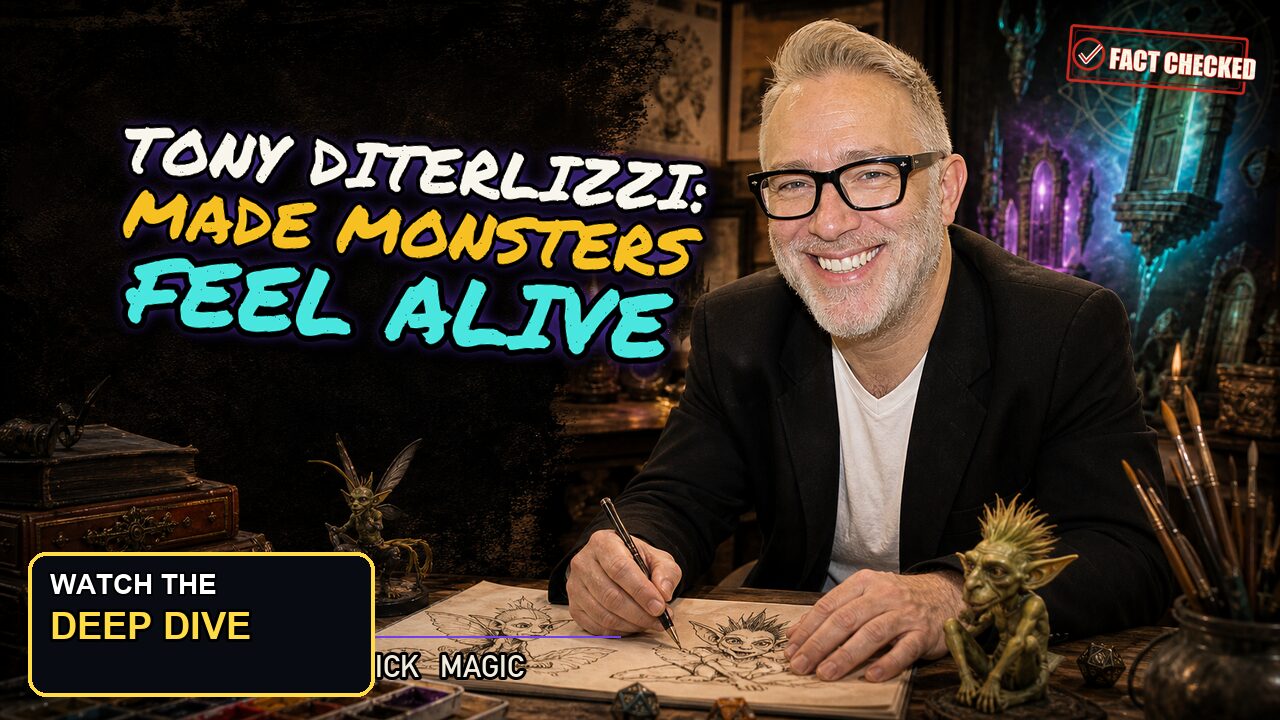
He made monsters look like they had lives.
Not just hit points. Not just armor class. Not just a claw attack, a bite attack, and a paragraph of lore waiting for the Dungeon Master to read out loud.
Lives.
His goblins had posture. His sprites had fashion. His modrons had tragic little mechanical souls. His tieflings looked like people from a city you might actually get lost in. Even the ugly creatures carried a kind of private dignity.
That was the change.
DiTerlizzi did not make tabletop fantasy safer. He made it more curious. He pulled Dungeons & Dragons away from pure monster catalog and toward bestiary, field guide, fairy tale, street portrait, and weird travel diary.
The creatures stopped waiting to be killed.
They started looking back.
The Sketchbook That Opened The Door
DiTerlizzi came into the industry the way a fantasy artist should: with a handmade object.
After art school, he was trying to break into illustration and sent work to TSR. The early responses were not magical. Rejection is part of the route. But he kept drawing D&D creatures and characters, not as sterile portfolio samples, but as artifacts from play.
He gathered the sketches into a distressed horizontal sketchbook made to feel like a little grimoire. It looked handled, imagined, and used.
That mattered.
Tim Beach saw it. Peggy Cooper saw it. The sketchbook led to work on Dragon Mountain, then to the assignment that changed DiTerlizzi’s life: the 1993 Monstrous Manual.
He was young, fast, and still close enough to the table to remember what monsters felt like before they became assignments.
The schedule was brutal. The materials were practical: bond paper, markers, ballpoint, pastel pencils, rubbing alcohol, whatever could get the image done on deadline. But the limitations gave the work part of its character. The images were not slick oil paintings. They were small, strange, immediate, full of line, shape, personality, and motion.
The book needed monsters.
DiTerlizzi gave it inhabitants.
The Monstrous Manual
The Monstrous Manual could have been a warehouse.
Hundreds of creatures. Endless reference. A useful book, certainly, but also the kind of project where art can become mere inventory.
DiTerlizzi fought that without making a speech about it.
He simply drew the monsters as if they mattered.
His bugbears, kobolds, goblins, sprites, medusae, trolls, golems, and faerie folk were not all beautiful. They were not all noble. Some were funny. Some were grotesque. Some were unsettling. But they carried physical logic and personality.
He used old engraving collections, costume references, animal anatomy, animation influences, fairy-tale illustrators, and memory from actual D&D play. He had absorbed Brian Froud, Alan Lee, Arthur Rackham, Dr. Seuss, Edward Gorey, Norman Rockwell, Jim Henson, and the weird emotional grammar of childhood fantasy.
That mixture made his creatures feel specific.
A DiTerlizzi monster often looks like it had a life before the player opened the door. It wears something. It holds something. It stands in a way that tells you how it thinks. Even when the anatomy is impossible, the attitude is readable.
That changed the emotional temperature of the book.
The player could still fight the creature.
But first, the player had to notice it.
Planescape
Then came Planescape.
This is where DiTerlizzi’s style found the world that needed it most.
Planescape was not ordinary D&D geography. It was a multiverse of belief, argument, doors, factions, impossible cities, and philosophical weather. Its center was Sigil, the City of Doors, a place where demons, angels, modrons, tieflings, merchants, liars, scholars, and cutters could all pass each other in the street.
That setting could not look like standard heroic fantasy.
DiTerlizzi understood that.
His Planescape art was wispy, rusted, organic, urban, and strange. The people looked angular and lived-in. The clothing felt scavenged from another reality. The buildings seemed to grow, sag, twist, and remember. The linework had delicacy, but the world had dirt under its nails.
That visual language made Planescape legible.
The setting’s ideas were enormous: rings, threes, alignment planes, belief shaping reality, philosophy as commerce. DiTerlizzi brought the camera down to street level. He gave the multiverse faces, silhouettes, boots, horns, sleeves, teeth, tools, and nervous little gestures.
He made the infinite personal.
The modrons are the perfect example. On paper, geometric beings of law could have remained a joke. DiTerlizzi leaned into their oddness and gave them fairy-tale machinery, part Oz, part clockwork bureaucracy, part tragic little puzzle. Suddenly they were not just silly shapes. They were citizens of Mechanus.
His tieflings did similar work. They were not just "people with fiend blood." They became city creatures: sharp, stylish, suspicious, wounded, cocky, and memorable. Their later popularity owes a lot to the fact that Planescape made them feel like more than a rules option.
The books themselves followed the art. Text wrapped strangely. Layouts broke away from boxy convention. Illustration and typography felt like they belonged to the same weird city.
That is why Planescape still has a visual memory.
You do not only remember the rules.
You remember the feeling of opening the book and realizing D&D could look like that.
Changeling, Magic, And The Wider Table
DiTerlizzi did not stay in one lane.
At White Wolf, Changeling: The Dreaming gave him another subject that made sense: magic overlaid on ordinary life. Mortal reality and fae reality sitting on top of each other. A world where wonder survives by hiding.
That idea feels like a cousin to Spiderwick before Spiderwick existed.
For Magic: The Gathering, he brought his personality into card-sized windows. He painted goblins, spirits, wurms, oddities, and spells with the same mixture of humor and menace. Some of those cards became deeply familiar to players who may never have known his name but knew the image.
The important thing is not that he worked on many properties.
The important thing is that the same design instinct kept appearing.
Make the creature memorable.
Make the object feel handled.
Make the magic intimate enough that someone believes it might be hiding in a drawer.
The Field Guide
The bridge from tabletop gaming to children’s books was not as strange as it looks.
DiTerlizzi had been building field guides all along.
The Monstrous Manual taught him how to make a catalog of creatures feel alive. Planescape taught him how to make a world feel infinite but readable. Changeling taught him how to layer the magical over the mundane. Magic taught him how to compress a whole creature, mood, or joke into one image.
Then came The Spiderwick Chronicles, created with Holly Black.
Spiderwick did for young readers what his game art had done for players: it suggested that the fantastic world was not elsewhere. It was nearby. Behind the wall. Under the floor. In the field guide. In the margins of the real.
Arthur Spiderwick’s Field Guide is the cleanest expression of the line running through DiTerlizzi’s career. It looks like a naturalist’s document for impossible creatures. It treats faeries, goblins, brownies, and sprites with the same mixture of curiosity, danger, affection, and warning that had animated his tabletop work.
That is why his jump into children’s literature worked.
He did not leave gaming behind.
He carried its bestiary heart with him.
What He Actually Built
Tony DiTerlizzi did not invent fantasy monsters.
He did not create Dungeons & Dragons, Planescape, Magic: The Gathering, Changeling, Spiderwick, or WondLa by himself. He worked inside collaborative worlds with designers, writers, editors, art directors, and publishers.
What he built was a creature language.
He made fantasy beings feel observed instead of merely described. He made weirdness warm without making it cute. He made monsters humorous without making them harmless. He made the strange approachable without sanding off the teeth.
That is a design contribution, even when it arrives through ink and watercolor rather than rules text.
Because once a monster feels like it has an inner life, the table changes.
The player wonders before attacking.
The Dungeon Master starts asking where it came from.
The world gets bigger.
Where To Find Him
As of May 2026, Tony DiTerlizzi remains publicly active through his official site, books, appearances, and ongoing adaptations of his work. His official biography highlights his Planescape and Dungeons & Dragons art, The Spiderwick Chronicles, WondLa, The Spider and the Fly, and the 2018 Norman Rockwell Museum retrospective Never Abandon Imagination.
The Spiderwick Chronicles and WondLa have both reached television in recent years, and his bibliography remains current with work tied to Dungeons & Dragons Art & Arcana’s 50th Anniversary Edition.
No reliable death notice surfaced in this check.
If you want to understand DiTerlizzi’s place in tabletop gaming, start with a monster.
Not the biggest one.
Not the strongest one.
The one with the strange hat, the nervous hands, the crooked grin, the impossible little weapon, and the feeling that it had somewhere to be before the heroes interrupted.
That is Tony DiTerlizzi.
He made the weird feel alive.
Fact Check Notes
Publication notes
This site is AI-assisted and human-reviewed. We use artificial intelligence to help gather research, organize source material, and draft profile content. Human editors then read, revise, and check each profile before it goes live. Most profiles are built through deep AI research and two separate rounds of fact-checking.
Leave a Reply
You must be logged in to post a comment.