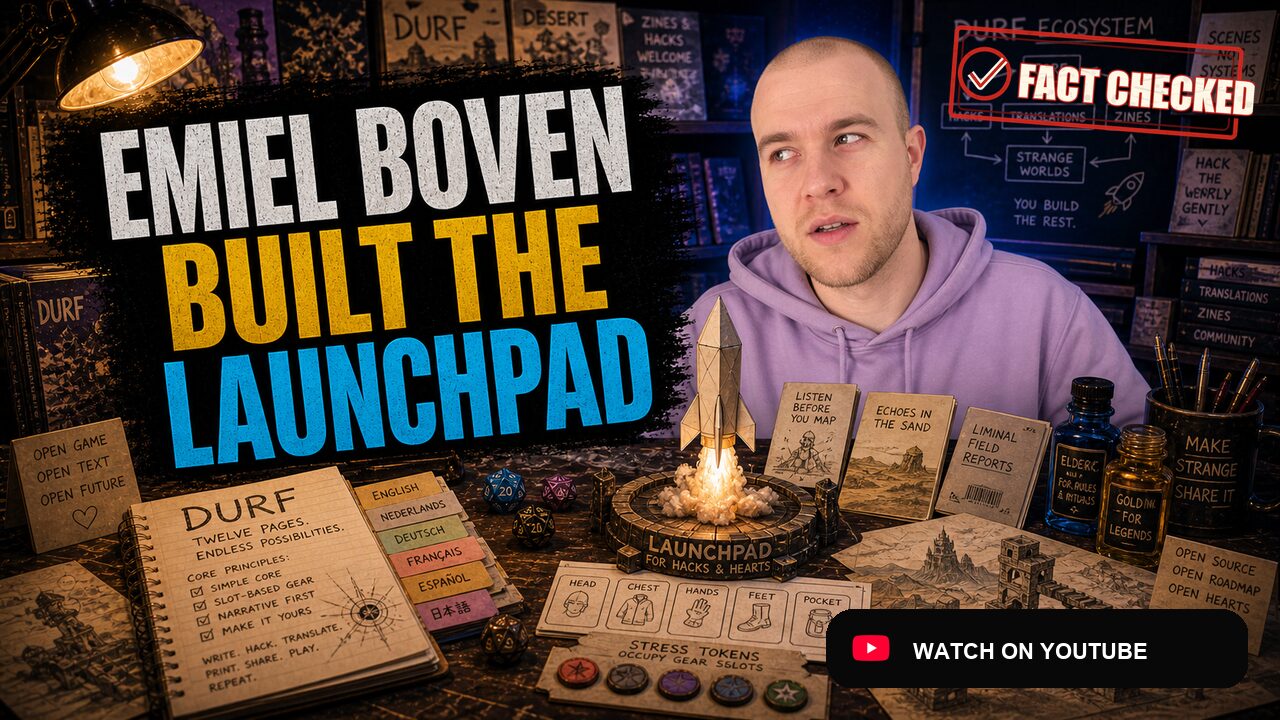
The Twelve-Page Door
Somewhere in the Netherlands, Emiel Boven made a tiny roleplaying game behave like infrastructure.
DURF was not a giant hardcover. It was not a declaration that every dungeon game before it had been wrong. It was a short, rules-light fantasy RPG built for speed, danger, and hacking. Boven wrote it, illustrated it, laid it out, released it through itch.io, and made the important choice: people could pull it apart.
That choice changed the shape of the work.
Within a few years, DURF had become less like a single game and more like a little runway. People translated it. People made adventures for it. People made variants, hacks, add-ons, monster collections, micro-supplements, post-apocalyptic versions, strange dungeons, and pocket-sized expansions. Some of those projects were tiny. Some were jokes. Some were earnest tools for home tables. Together they made the point.
Boven did not build a cathedral. They built the launchpad.
That distinction matters because it keeps the story honest. DURF did not come from nowhere. It came out of a very specific moment in tabletop RPG design, when old-school dungeon play and newer indie publishing habits were getting braided together in public.
The useful question is not whether Boven invented the current. They did not.
The useful question is why so many people found their version easy to swim in.
The Current They Used
By the time DURF appeared, rules-light dungeon design already had a shared language.
Chris McDowall had shown how much could be stripped away in Into the Odd. Ben Milton’s Knave had made equipment feel like character identity. The broader NSR conversation had pushed games toward lighter rules, faster setup, Creative Commons licenses, zine formats, itch.io pages, and systems that invited modification instead of guarding themselves behind locked gates.
DURF belongs inside that conversation. It uses a simple roll-under structure. Characters are shaped by what they carry. Combat is dangerous enough that clever play matters more than fair fights. The rules do not try to simulate a whole world. They try to give a table enough pressure, consequence, and permission to start moving.
That makes it easy to underestimate.
A game this small can look like a summary of better-known influences. In some ways, it is. You can see the Knave DNA. You can see the Into the Odd appetite for speed. You can see the old-school distrust of combat as a default answer. If someone comes looking for a thunderclap of mechanical originality, DURF will not give them one.
But Boven’s strength is not thunder. It is assembly.
They took familiar parts and arranged them so that the game felt approachable, editable, and friendly to strangers. The rules fit in the hand. The tone feels casual without being sloppy. The art and layout are part of the invitation. A person can read DURF and almost immediately imagine making something for it.
That is a design achievement, even when the raw materials are shared.
Stress Takes Up Space
The cleanest little move in DURF is stress.
When a character pushes beyond their limits, the cost does not go onto a separate mental track. It goes into inventory. Stress occupies a slot. The same space that could hold a torch, a rope, a weapon, or a useful oddity now holds the consequence of forcing yourself a little too hard.
That does a lot with almost nothing.
It makes exhaustion physical. It makes mental pressure compete with useful gear. It turns a choice that could have been bookkeeping into a table-facing object. You do not ask whether your character has abstract strain left on a hidden meter. You look at the sheet and see that your load is filling up.
Again, Boven was not alone in this area of design. Other games had already used stress, conditions, and inventory pressure in clever ways. Mausritter had placed conditions into inventory slots. Mothership and Blades in the Dark had already made stress into a serious resource. What DURF does is compress those instincts into a small interface where carrying too much, pushing too hard, and getting worn down all speak the same language.
That is the Boven pattern: not a new alphabet, but a cleaner sentence.
The game keeps asking what can be made immediate. If a rule needs a separate subsystem, maybe it can share a container. If a cost can be seen instead of remembered, put it where the player has to look. If the whole game can be short enough to hack without fear, keep cutting.
That design philosophy would become even more visible when Boven moved from dungeon fantasy into science fantasy.
The Ink Economy
The Electrum Archive, created by Boven with Ava Islam, is stranger, brighter, and more personal than DURF.
It moves away from the familiar dungeon frame and into Orn, a dying science-fantasy world full of elder ruins, weird ecology, ancient technologies, and sharp, Moebius-flavored visual identity. The project is being developed through zines, which fits Boven’s instincts: build enough of the world to make the table hungry, then leave room for motion.
Its strongest design image is elder ink.
In Orn, gold and silver are common enough that they do not carry the usual fantasy weight. The main currency is drops of elder ink, a magical substance left behind by the Elders. That same ink fuels ancient technology. It also powers magic when warlocks inhale it and touch the Realm Beyond.
Money, magic, and machine fuel are the same contested resource.
That single decision gives the setting a spine. A character spending wealth is also spending potential power. A party using ancient technology is also burning a magical reserve. The economy is not a shopping list bolted onto the game. It is part of the same pressure system as spellcasting and exploration.
This is where Boven’s work starts to feel less like a stripped-down response to other games and more like a distinctive design voice. The Electrum Archive still belongs to a lineage. You can feel Morrowind, Ultraviolet Grasslands, Mothership, Cairn, and other weird exploration games in the air around it. But elder ink is the kind of detail that makes a setting function mechanically, not just aesthetically.
It is also a good example of how Boven thinks visually.
The art does not sit outside the rules. The visual identity tells you how the world should feel before the procedure begins. Orn is not just a place with lore. It is a place with a texture, a palette, and a resource economy that tells players what kind of danger they are entering.
The Open Door
The decision that defines Boven’s work may not be a mechanic at all.
It is the door.
DURF was released under a Creative Commons Attribution 4.0 license. The public DURF page tells people the game is made to be hacked, pulled apart, and built on top of. The source text is available for editing. The only basic requirement is credit.
For a small RPG, that is not just generosity. It is architecture.
Licensing changes who feels allowed to participate. A short game with a closed license can be played and praised. A short game with an open license can be translated, reskinned, expanded, taught, remixed, and used as the engine for someone else’s first project. That is exactly what happened.
The DURF collection on itch.io is a map of that participation. There are adventures, supplements, settings, hacks, and odd little offshoots from different creators. The main DURF page links translations into Italian, French, Spanish, German, Brazilian Portuguese, European Portuguese, Russian, Polish, Finnish, Chinese, Czech, Esperanto, Toki Pona, and Ukrainian.
That is a remarkable afterlife for a small dungeon game.
It does not mean DURF changed all of tabletop design. It means Boven understood something practical about the indie RPG ecosystem: people build where friction is low. Give them a clean chassis, a friendly invitation, editable text, a permissive license, and a tone that says, yes, go ahead. A few people will build. Then the next person sees the pile and realizes there is room for one more.
That is platform thinking.
The Bigger Book
Boven’s current work shows the same question from a new angle: what happens when the little launchpad becomes a larger machine?
DURF Expanded is in production through BackerKit after a successful crowdfunding campaign. The project is described as an updated and expanded version of DURF, and public updates in 2026 show Boven still working through art and production. That matters because it turns the old strength into a test.
The original DURF worked because it was small. The rules got out of the way. The open license and compact presentation made the game easy to enter. Expanding that into a larger book creates a real design problem.
Can the launchpad grow without becoming heavy?
That is not a rhetorical question. Many rules-light games lose their charm when expanded. More monsters, more procedures, more examples, more options, and more art can make a game richer. They can also bury the part that made people want to hack it in the first place.
Boven seems aware of that tension. Their best work has always been about pressure and space: inventory space, layout space, rules space, community space. DURF Expanded will show whether that instinct survives scale.
What They Actually Built
Boven did not invent rules-light dungeon gaming. They did not create the old-school revival, the NSR, inventory-based characters, stress as a resource, science-fantasy zines, or open gaming licenses.
What they built was a practical invitation.
DURF gave people a small, clear, charmingly illustrated base they could understand quickly and modify without fear. The Electrum Archive showed that Boven’s design could move beyond dungeon minimalism into a stranger world where currency, magic, technology, and art direction all reinforce each other. DURF Expanded shows a designer testing whether a tiny open platform can become a more complete book without losing the quality that made it useful.
That is the honest shape of the contribution.
Boven’s work is not important because every designer copied a single mechanic. It is important because a community could gather around the work and make more of it. The game became a seed. The translations became branches. The hacks became proof that the invitation was real.
Some designers build monuments. Boven builds surfaces other people can launch from.
Where To Find Them
As of 2026, Emiel Boven remains active through CULT OF THE LIZARD KING, itch.io, Patreon, newsletter updates, and the ongoing DURF Expanded production. Their public catalog includes DURF, The Electrum Archive, related zines and tools, adventures, visual resources, and collaborative projects.
If you want the shortest version of the story, start with DURF. It is small enough to read quickly, but the real design is in what happens after you close it.
A twelve-page game became a place where other people could begin.
Fact Check Notes
Publication notes
This site is AI-assisted and human-reviewed. We use artificial intelligence to help gather research, organize source material, and draft profile content. Human editors then read, revise, and check each profile before it goes live. Most profiles are built through deep AI research and two separate rounds of fact-checking.
Leave a Reply
You must be logged in to post a comment.