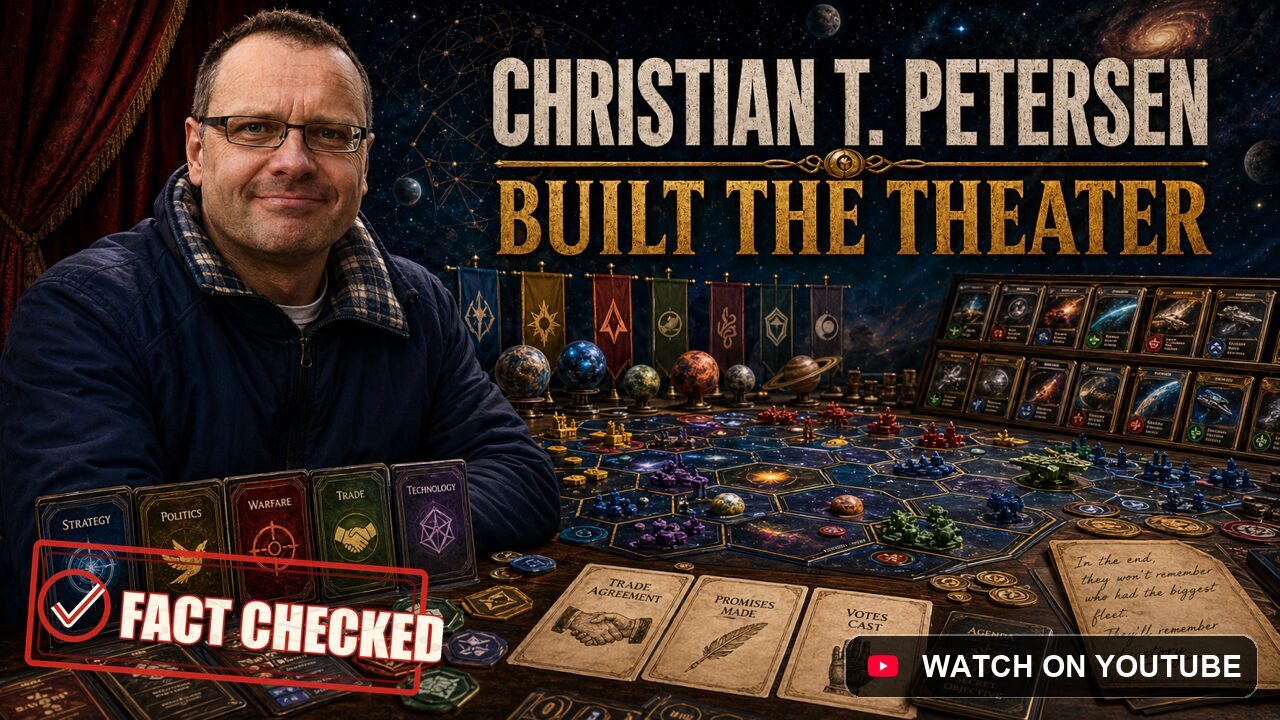
Not a tidy puzzle. Not a short fight. A table-sized opera where civilizations rose, alliances bent, speeches mattered, betrayals had names, and everyone left with a story they would retell years later.
That game became Twilight Imperium.
The first edition arrived in 1997 from the young company Petersen had founded, Fantasy Flight Games. It was huge, ambitious, messy, and unmistakably alive. Players did not simply move pieces across a board. They inhabited galactic powers with agendas, fleets, trade deals, political leverage, and grudges.
The game was not just asking who could win.
It was asking who could command the room.
Most games try to protect the players from each other. They give you clean math. They give you private planning. They give you systems that do not require eye contact.
Petersen kept building the opposite kind of box.
His best work puts everyone in the same space and asks the hardest tabletop question. Can you live with what you just promised?
The Galaxy As Stage
Twilight Imperium is the center of the Petersen story because he kept returning to it.
Some designers publish a game and move on. Petersen spent decades refining the same galactic stage. The early editions had the force of invention. Later editions made the system stronger, clearer, and more playable without making it small.
That last part matters.
Twilight Imperium did not become great by apologizing for its size. It became great by making the size feel earned. A session can still take most of a day. The table can still disappear under ships, planets, tokens, cards, and negotiation.
But that is also the point.
The scale creates the theater.
You do not remember a Twilight Imperium session because your engine converted resources efficiently.
You remember it because someone said, out loud, that they would not cross that border.
Then the border became useful.
By the time Twilight Imperium’s modern form solidified, strategy-card role selection was one of the series’ defining levers. Each round, players choose powerful roles that shape turn order and major opportunities. The card you pick is not just an efficiency choice. It is a signal. It tells the table what kind of round you intend to have, and it gives everyone else a reason to react.
The day gets swallowed by people reading each other.
Twilight Imperium Fourth Edition, developed by Corey Konieczka with Dane Beltrami and built on Petersen’s original game, shows the refinement arc at full strength. The system is cleaner. The factions are sharper. The political, military, economic, and technological layers interlock without losing the feeling that the whole galaxy is arguing.
That is rare.
A game can be long because it is bloated.
Twilight Imperium is long because it wants the drama to have room to breathe.
The Politics Of Betrayal
Petersen’s best designs understand that betrayal is more powerful when the rules make it polite.
A Game of Thrones: The Board Game is the cleanest example. Players do not simply attack when they feel like it. They place hidden orders. They commit in secret. Then everyone reveals at once, and the table learns who lied, who hesitated, who misread the room, and who was waiting for exactly this moment.
That is why the game works as an adaptation.
It does not merely paste familiar names onto a war map. It turns mistrust into procedure. The order tokens make betrayal feel formal, almost bureaucratic. You promised support. The token says otherwise. The table sees it. The story begins.
The rules do not let you betray casually.
They make you commit.
Then they make you watch the reaction.
That same instinct appears in Twilight Imperium. Votes, trades, support, borders, ceasefires, alliances, and timing all become dramatic material. Petersen’s games are not only about optimal play. They are about social pressure given rules.
The board is the set.
The players are the cast.
The mechanisms are stage directions.
The Living Card Game
Petersen also left a mark on card gaming through publishing structure, not just design.
For years, collectible card games ran on randomized boosters. You bought sealed packs and hoped. Competitive play became partly a test of skill, partly a test of collection access, money, and luck.
Fantasy Flight’s Living Card Game format offered a different promise. Fixed distribution. When you bought a pack, you knew what cards were inside. Every player had access to the same card pool. The advantage moved closer to deckbuilding judgment, play skill, and metagame understanding.
There is an emotional piece to that change.
It lowers the temperature.
It turns an arms race into a conversation about choices.
That is a publishing decision and a design decision at the same time.
The cards still had to be good games. But the format changed the relationship between player and product. It made expansion feel less like gambling and more like participation in an evolving system.
Fantasy Flight used the model across multiple lines, including A Game of Thrones, The Lord of the Rings, Android: Netrunner, Arkham Horror, and Marvel Champions. Other publishers adopted similar fixed-content approaches under different names. The important point was the promise to players. You could choose the game on its merits and keep up without chasing rare pulls.
That shift helped change what expandable card games could be in the public mind.
The Company As Instrument
The difficult thing about Petersen is that his greatest design object may be Fantasy Flight Games itself.
That is not a dodge. It is the center of the story.
Under Petersen, Fantasy Flight became a studio with a recognizable house style. Big boxes. Lavish production. Ambitious licenses. Serious mechanics. Games that treated theme as structure rather than decoration. Star Wars. Game of Thrones. Battlestar Galactica. The Lord of the Rings. Warhammer. Arkham Horror.
Before Fantasy Flight, licensed games often carried a stigma. Too many were quick products leaning on a logo. Fantasy Flight helped change that expectation. A licensed game could be mechanically rich, dramatic, and serious.
But Petersen did not personally design all of those games.
He built the theater where other designers could perform.
The weight of that kind of building is easy to miss if you only look for author credits. A studio culture is invisible until you have lived inside it. Then you can feel it in the box. In the rulebook voice. In the way the components dare you to set aside a full evening and commit.
Corey Konieczka, Kevin Wilson, Jay Little, Nate French, Eric Lang, and many others made major contributions inside the world Petersen helped build. That matters because leadership is not the same as individual authorship. It is also not nothing. A studio can have a design culture, and Fantasy Flight had one.
Petersen’s personal taste and his executive vision reinforced each other. He liked games that produced stories. He built a company that could publish them at scale.
There is a reason so many Fantasy Flight boxes feel like invitations to clear a table and commit.
Petersen treated production values as part of the contract. If the game was going to ask for your whole evening, the components had to help carry that weight. The presentation had to make the promise visible before you even read the rules.
That is not just marketing. It is emotional honesty. The box admits, up front, what it wants from you.
In his public goodbyes, he framed the work in those terms. Not products. Stories and dreams in boxes. That language fits because it describes the real goal. You open the lid and you get a world, a conflict, and a reason to talk.
What He Actually Built
Christian T. Petersen did not personally author every great Fantasy Flight title.
Christian T. Petersen did not singlehandedly reinvent the entire modern hobby.
What he built was a set of theaters for tabletop drama.
He created Twilight Imperium, one of the great monuments of long-form board gaming. He designed A Game of Thrones into a game where betrayal became a formal language. He helped steer Fantasy Flight’s Living Card Game publishing model into the mainstream, making expandable card play more transparent and less dependent on randomized boosters. And he built Fantasy Flight Games into a studio where ambition felt normal.
His design catalog is smaller than his company legacy.
That is the honest shape of the career.
Some people leave a shelf of titles.
Some people leave a room where other people can do their best work.
Petersen did both.
But when he did step onto the stage, he knew what kind of show he wanted.
Large.
Political.
Memorable.
Full of people making promises they might regret.
Where To Find Him
Petersen stepped down from Asmodee North America effective December 31, 2018, after Fantasy Flight’s long arc from scrappy publisher to the center of a much larger corporate orbit. Twilight Imperium, the Living Card Game lines, and the many designers who passed through Fantasy Flight remain the public legacy of the theater he built.
The lasting image is still a table covered in planets.
Someone asks for support.
Someone promises peace.
Someone reaches for the strategy card everyone else hoped would stay on the table.
Hours later, the game ends.
The story does not.
Fact Check Notes
Publication notes
This site is AI-assisted and human-reviewed. We use artificial intelligence to help gather research, organize source material, and draft profile content. Human editors then read, revise, and check each profile before it goes live. Most profiles are built through deep AI research and two separate rounds of fact-checking.
Leave a Reply
You must be logged in to post a comment.