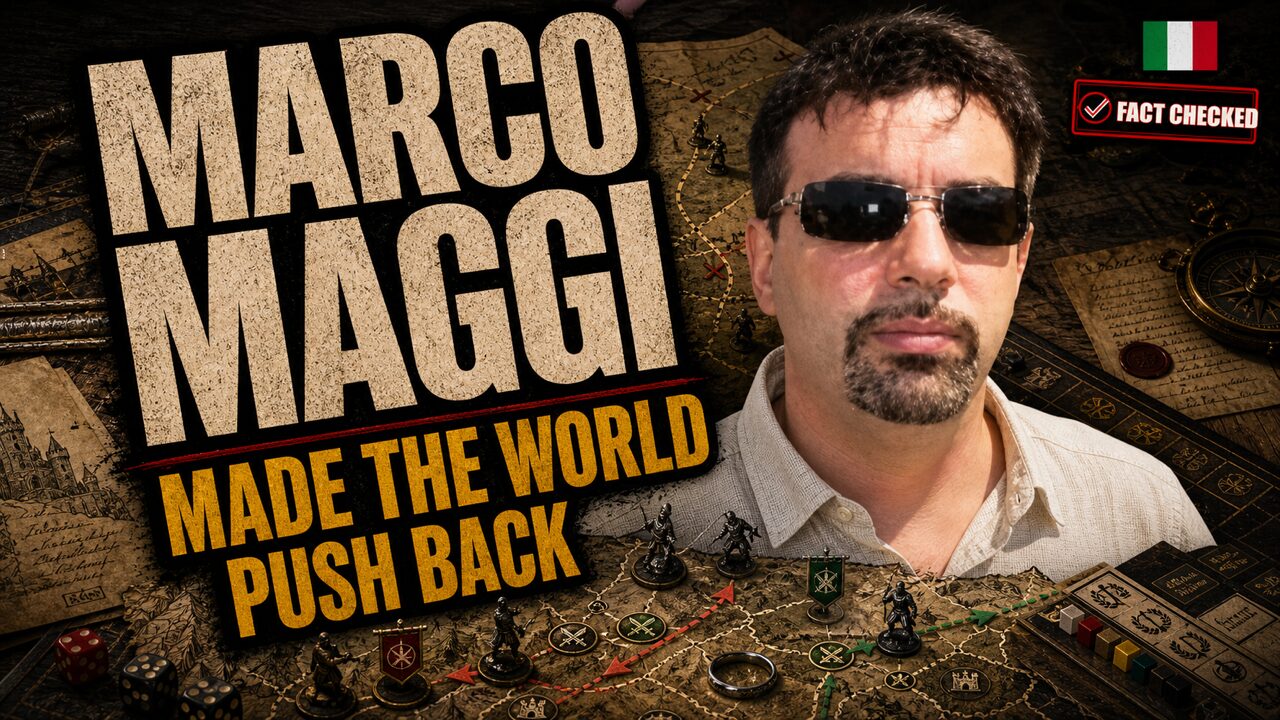
The nations of Middle-earth are not ready. Political tracks delay their entry into the war. The Fellowship must stay hidden while moving toward the one place that can destroy the Ring. Every turn offers more useful actions than the dice permit. Sauron has overwhelming military strength, but a military victory can still become a distraction from the smaller, stranger contest moving under the map.
That pressure is not Tolkien painted onto a conventional wargame. It is the story rebuilt as a set of limits.
Marco Maggi helped build those limits. The credit belongs to a team: Maggi, Francesco Nepitello, and Roberto Di Meglio designed War of the Ring. Across a long collaboration with Nepitello and other partners, Maggi repeatedly helped turn fictional worlds into systems that resist the player in the right way.
The Roman Empire delays, investigates, and fractures in Lex Arcana. Middle-earth makes travel exhausting and corruption dangerous in The One Ring. Dune turns logistics, mobility, and asymmetric purpose into the shape of a war.
Maggi’s work asks a precise question. What must the world do back to the players before the game feels like that world?
The Venice Table
Maggi is an Italian designer from Venice. His birth date remains unverified, and it is better left out than guessed. He is also not the Uruguayan visual artist with the same name, nor is he connected to the modern board games named for the explorer Marco Polo.
The useful beginning is not a date. It is a design culture.
Maggi and Francesco Nepitello knew each other from school and shared an early interest in gamebooks and roleplaying games. Their professional path passed through the Venice circle around Studiogiochi, Dario De Toffoli, Leo Colovini, and Alex Randolph. Randolph had spent years pressing publishers to place designers’ names on boxes. In Venice, that idea became more than a credit policy. It helped form a community in which games were discussed as authored objects.
The circle was collaborative. Designers tested one another’s prototypes, argued over mechanisms, and crossed the boundaries between roleplaying games, board games, retail, development, and publishing. Maggi’s career kept that structure. His bibliography is large, but it is not a solo bibliography.
That matters from the first major credit.
Rome That Never Fell
Lex Arcana appeared in 1993. Its design and authorship belong to Marco Maggi, Francesco Nepitello, Leo Colovini, and Dario De Toffoli.
The game imagines a Roman Empire that did not collapse when history says it should have. Players serve the Cohors Auxiliaria Arcana, an imperial force sent to investigate threats at the edge of a vast alternate Rome. History, myth, military procedure, and supernatural danger share the same assignment.
Later accounts describe areas of concentration within the team, but they do not justify turning a shared credit into four cleanly separated inventions. Maggi and Nepitello worked heavily on background and introductory fiction. Colovini is associated with the central mechanics, and De Toffoli with accessibility and development. The published game remains the work of the group.
Lex Arcana established a pattern that followed Maggi. The setting was not a costume placed over generic fantasy. The characters belonged to an institution. Travel, rank, investigation, and imperial power shaped what they could do. The alternate history supplied obligations as well as color.
Maggi and Nepitello kept moving between forms. X-Bugs, later developed through Micro Mutants, turned small plastic pieces into flicking creatures with different powers. Other projects ranged across card games, licensed properties, historical settings, and family play. Each carried its own collaborators. What survived across the catalog was an interest in rules that make a theme behave.
The War Inside The Ring
War of the Ring arrived in 2004 and was substantially revised in its later edition. Maggi, Nepitello, and Roberto Di Meglio share the principal design credit.
The problem was enormous. The Lord of the Rings contains armies, sieges, diplomacy, journeys, temptation, secrecy, and a war that can be won by people who would lose almost every conventional battle. A game that reduced the story to troop strength would miss its center. A game that followed only the Fellowship would lose the scale of the conflict.
The design lets both wars exist at once.
Custom action dice determine which kinds of moves are available during a round. A player may want to recruit, move armies, play events, or advance characters, but the roll limits the verbs. Political tracks mean that threatened nations do not automatically mobilize. The Fellowship moves secretly, and the Shadow player must decide how much attention to spend on the hunt while armies advance elsewhere.
The Free Peoples are weaker in open war. The Shadow has more force, but not unlimited time. Each side has a military path to victory, yet the Ring remains a second contest with different information and different risks.
The result is not a reenactment script. Players can change the war. The system simply makes them pay in the currencies Tolkien made important: time, attention, trust, distance, and corruption.
Maggi should not be assigned sole ownership of the action dice or any other subsystem without a direct source. Di Meglio, Nepitello, developers, artists, publishers, and playtesters all belong to the product’s history. The honest claim is already strong. Maggi helped a team make one story operate at two scales without letting either one become decoration.
The Road Is A Rule
The One Ring brought the same design instinct into roleplaying.
The first edition began in 2011. The later Free League edition was crowdfunded in 2021 and reached retail afterward. Both editions credit Marco Maggi and Francesco Nepitello as game designers, with Nepitello credited as lead writer on the second edition.
That division matters. Maggi is not the sole author of Middle-earth at the table. He is not merely a developer standing beside somebody else’s design, either. The printed credit names a partnership.
Many fantasy roleplaying games can describe a long trip in a sentence. The One Ring treats the road as a source of weariness, danger, discovery, and changing responsibility. Fellowship, hope, shadow, councils, and periods of recovery become procedures. Characters are not only adventurers acquiring power. They are people trying to carry purpose through a world that can exhaust or corrupt them.
The mechanics do not imitate every event in Tolkien. They create pressures that produce related choices. A company decides who guides, who watches, and how much risk the journey can bear. Shadow is not just damage with a darker name. It records what proximity to fear and evil does to a hero.
This is adaptation as architecture.
A licensed game can use familiar names and images while behaving like any other game. Maggi and Nepitello chose the harder route. Middle-earth had to regulate attention, travel, fellowship, and moral cost.
The Collaborator In The Credit Line
Maggi’s name is sometimes shortened out of summaries. Nepitello is more publicly associated with writing and interviews. War of the Ring is sometimes discussed as though one famous designer made it, while The One Ring is reduced to a publisher or a license.
The correction is not to create a hidden solo genius.
Maggi’s career argues for the opposite.
Lex Arcana required four named creators. War of the Ring required three principal designers. The One Ring places two designers beside a larger writing, development, art, editing, and publishing team. The Battle of Five Armies, The Hunt for the Ring, Dune: War for Arrakis, and other projects also carry shared credits that should remain visible.
Maggi’s significance is collaborative design sustained across decades. He works inside partnerships where a fictional property is treated as a system of causes, not a shelf of recognizable objects.
That is less dramatic than the myth of one inventor. It is more accurate, and it explains the work better.
What Maggi Actually Built
Marco Maggi did not invent thematic board games. He did not create Tolkien’s world, and he did not design War of the Ring, The One Ring, or Lex Arcana alone. No source supports assigning every famous mechanism in those games to him personally.
What he helped build was a repeatable method for making a setting push back.
Rome gives characters duty and hierarchy.
Middle-earth makes distance expensive.
The Ring divides attention between military power and moral danger.
Dune turns asymmetry into strategy rather than imbalance.
Across these games, the fiction does not wait for a paragraph to explain it. It enters the action economy, the map, the journey, the political delay, the hidden movement, and the cost of choosing one necessary task over another.
Maggi’s work is not important because his name can be separated from every collaborator. It matters because the partnerships held. The same designer could move from an alternate-history RPG to a vast Tolkien wargame, then back into roleplaying, while preserving a demanding standard: the rules must know where they are.
Where To Find His Work
Studiogiochi maintains an author page for Marco Maggi at https://studiogiochi.com/en/author/marco-maggi-en/. It provides a useful route into his catalog and the Venetian design context.
War of the Ring and its related games remain available through Ares Games. The One Ring is published by Free League, while Lex Arcana’s current edition is represented through Studiogiochi and its publishing partners. Individual product pages and printed credits remain the best guide to exactly who did what.
Recent corporate and consulting roles should be checked title by title. Employment by a studio does not make every product from that studio a Maggi design.
The durable record is on the table. When a player cannot do everything, when the road becomes a decision, and when the world answers an action with a cost specific to that world, Marco Maggi’s kind of design is at work.
Fact Check Notes
Publication notes
This site is AI-assisted and human-reviewed. We use artificial intelligence to help gather research, organize source material, and draft profile content. Human editors then read, revise, and check each profile before it goes live. Most profiles are built through deep AI research and two separate rounds of fact-checking.