That is the whole story.
It is also why the game mattered.
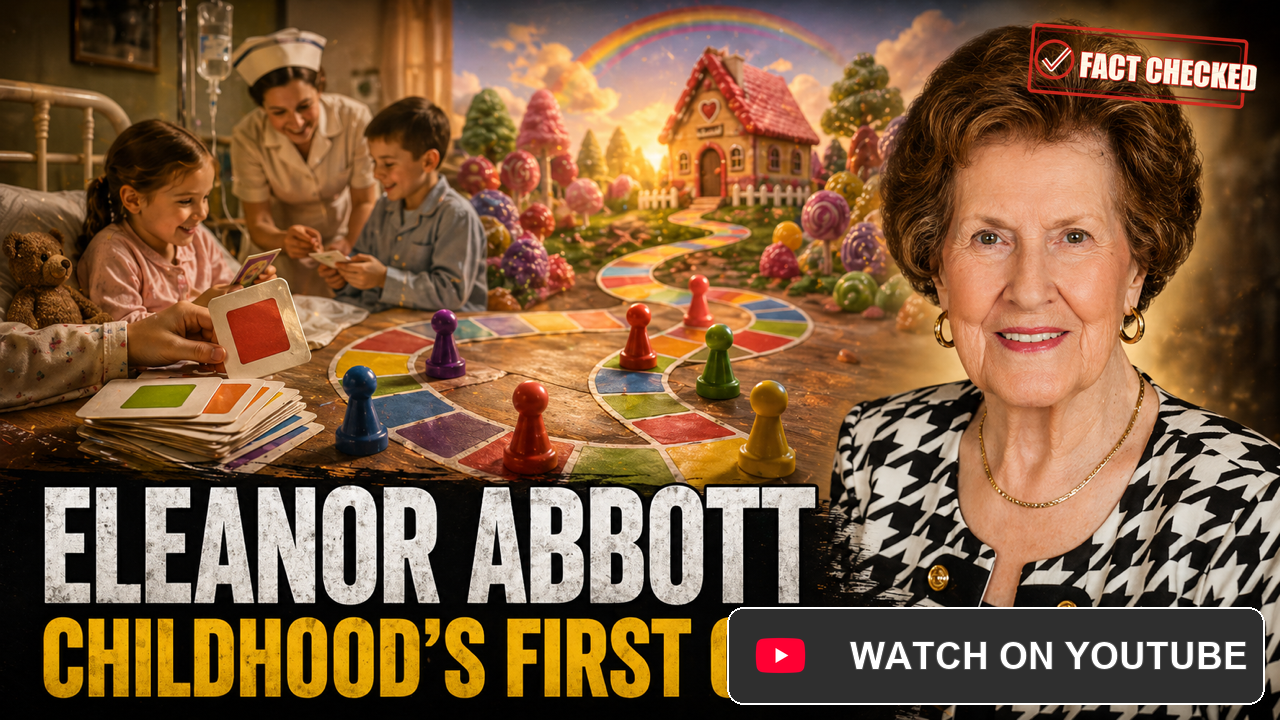
In the late 1940s, polio changed childhood. Pools closed. Playgrounds emptied. Children disappeared into hospital wards. Some were in braces. Some were in pain. Some could barely sit up. Their parents came and went on visiting schedules. The day stretched out in white sheets, metal beds, and waiting.
Abbott was there too.
She was a schoolteacher recovering from polio, watching children around her who needed something simple enough to play from a bed. Not a game that required reading. Not a game that required counting. Not a game that required strategy, competition, adult explanation, or a body that could move easily.
So she made one.
She drew Candy Land.
The Color
The design is almost too simple to notice.
Draw a card. Look at the color. Move your piece to the next matching color on the board.
That is it.
No reading. No arithmetic. No choices. No tactical layer hidden underneath. A child who can recognize red, blue, yellow, green, orange, and purple can play. A child who cannot read the word red can still know what red is.
That was the breakthrough.
Many games for children existed before Candy Land, but they usually expected something more from the player. Read a card. Count spaces. Follow text. Make choices. Abbott lowered the floor until a preschool child could enter the game without being translated through an adult.
The card did two jobs at once.
It randomized movement, and it gave the instruction.
There was no middle step.
That is radical accessibility. Not because the game is clever in a hidden way, but because it removes almost every barrier between a very young child and the experience of having a turn.
The Absence
Candy Land has almost no agency.
That has made generations of adult gamers roll their eyes. It also misses the point.
The absence of meaningful choice is not a flaw in the original problem. It is the answer to the original problem. Abbott was not designing for adults at a hobby table. She was designing for children in a polio ward, children who might be tired, frightened, bored, isolated, or operating at the edge of what their bodies would allow.
For that audience, a decision-heavy game would have been another wall.
Candy Land makes the turn automatic.
Draw. Match. Move.
The child does not need to be clever. The child does not need to be lucky in a way that can be improved by skill. The child only needs to participate.
That creates a strange kind of fairness. A three-year-old can beat a parent. A bedridden child can win without strength, reading, or calculation. The outcome is not earned in the adult sense, but the experience is real.
The game gives motion to children who had lost motion.
That is why the board matters.
The Road Home
The original Candy Land was not only a candy fantasy.
It was a path.
That path is important because Candy Land is a mobility dream. A child draws a color and moves forward through a bright world. The body stays in the bed. The token travels.
Later versions built out the fantasy with named characters, villains, princesses, castles, and a whole branded geography. Those additions made commercial sense. They also changed the feeling of the original object.
The first version was plainer and more direct.
The old source notes that the original destination was Home. Not a throne. Not a conquest. Not a treasure room. Home.
For children in a hospital ward, that is not a small word.
The genius of Candy Land is not that it simulates candy. It simulates going somewhere when you cannot go anywhere. Every color card is permission to move.
The Company That Needed It
Milton Bradley did not know it was buying one of the most durable children’s games in history.
The company published Candy Land in 1949 after Abbott submitted it. The story that survives comes mainly through Mel Taft, a Milton Bradley executive later interviewed by toy historian Tim Walsh. The historical trail is thin. Abbott did not become a public celebrity. She did not leave behind a shelf of design notebooks. She did not build a career as a game designer.
That thin record matters.
But the game was real, and the market responded.
Candy Land became a gateway product at exactly the moment the country had more young children than ever. The postwar baby boom had created a huge preschool audience. The toy industry had not fully built for them yet. Candy Land did not ask children to grow up before they could play a board game. It brought the board game down to them.
That is why it lasted.
The Franchise After Abbott
The Candy Land most people remember is not exactly Abbott’s Candy Land.
Over time, the game became a franchise. Later editions added named characters, a stronger storybook frame, more polished illustrations, and a commercial world that could support films, licensing, digital versions, and branded spinoffs.
King Kandy, Lord Licorice, Queen Frostine, Princess Lolly, Mr. Mint, Gramma Nutt. Those names belong to the later commercial layer, not to Abbott’s original design.
The distinction matters.
Abbott built the chassis.
The franchise built the costume.
The modern product is a hybrid: Abbott’s color-card movement system under decades of character, artwork, and brand development. If you are measuring franchise management, many hands enter the story. If you are measuring the mechanical design, the core remains hers.
Draw a color.
Move to that color.
That is the whole machine.
The First Lesson
Candy Land does teach something.
Not strategy. Not probability. Not tactics.
It teaches the grammar of games.
A child learns that the board is a shared place. A card can tell you what happens next. A piece can stand in for you. A turn belongs to one person, then passes to another. A rule can be followed even when you wish it said something else. A game can have a path, a finish, a winner, and another chance to play.
Those lessons are invisible to adults because adults already know them.
A preschool child does not.
That is why the simplicity matters. Candy Land is not training a child to outthink an opponent. It is training a child to understand what play looks like when it has structure. The game gives the child board-game literacy before written literacy.
That is a real design achievement.
The Ghost In The Record
Almost nothing is known about Eleanor Abbott compared with the scale of the game she created.
She was born in 1910 and died in 1988. She lived quietly in San Diego. She is credited everywhere that matters as the designer of Candy Land. Beyond that, the record thins quickly.
This is one of the strangest parts of her story.
The game is everywhere.
The designer is almost gone.
That does not make the story false. It makes it fragile. The polio-ward origin, the butcher-paper prototype, and the royalty-donation story all travel through a narrow source chain. Some details are widely repeated. Fewer are independently documented.
So the careful version is the honest one.
Abbott made Candy Land while recovering from polio. She made it for children who needed a game they could play. Milton Bradley published it in 1949. The game became a permanent part of childhood.
That is enough.
What She Actually Built
Eleanor Abbott did not build a career in game design.
She did not create a deep catalog. She did not refine systems over decades. She did not design the later Candy Land characters, films, licensing strategy, or modern brand world.
What she built was the first door.
Candy Land taught millions of children what a board game feels like: taking turns, drawing cards, moving a piece, following a path, waiting, hoping, finishing. It did not teach strategy. It taught participation.
That is a different achievement.
For hobby gamers, Candy Land can feel empty because it asks so little from the player. For a preschool child, that is exactly the gift. The game does not demand literacy before play. It does not demand arithmetic before joy. It does not demand agency before belonging.
It says: you can play now.
The Road That Stayed
Candy Land entered the National Toy Hall of Fame in 2005.
That honor fits, but it also understates the game’s role. Candy Land is not only a famous children’s game. It is a teaching ritual. For many children, it is the first board, the first pawn, the first deck, the first turn, the first victory, the first loss, the first time the family gathers around a rule system made small enough for them.
The game has been changed many times.
It has also stayed itself.
The color card still tells the child where to go. The road still moves forward. The promise is still simple enough to understand before you can read it.
Abbott designed one game.
One game is not a career.
But sometimes one game finds a door nobody else saw and holds it open for seventy-five years.
Eleanor Abbott drew a road for children who could not walk it.
Then generations walked it for them.
Fact Check Notes
Publication notes
This site is AI-assisted and human-reviewed. We use artificial intelligence to help gather research, organize source material, and draft profile content. Human editors then read, revise, and check each profile before it goes live. Most profiles are built through deep AI research and two separate rounds of fact-checking.
Leave a Reply
You must be logged in to post a comment.