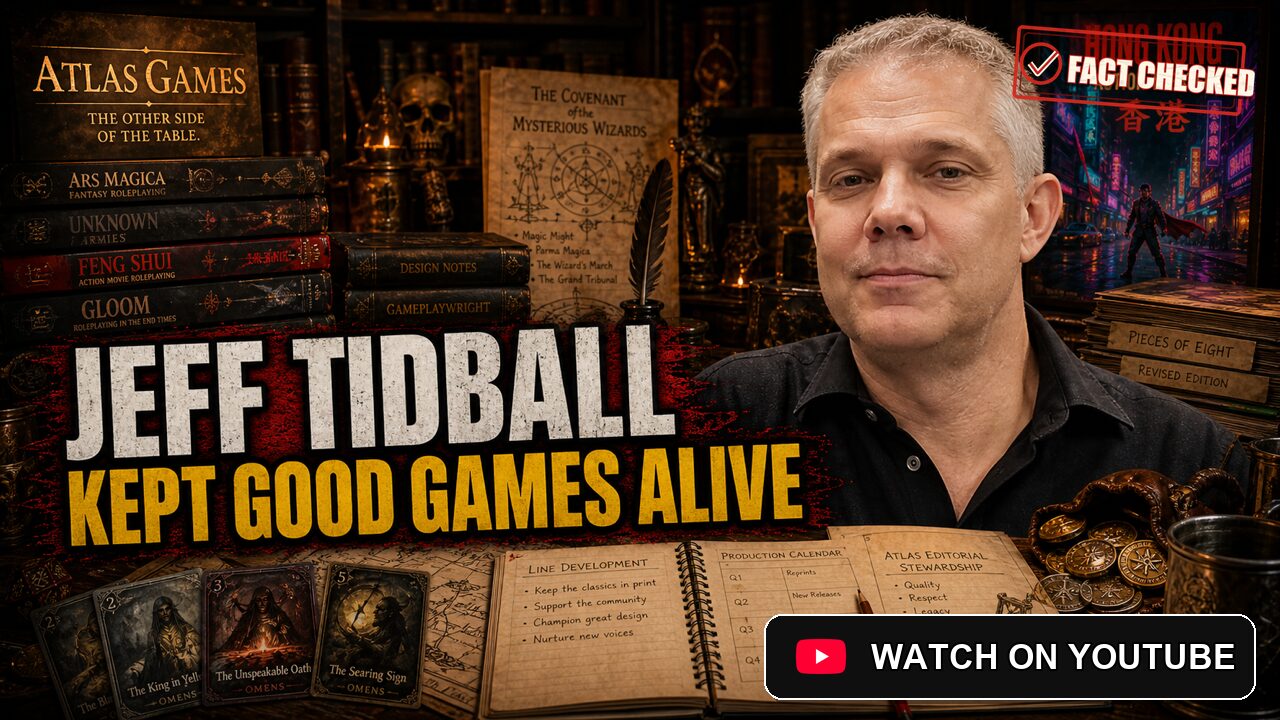
Jeff Tidball is harder to pin down than that.
His career sits on the other side of the table: editing, developing, publishing, managing, keeping lines alive, making other people’s games clearer, and occasionally designing something strange enough that it could only have come from someone who understood the business side and the table side at the same time.
That makes him easy to underrate.
It also makes him useful to understand.
Tabletop history is full of brilliant games that vanished because nobody could keep the machinery running around them. Somebody has to handle schedules, books, freelancers, warehouses, budgets, errata, production judgment, and the thousand small decisions that decide whether a clever game becomes a line or a memory.
For many years at Atlas Games, Tidball worked in that machinery.
He did not create Ars Magica. He did not invent Feng Shui. He was not the original voice behind Unknown Armies. He did not design Gloom from whole cloth.
But those games stayed visible, playable, and supported while Atlas occupied one of the most interesting middle spaces in tabletop publishing: too sharp to be generic, too professional to be treated as a garage operation, and too stubborn to vanish.
That takes design work too.
The Atlas Shelf
Atlas Games has always had a particular flavor.
Its catalog was never only one thing. Ars Magica offered scholarly medieval wizardry with covenant play and deep magical structure. Feng Shui brought Hong Kong action cinema to the table with speed and swagger. Unknown Armies made modern occult horror feel personal, ugly, funny, and dangerous. Over the Edge bent conspiracy and surrealism into something stranger than a standard setting. Gloom turned misery into transparent-card comedy.
Those games do not belong to one neat genre family.
That was part of the problem.
A publisher with that kind of shelf needs people who can understand different creative engines without sanding them into one house style. Ars Magica cannot be developed like Feng Shui. Unknown Armies cannot be treated like Gloom. Over the Edge should not be forced to behave like a conventional adventure line.
Tidball’s value was not that he made them all sound like him.
His value was that he helped the shelf keep working.
That is a quieter form of authorship. It lives in development decisions, product judgment, editor notes, line stewardship, and the ability to recognize what a game is trying to do before trying to fix it.
When that work is done badly, players notice immediately.
When it is done well, they usually credit the game.
That is the job.
Pieces Of Eight
Tidball’s most distinctive personal design is Pieces of Eight.
Published in 2006, it is a pirate-themed coin game played with actual metal coins. That physical choice matters. A coin is not just a marker. It has weight. It stacks, flips, clinks, hides, tempts, and feels like treasure before the rules say anything.
The game takes advantage of that.
Pieces of Eight sits in that odd, pleasing space where the component teaches the theme. You are not pushing cardboard pirates around a map. You are handling coins like loot. The object and the fiction talk to each other.
That kind of design is easy to describe and hard to fake.
It also explains something about Tidball’s broader career. Pieces of Eight is not a giant system manifesto. It is a practical, tactile idea executed at the right size. The game knows what it is. It uses the table honestly. It makes the physical object carry some of the emotional load.
That is publisher thinking and designer thinking meeting in one place.
Not every idea needs a 300-page rulebook.
Some ideas need the right metal in the player’s hand.
The Developmental Hand
Development work is difficult to celebrate because it is often invisible by design.
A developer can save a manuscript without leaving fingerprints. An editor can make a game’s voice sharper without taking over the book. A publisher can keep the line alive without becoming the public face of the system.
Tidball’s Atlas years are full of that kind of work.
Unknown Armies, Feng Shui, Ars Magica, Over the Edge, Gloom, and Atlas itself all belong in this story, but they need a clean frame. Tidball should not be treated as the creator of those games. The stronger claim is more specific:
He helped sustain a catalog that needed adult supervision without losing its weirdness.
That is not small.
Unknown Armies is still weird because it was allowed to stay weird. Feng Shui is still fast because nobody tried to turn it into a generic universal system. Ars Magica is still deep because depth was treated as a feature, not a problem to be shaved away.
The publisher’s job is not always to make the game bigger.
Sometimes it is to keep the game itself.
Gameplaywright And The Design Conversation
Tidball’s work also moved into the conversation around games.
With Gameplaywright, he helped publish books about game design, play, performance, and the thinking around tabletop practice. That line was not the same kind of work as releasing another supplement. It was closer to building a shelf for designers to talk to one another.
That mattered because tabletop design often learns by apprenticeship, by forums, by convention hallway conversations, by examples stolen and improved at the table.
Books about game design give that conversation a more durable form.
Gameplaywright’s catalog included work from designers and thinkers writing about the craft from inside the hobby. It treated game design as something worth discussing seriously without draining the playfulness out of it.
That fits Tidball’s pattern.
He kept returning to infrastructure: product lines, publishing operations, component choices, editorial judgment, design books, studio leadership. The work is rarely glamorous in the simple way. It is the kind of work that helps better-known creative work survive.
Keeping The Lights On
"Keeping the lights on" can sound like faint praise.
In tabletop publishing, it is not.
The industry is littered with beautiful dead lines. Games disappear because the publisher runs out of cash, the editor leaves, the license ends, the production schedule breaks, or the people who love the game cannot make the business hold together.
Creative work needs caretakers.
Tidball’s career is full of caretaker design. Not caretaker as in passive maintenance. Caretaker as in the person who understands the thing well enough to keep it alive without smothering it.
That is why his work belongs in a designer profile series even though the obvious headline is not one world-changing mechanic.
Design is not only invention.
Design is also stewardship.
What He Actually Built
Jeff Tidball did not build the Atlas catalog alone. He did not create every game he helped publish. He did not leave behind one towering system that changed the entire hobby.
What he built was a career around making good games durable.
He worked where design meets publishing: the edge where manuscripts become books, books become lines, lines become businesses, and businesses either support the next weird idea or quietly die. Pieces of Eight showed his own design instinct for tactile, table-facing play. Gameplaywright showed his interest in preserving and expanding the design conversation. Atlas showed his ability to help steward strange, respected games through real-world publishing demands.
That is the bridge.
Not between tabletop and digital.
Between creativity and survival.
That bridge is less romantic than a famous mechanic, but most of the hobby depends on it.
The Games That Stayed
The easiest way to see Tidball’s contribution is to look at the shelves.
Ars Magica is still part of the conversation when people talk about troupe play, long-form wizard stories, and medieval fantasy with teeth. Unknown Armies still has that dangerous personal charge. Feng Shui still understands speed. Gloom still makes misery funny. Atlas still means something specific to people who came up through the indie-to-mid-tier RPG years.
Tidball was not the only reason.
He was part of the reason.
That distinction matters, and it is enough.
Every game industry has visionaries. It also needs people who can keep the work printed, edited, shipped, explained, archived, and handed to the next table.
Someone has to keep the good games alive.
Where To Find Him
Tidball’s current public trail points beyond his Atlas years. He has served as head of studio at Chip Theory Games, where the work is again about studio operations, publishing judgment, and helping complex tabletop products reach players.
His Left Justified Studio site keeps his writing, editing, and design history visible, including books, games, and publishing work. Gameplaywright’s catalog was later sold to Pelgrane Press, which keeps that design-conversation thread from simply vanishing.
Pieces of Eight remains the cleanest personal design artifact if you want to see his own table instinct in a single object.
A pirate coin game. A design press. An Atlas shelf full of strange survivors. A studio role helping new complex games get made.
That is the shape.
Not one spotlight.
A lot of lamps, kept burning.
Fact Check Notes
Publication notes
This site is AI-assisted and human-reviewed. We use artificial intelligence to help gather research, organize source material, and draft profile content. Human editors then read, revise, and check each profile before it goes live. Most profiles are built through deep AI research and two separate rounds of fact-checking.
Leave a Reply
You must be logged in to post a comment.