Fact-Checked Icon
Tom Parkinson Morgan
Webcomic Artist Who Put The Pilot Back Inside The Machine
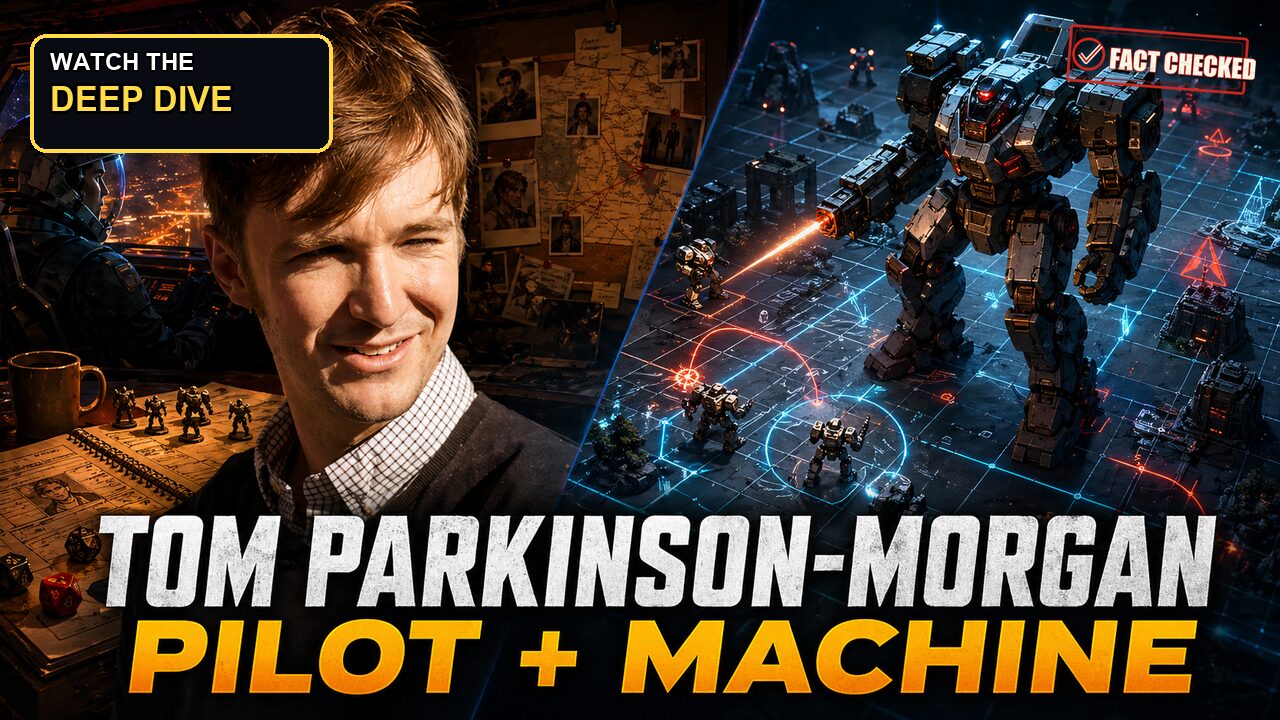
The mech is not the whole story.
The pilot matters. The reason for the mission matters. The thing waiting on the other side of the tactical map matters. If the machine is only a stat block, the fight becomes equipment math. If the pilot is only a bit of fiction stapled to the front of a war game, the drama falls away as soon as the hex grid appears.
Tom Parkinson-Morgan, working with Miguel Lopez, helped build a game that refused to choose between those halves. Lancer gives the table both the person and the chassis. It gives you the conversation before the drop, the debt that follows you into the hangar, the cause that makes the mission more than a contract, and then it gives you heat, armor, range bands, weapon mounts, frame licenses, positioning, and a tactical fight where the machine has to earn every square.
That combination is the point.
Before Lancer, mecha roleplaying already had a long history. BattleTech had been making giant machines feel heavy for decades. Mekton and other games had explored anime-style robot combat. Tactical science fiction was not new. Pilot drama was not new either.
What Lancer did in 2019 was bring those pieces together with unusual confidence. Out of the mech, the game can move fast. It lets characters talk, investigate, recover, make trouble, and carry the story forward without making every human-scale moment fight through a dense procedure. Inside the mech, the game tightens. The board matters. Loadout matters. Heat matters. Position matters. The machine is not flavor. It is the interface through which the player solves the problem.
The result was not just a clever design trick. It found an audience.
Lancer’s Kickstarter campaign raised $432,029 from 9,440 backers. For an indie tabletop RPG about customizable mechs in a politically charged far future, that number matters. It showed there were players hungry for something that did not sand off the tactical edge to become story-first, and did not bury the human story under steel, guns, and charts.
Lancer let both engines run.
The Artist Before The Hangar
Parkinson-Morgan did not arrive at Lancer as a traditional tabletop industry figure.
He was already known as the creator of Kill Six Billion Demons, the long-running webcomic published under the name Abbadon. The comic is loud, strange, mythic, crowded, violent, funny, and built like a universe that has existed far longer than the reader has been allowed to see. It is full of divine architecture, impossible cities, throne-room theology, grotesque beauty, and people standing at the edge of choices too large for them.
That matters because Lancer does not feel like a game made by someone who only loved rules.
It feels like a game made by someone who thinks worlds should have pressure inside them. Its far future is not a neutral playground for robot fights. It is a political and moral setting, built around Union, old empires, corporate powers, frontier violence, liberation projects, and the question of what a better world costs when people still have to fight inside the old one.
The mechs are gorgeous, but the setting is not there just to justify the art.
The world gives the machines meaning.
That is one of Parkinson-Morgan’s strongest instincts as a creator. He builds spectacle, then puts belief underneath it. Kill Six Billion Demons does this with myth and violence. Lancer does it with science fiction and war machines. In both cases, the visual scale is enormous, but the emotional scale stays human.
You can see the same hand at work.
The Dual Engine
The cleanest design idea in Lancer is also the easiest to misunderstand.
It is not one system that tries to do everything with the same weight. It is a game with two operating modes.
Outside the cockpit, play is lighter and more fiction-forward. The rules give the table enough structure to keep the story moving without making every conversation feel like a combat round waiting to happen. Pilots have lives, histories, relationships, causes, pressure points, and consequences. They exist before the mission starts and after the mission ends.
Then the mech hits the field.
At that point, Lancer becomes a different kind of beast. It wants the map. It wants line of sight. It wants the player to care about whether a target is just inside range, whether a reactor can handle one more push, whether the build that looked beautiful in the hangar actually survives contact with the enemy. The tactical layer is not decorative. It is deep enough for players who enjoy optimization, squad roles, battlefield control, and the pleasure of a strange machine doing exactly what it was designed to do.
That split could have failed.
A two-mode game can feel like two games duct-taped together. The narrative half can seem like filler between the real fights. The tactical half can become a separate board game that forgets the story that brought everyone there. Lancer mostly avoids that because the two modes answer different emotional needs.
The pilot scenes give the fight its reason.
The mech scenes give the story its consequence.
A player does not just ask, "Can my weapon reach?" The better question is, "Why am I willing to fire it?" Lancer gives the table room for both.
The Machine As Character
One of the reasons Lancer landed so hard with its audience is that its mechs are not interchangeable suits of armor.
They are identities.
A frame tells the table what kind of problems a player wants to create and solve. Some frames want to hold the line. Some want to break it. Some turn the battlefield into a targeting puzzle. Some are ugly little miracles of support, repair, heat pressure, drones, hacking, displacement, or patient violence. The license system gives players a reason to think about development over time, not just equipment at character creation.
That is where the tactical craft shows.
Lancer understands that a mech game lives or dies by customization, but customization alone is not enough. A player needs meaningful build choices. The choices need to show up at the table. The machine needs to feel different when it moves, when it takes a hit, when it overheats, when it creates an opening for the rest of the squad.
The best Lancer frames feel like arguments.
This is how I solve war. This is what I protect. This is what I risk. This is the shape of my answer when the map turns hostile.
That is a strong design move. It turns mechanical loadout into personality without pretending the mech and the pilot are the same thing. The pilot brings motive. The machine brings method.
Together, they make the character visible.
The Tools That Made It Playable
Lancer also benefited from something that matters more than designers sometimes admit: support infrastructure.
Games with heavy customization can collapse under their own promise. If character building becomes too slow, if the options are hard to track, if players need too many sheets and references before the first mission, the fantasy gets trapped behind administration.
Lancer’s ecosystem made that easier to survive.
COMP/CON, the digital character and campaign tool associated with the game, became part of how many players experienced Lancer. It helped make an ambitious tactical RPG feel approachable. A game about licenses, frames, talents, weapons, mounts, systems, structure, stress, heat, and mission prep needs more than enthusiasm. It needs a cockpit that players can actually read.
That support did not replace the design.
It let more people reach it.
This is one of the quiet lessons of Lancer’s success. Modern tabletop games do not live only in the book. They live in PDFs, community spaces, online tools, virtual tabletops, Discord servers, character builders, fan art, actual play, and searchable rules references. A crunchy game that ignores that reality asks too much of its players.
Lancer met its audience where that audience already played.
That helped the game feel bigger than its original footprint.
What He Actually Built
Parkinson-Morgan’s tabletop career is still young.
That matters. Lancer is the major game. ICON, his mythic fantasy RPG playtest from Massif Press, carries some of the same dual-mode thinking into another genre, with narrative play beside tactical combat inspired by console RPGs and fantasy adventure. It is a fascinating continuation, but it does not yet have the same public weight as Lancer.
So the honest assessment has to stay measured.
Parkinson-Morgan has not built a long catalog across decades. He has not proven the same design instincts across a shelf of finished tabletop products. His place on a list like this rests heavily on one game.
But it is a hell of a game to rest on.
Lancer proved that an indie mecha RPG could be tactical without becoming inaccessible, political without becoming homework, stylish without becoming thin, and narrative without giving up the joy of a hard mechanical fight. It gave giant robot fans a game where the machine mattered and the person inside it mattered too.
That is the real contribution.
He helped make the pilot and the mech belong to the same sentence again.
Where To Find Him
Tom Parkinson-Morgan is now often credited publicly as Tom Bloom and is still closely associated with the creator name Abbadon. His major public works remain Kill Six Billion Demons, Lancer through Massif Press, and the ongoing ICON playtest.
Kill Six Billion Demons remains available online. Lancer is available through Massif Press, with a large and active player community still building missions, frames, stories, campaigns, and arguments about the best way to survive a bad tactical situation. ICON continues to show where some of the same instincts may go next.
The career is not finished enough for final judgment.
That is part of what makes it interesting.
Some designers enter the field with a long apprenticeship and a trail of credits behind them. Parkinson-Morgan entered from webcomics, worldbuilding, visual excess, and mythic architecture, then helped produce a game that made giant robot combat feel emotionally legible again.
You are a pilot.
Your machine is waiting in the bay.
The map is about to matter.
But before the tactical grid hits the table, you are still a person. You have bonds, debts, orders, ideals, old wounds, and a reason to climb into all that metal.
Lancer holds both truths at once.
The pilot and the machine.
One game. Two engines. No easy way out.
Fact Check Notes
Publication notes
This site is AI-assisted and human-reviewed. We use artificial intelligence to help gather research, organize source material, and draft profile content. Human editors then read, revise, and check each profile before it goes live. Most profiles are built through deep AI research and two separate rounds of fact-checking.
Leave a Reply
You must be logged in to post a comment.