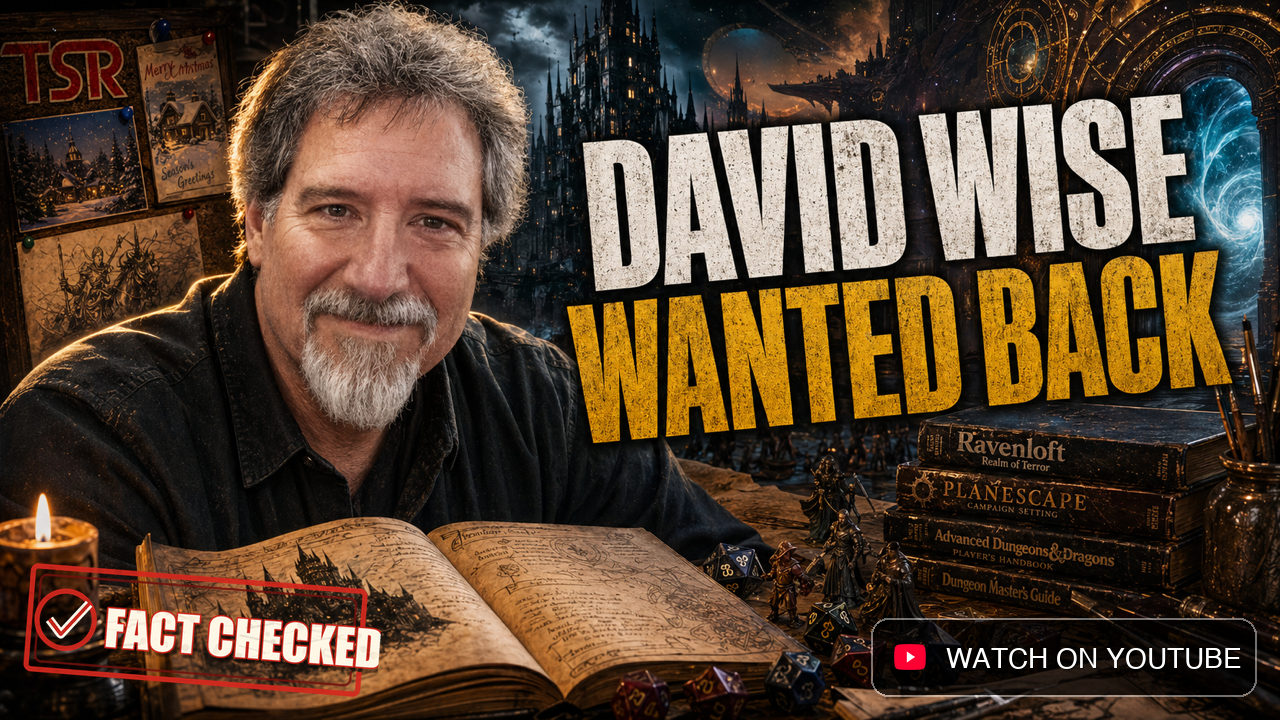
When Wizards of the Coast bought TSR in 1997, the new owners inherited more than a catalog. They inherited a wounded room, and they had to decide what was worth saving and who could still do the work.
Who should we bring back?
In one story repeated by TSR alumni, the same name kept coming up: David Wise.
That matters because Wise had just been laid off. He was one of the people cut during TSR’s brutal December 1996 layoffs, the day remembered by many former employees as the “Christmas Axe.” The version that stuck is not a corporate headline. It is an image: Wise putting up Christmas cards while the company was deciding who would still be there by the end of the day.
The detail lasts because it is not inspirational. It is practical. It is what you do when the floor is shaking and you are trying not to turn into rubble with it.
When Adkison later reached him, the story goes that Wise did not come in to sell himself. He came in to explain the people who were still there. He wanted the new owner to know who could do what, who should be trusted, and where the remaining strength of the company still lived. Then Adkison asked whether that meant Wise would refuse a job if one was offered.
That is the David Wise story in miniature. Not the loudest name on the cover. Not the designer whose reputation rests on one famous system. The person other creative people wanted in the room because he made the work safer, cleaner, stranger, and more possible.
The Kargat Chief
By the early 1990s, Wise was working for TSR, first as a freelancer and then on staff. His roles lived on the seam between design and editorial stewardship, where the work is real and the credit is easy to miss.
By the middle of the decade, he was tied to some of TSR’s most atmospheric work: Ravenloft, Planescape, board games, trading cards, organized play, and the quiet job of keeping creative teams alive inside a company that was already under stress.
Ravenloft is where his designer and editor instincts meet most clearly. Inside TSR’s Ravenloft orbit, Wise was associated with the “Kargat Chief” label, a nickname that fit the line. Ravenloft was gothic horror wearing Dungeons & Dragons clothes. It needed consistency and mood. It needed someone watching the shadows between books so the setting did not collapse into ordinary fantasy with more fog.
That kind of work is easy to underrate because it rarely announces itself as invention. A line editor can shape what a setting feels like without becoming the public face of the setting. A manager can keep the room intact long enough for anyone to write a single good page. A designer can build one crucial rule, then watch it become part of the house language.
Wise did all three.
Madness In The Dark
One of his clearest design fingerprints is tied to Thoughts of Darkness, an early-1990s Ravenloft adventure built around mind flayers, psionics, and psychological collapse. The important piece was not just the monster. It was the damage.
Wise’s hook for the module is the idea that horror in Ravenloft should not only take hit points. It should also grind at a character’s stability. Madness checks made that pressure visible at the table.
He did not invent psychological damage in roleplaying games. Call of Cthulhu had already made Sanity one of the defining mechanics in horror gaming. The difference is that Wise translated that kind of pressure into D&D’s specific machinery.
D&D is built around heroic survival. Ravenloft works best when heroism remains possible but safety never feels complete. A fear rule or madness rule changes the emotional temperature of a session. The player is no longer only asking, “Can I survive this fight?” The player is also asking, “What will this place do to me if I keep going?”
That question is the secret engine of Ravenloft. Wise helped put it into the rules.
The Gateway Box
Dragon Quest showed another side of him. Co-designed with William W. Connors and Walter E. Johnston IV, Dragon Quest was an early-1990s attempt to make a boxed gateway game for younger or newer players. It sat in the same broad space as HeroQuest: a board, miniatures, cards, monsters, heroes, treasure, and dungeon rooms you could understand before you understood the full weight of AD&D.
The box was generous. Rulebook. Adventure book. Cards. Board. Miniatures. A real attempt to give players a bridge rather than a pamphlet.
Dragon Quest stripped away some of D&D’s older friction. It used straightforward hit points instead of hit dice. It leaned on attribute checks where full AD&D had more specialized subsystems. It used a cleaner combat abstraction instead of asking new players to wrestle with THAC0 before they knew why the math mattered.
These were practical choices for a gateway product. They were not a manifesto. Wise and his co-designers were not writing the future of D&D on stone tablets. Still, the direction is striking. Decades later, D&D would move toward many of the same instincts: fewer opaque subsystems, more unified checks, easier entry points, less arithmetic as a barrier to imagination.
Dragon Quest did not beat HeroQuest. It did not become the gateway game that defined a generation. HeroQuest had the stronger brand position, cleaner toy appeal, and the famous little furniture. Dragon Quest had more content, more D&D density, and more dependence on someone at the table carrying the game.
That was the trade-off. It wanted to welcome new players without becoming shallow. It wanted to be a doorway without being a dumbed-down imitation. That is a harder design problem than it looks.
Planescape Needed A Shield
Planescape belongs to David “Zeb” Cook. That credit matters.
But Planescape also needed editors and managers who understood what was being built. A setting that strange could have been sanded down easily. Philosophical factions, planar slang, impossible city logic, moral argument as geography, and the cant of Sigil all needed protection from people who might have preferred something safer.
Wise worked in and around that editorial world, and people close to the line have credited him as one of the figures who helped the setting find and keep its voice. That does not make him the creator of Planescape. It makes him part of the reason Planescape reached the public in the form people remember.
Some creators build the machine. Some keep the machine from being broken before it ships. The second role is less visible, but anyone who has worked inside a creative company knows how much can die in meetings. Wise’s reputation inside TSR seems to come from that kind of trust. He could edit, write, and manage. He could stand between creative people and corporate pressure long enough for the work to survive.
The Christmas Axe
By 1996, TSR was in trouble. The company was carrying too many products, too much debt, too much inventory, and too little room for the people trying to make good games inside the machine.
Wise had risen into senior creative leadership. Then the layoffs came.
The Christmas-card detail lasted because it says something precise. It was not denial. It was not sentiment. It was someone trying to keep a human scale inside a collapsing office.
After Wizards of the Coast brought him back, Wise served as RPGA Worldwide Manager and helped organized play move through one of D&D’s biggest transition periods. The game was heading toward Third Edition. The network of players, judges, events, and shared campaign expectations had to move with it.
That work is not as easy to put on a thumbnail as a dragon or a castle. It is operations. It is trust. It is getting hundreds or thousands of tables pointed in the same direction without flattening the fun out of them.
Wise’s later published work includes Van Richten’s Guide to the Vistani, a Ravenloft supplement, and Marvel Super Dice, co-designed with James M. Ward. Marvel Super Dice was a collectible dice game years before dice-building and collectible dice became more familiar in the hobby. It did not get the runway it needed. TSR changed hands. The line ended almost as soon as it began.
That is another Wise pattern: good ideas inside unstable rooms.
What He Actually Built
David Wise did not invent Ravenloft. He did not create Planescape. He did not design D&D Third Edition. He was not the architect of the Open Game License. Those claims belong elsewhere.
What he built was quieter and more specific. He helped bring psychological pressure into D&D horror play through Thoughts of Darkness. He co-built a gateway D&D board game that tried to make the system easier to enter without making it empty. He wrote and edited inside Ravenloft when that line needed tone as much as rules. He helped protect Planescape’s voice at the point where a stranger setting could have been made ordinary. He helped manage organized play at a moment when D&D was changing engines.
Most of all, he made other people’s work stronger.
That is hard to measure from credits. A product page can tell you who wrote a booklet. It cannot tell you who kept a team from being interrupted, who caught the false note in a paragraph, who knew which designer needed room and which one needed structure, or who a company full of wounded creatives wanted back after the house changed hands.
In a hobby that loves named systems and famous settings, Wise’s story is about a different kind of contribution: being the person other people trust when the room is under pressure.
Where To Find Him
Wise appears to have left tabletop games around the early 2000s. A modest public trail now points away from games and into business-development and consulting work in the Milwaukee area. A public LinkedIn profile and a 2019 announcement tied to Concilium Global Compliance, Investigations & Defense Network connect a David Wise with legal and business-development work, but I found no current public tabletop design hub or active game-design storefront to point readers toward.
That may be the right ending for this piece.
Some people leave behind a single famous mechanic. Some leave behind a shelf of books. Wise left behind something harder to package: lines that held together, settings that kept their voice, players who found a doorway in, and colleagues who remembered exactly who they wanted back when the room had to be rebuilt.
The credits tell part of the story.
The people who asked for him tell the rest.
Fact Check Notes
Publication notes
This site is AI-assisted and human-reviewed. We use artificial intelligence to help gather research, organize source material, and draft profile content. Human editors then read, revise, and check each profile before it goes live. Most profiles are built through deep AI research and two separate rounds of fact-checking.
Leave a Reply
You must be logged in to post a comment.