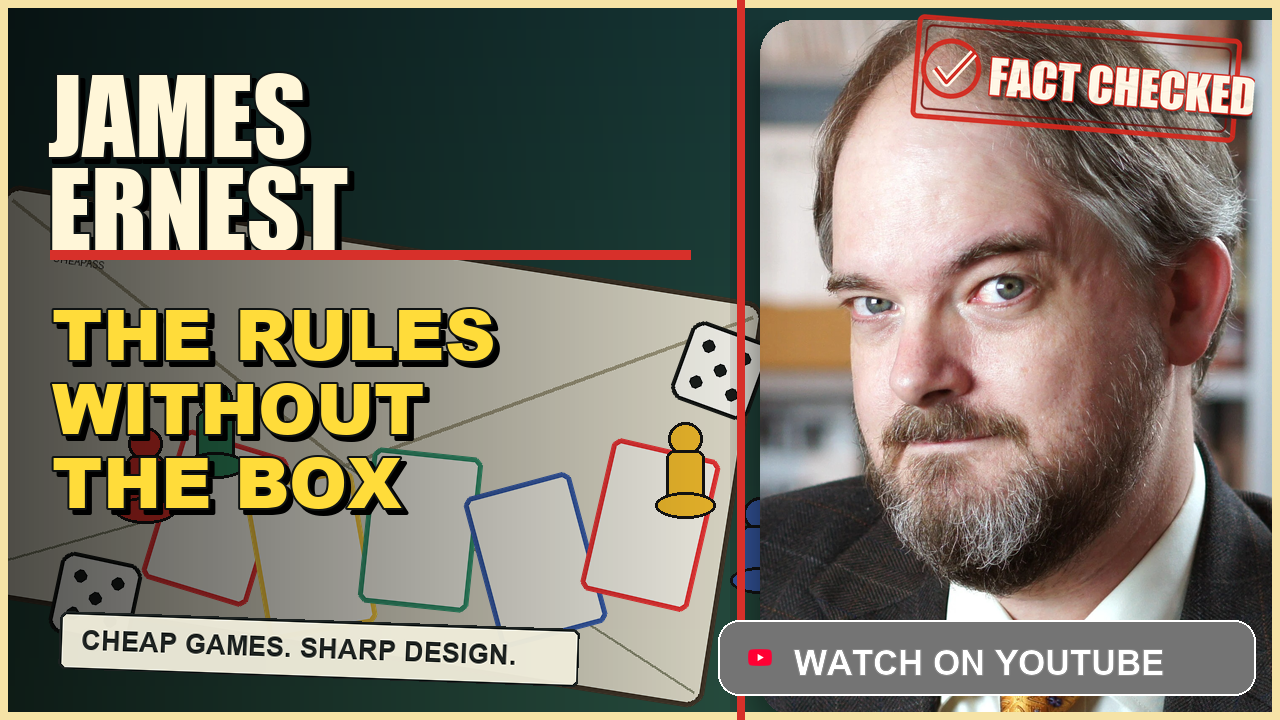
James Ernest looked at the board game box and saw the waste first.
Not the pleasure. He understood the pleasure. He loved the dice, the cards, the odd little tokens, the little theater of a table turning into a place where something could happen. But he also saw the absurdity. Every game had its own set of pawns. Every game had its own fake money. Every game had dice. If you already owned ten games, you probably owned enough generic parts to play the eleventh.
So Ernest sold the eleventh game without them.
Cheapass Games did not arrive in the 1990s as a polished hobby-game brand with glossy boxes and shelves full of plastic. It arrived as a dare: here are the rules, here are the weird parts you actually need, now go steal the rest from Monopoly. The games came in envelopes or cheap packaging. The art was black and white. The prices were low. The attitude was not.
That was the design move. Not just cheapness. Focus.
Ernest stripped the product down until the game itself had nowhere to hide.
The Juggler Who Learned Timing
Before Cheapass Games, Ernest was a professional juggler.
That sounds like a colorful footnote until you look at his games. Juggling is timing, rhythm, spatial prediction, and failure management. It is also performance. You do not get to explain the trick for ten minutes before the audience decides whether it works. The thing either lands or it does not.
Ernest worked as a performer before he became a fixture in tabletop publishing. He also self-published Contact Juggling, a book about a one-ball manipulation style associated with Michael Moschen and made famous to many viewers through Labyrinth. The book belongs to his pre-game life, but the habit matters: write clearly, lay things out yourself, make the physical object, sell it without waiting for permission.
That skill set became more useful than a business degree.
In 1993, Ernest joined Wizards of the Coast, just as Magic: The Gathering was turning a small game publisher into the center of a new industry. He worked there as an editor, graphic designer, and technical writer. In other words, he was standing near the machinery at the moment hobby gaming discovered that rules, graphic clarity, collecting, community, and distribution could all ignite each other.
He learned a lot. He also saw the parts that did not fit him.
The early collectible card game boom was explosive, but it was not small. It rewarded scale, rarity, product churn, and industrial confidence. Ernest’s instinct ran the other direction. He wanted to make a bunch of games quickly, see which ones lived, and keep the useful parts moving.
When the idea for Cheapass Games did not find a home at Wizards, he took it outside.
The White Envelope Revolution
Ernest launched Cheapass Games in 1996.
The name was funny, but it was also a thesis. Cheapass Games sold games that left out the common components players already owned. You supplied dice. You supplied pawns. You supplied play money. Cheapass supplied the idea, the rulebook, the board or cards that made this game different from the pile on your shelf.
That changed the economics of small games. It also changed the psychology.
A Cheapass game did not ask to be treated like a luxury object. It asked to be played. The low price made experimentation easier. The stripped package made the rules feel closer to the table. If a game failed, it failed fast and honestly. If it worked, it worked because the engine was alive.
Kill Doctor Lucky made the argument in one clean joke.
Instead of solving a murder after it happened, players tried to commit one before anyone else could see them. Doctor Lucky wandered his mansion. The players stalked him. Line of sight mattered. Timing mattered. The premise was a joke, but the joke was not pasted on top. It was the mechanism. Every player understood what they wanted and why they could not quite do it yet.
That became one of Ernest’s signatures. His best comedy games are not joke-delivery systems. The humor comes from the rules putting players into ridiculous pressure. A zombie fast food restaurant in Give Me the Brain. A freefall in Falling. A kung fu fight in Brawl. Cows clearing minefields in Unexploded Cow.
The premise makes you laugh once. The system makes the table laugh again.
The Small Machines
Cheapass Games became a laboratory because the costs were low enough to let Ernest keep trying things.
Button Men turned pin-back buttons into fighter cards. Each button showed a character and a set of dice. The button was identity, package, rules reference, and collectible object at the same time. That is a very James Ernest move: collapse four jobs into one physical thing and then let the players fight with it.
Falling and Brawl pushed tabletop games into real time. Players did not wait politely for turns. They played fast, interrupted, reacted, and tried to keep up. The point was not chaos for its own sake. It was matching the rules to the fiction. A game called Falling should not feel like a committee meeting. A brawl should not ask everyone to take a number.
Diceland went after the component itself. The game used paper dice as both randomizers and battlefield pieces. You did not just roll the object. You positioned it. You read it. You fought with it. Again, the object did more than one job.
Pairs, designed with Paul Peterson, is quieter but just as revealing. It uses a triangular deck: one 1, two 2s, three 3s, all the way up to ten 10s. That 55-card deck is not merely a deck for one game. It is a platform. Many games can live on that distribution, the same way hundreds of games live inside a standard deck of playing cards.
That is Ernest at his most distilled. He likes games that feel like they could have existed already. Not because they are old-fashioned, but because they are clean enough to survive outside their first box.
The Bigger Table
The Cheapass identity was strong enough that it can obscure the range of Ernest’s career.
He did not only make small envelope games. He co-designed Lords of Vegas with Mike Selinker, a full-bodied casino-building game far from the spare Cheapass presentation. He helped bring Tak: A Beautiful Game into the real world with Patrick Rothfuss, turning a fictional game from The Wise Man’s Fear into an abstract strategy game people could actually study, play, and argue about. He worked on Trogdor!! The Board Game with The Brothers Chaps, translating Homestar Runner absurdity into cooperative tabletop action.
He also moved through digital game work, including time with Microsoft’s Carbonated Games and credits connected to projects such as Fable II Pub Games and Full House Poker. That part of the story matters because Ernest has always been unusually comfortable with game math. Casino games, pub games, push-your-luck systems, dice volatility, bluffing, probability: these are not decorative interests in his work. They are the floor.
He is not a theme-first designer in the lazy sense. He is a theme-as-clarity designer. If the story makes the rules easier to remember, the story is doing work. If the component carries the information, the component is doing work. If the joke explains the decision, the joke is doing work.
Nothing gets a free ride.
The Business Kept Changing
Cheapass Games never sat still because the business around it never sat still.
The company began as a small press experiment in low-cost publishing. It later moved through fuller productions, print-and-play releases, Kickstarter campaigns, deluxe editions, licenses, collaborations, and catalog management. In 2019, Ernest licensed the Cheapass Games catalog to Greater Than Games and started building Crab Fragment Labs as a new creative home for games, essays, fiction, videos, and experiments.
Then the catalog came home.
By 2025, Cheapass Games and Crab Fragment Labs were reunited under the Crab Fragment roof. The official site now treats them as two sides of the same long project: the older Cheapass catalog and the newer Crab Fragment work, with print-and-play files, print-on-demand options, DriveThruCards releases, videos, design articles, and current updates.
That is not a retreat from publishing. It is a return to the part Ernest always seemed to trust most: direct connection between a designer, a rules system, and the players willing to try it.
The old Cheapass joke was that games cost too much. The deeper point was that publishing can make designers forget what the game is.
Ernest rarely forgot.
What He Actually Built
James Ernest did not invent independent tabletop publishing. He did not invent funny games. He did not invent print-and-play. He did not invent small games.
What he did was make a durable argument for all of them at once.
He proved that a tabletop game could be cheap without being careless. It could be funny without being disposable. It could be physically minimal and still mechanically sharp. It could use an envelope, a button, a paper die, a borrowed pawn, or a strange card distribution and still feel complete.
That matters because tabletop games are always fighting the same temptation: more stuff. More components, more rules, more chrome, more box, more shelf presence. Sometimes more is right. Sometimes the dragon miniature really does carry the moment. Sometimes the deluxe board earns its space.
Ernest’s work asks the harsher question first.
What if the game does not need it?
That question shaped a whole corner of the industry. You can see its shadow in the acceptance of print-and-play files, small-box games, microgames, fast crowdfunding prototypes, handmade editions, experimental card decks, and designer-led publishing that does not wait for a traditional gatekeeper to bless it. Not every one of those paths comes from Cheapass Games. The industry is bigger and messier than one origin story. But Ernest gave designers a visible model for how to be prolific, strange, frugal, and serious about the work.
He also gave players permission to meet a game halfway. Bring your own dice. Bring your own pawns. Bring your willingness to try something odd.
The box was never the point.
Where To Find Him
James Ernest is active through Crab Fragment Labs, the current home of both his newer work and the Cheapass Games catalog. The site hosts games, design writing, fiction, videos, print-and-play material, and links to current stores and support channels. It also keeps a schedule page for appearances and events.
He remains connected to the practical side of design: teaching, explaining, testing, revising, publishing, and finding new ways to get old and new games back onto tables without rebuilding the same expensive machine around them.
That is the throughline from the white envelopes to Crab Fragment Labs. Ernest keeps asking how little a game needs in order to become playable, memorable, and alive.
Then he sells you that part.
Fact Check Notes
Publication notes
This site is AI-assisted and human-reviewed. We use artificial intelligence to help gather research, organize source material, and draft profile content. Human editors then read, revise, and check each profile before it goes live. Most profiles are built through deep AI research and two separate rounds of fact-checking.
Leave a Reply
You must be logged in to post a comment.