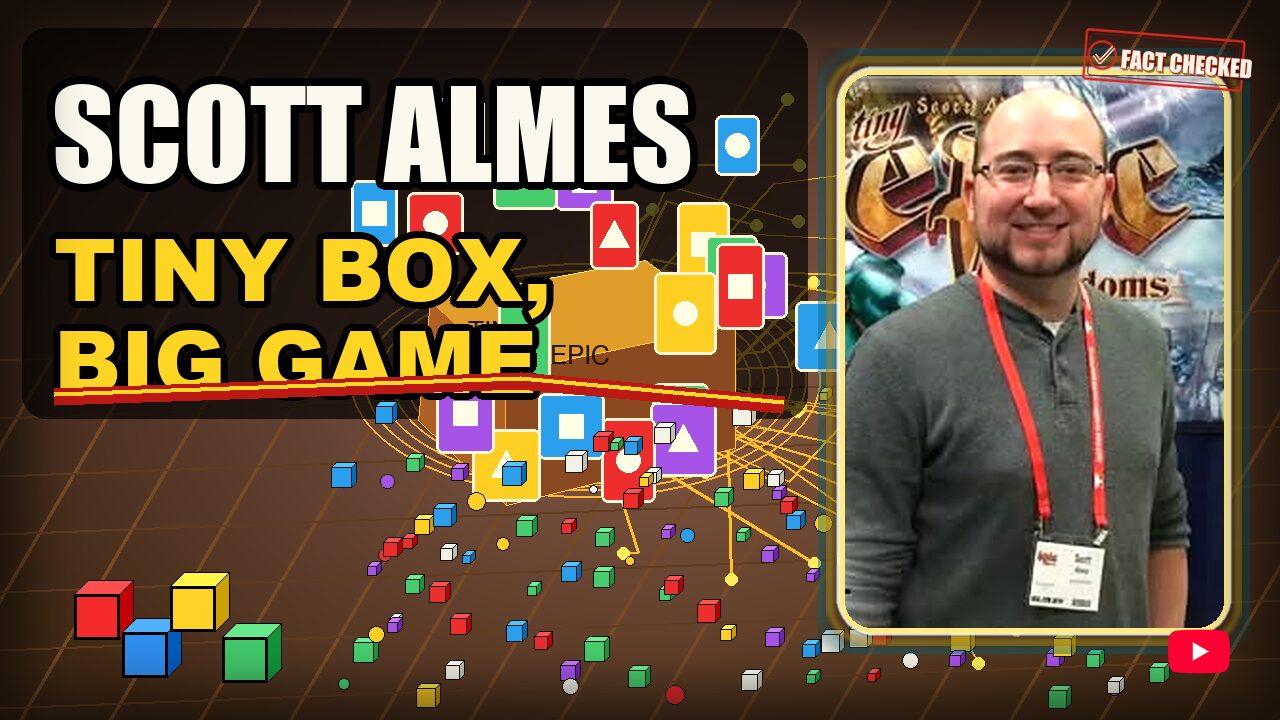
Scott Almes did not make small games because small was cute.
He made small games because small was the problem.
That is the difference. A tiny box can be a gimmick. A pocket-sized strategy game can be a novelty. A reduced component count can be a marketing hook. Almes turned all of that into a repeatable design discipline. The question was not, "Can a game fit in here?" The question was, "What has to become sharper if this is all the room you get?"
Tiny Epic Kingdoms answered first.
Released through Kickstarter in 2013, it took area control, resource management, faction powers, and a full fantasy strategy feel and packed them into a box that looked almost too small for the job. It was not the first small-box game. It was not the first microgame to prove that minimal components could still produce real decisions. But it made a different argument.
Small did not have to mean slight.
That idea became the center of Almes’s public design identity. Tiny Epic was not one game. It was a promise repeated across genres.
The Tiny Epic Proposition
The Tiny Epic line works because the title is a dare.
Tiny sets the constraint. Epic sets the expectation. If either half fails, the game collapses. Too tiny, and the experience feels thin. Too epic, and the box cannot hold it. Almes’s job was to keep both words alive at the same time.
Tiny Epic Kingdoms established the pattern. Players received a fantasy civilization game with territories, resources, factions, and conflict, but without the giant table footprint that usually comes with that kind of experience. It asked players to look at a small spread of cards and pieces and imagine a much larger war happening underneath.
Tiny Epic Galaxies pushed the idea into space. Dice became ships, decisions, timing, and opportunity. The follow-the-leader activation system made every player’s roll matter beyond one turn. Someone else took an action and you had to decide whether to spend culture to follow. That single move did a lot of work. It kept players engaged, created pressure around timing, and made a small dice game feel like a shared race for planetary control.
Tiny Epic Quest leaned toward adventure and push-your-luck fantasy. Tiny Epic Dinosaurs brought worker placement into a dinosaur ranch. Tiny Epic Tactics played with terrain and tactical combat. Tiny Epic Pirates, Tiny Epic Vikings, Tiny Epic Zombies, and Tiny Epic Crimes each took a different genre and asked the same design question again.
What is the smallest physical form that can still carry the experience?
That is not a simple production question. It is a design question.
The Engineering Mindset
Almes has worked outside tabletop as a product development engineer, and that matters. His games often feel like they come from someone who thinks in constraints, tolerances, and efficient use of material.
A larger game can hide waste. Add another deck. Add another board. Add another phase. Add a tray of custom pieces. The table gets bigger, the box gets heavier, and the design can sometimes avoid choosing what really matters.
Tiny Epic cannot do that.
A card may need to be a map, a power, a rule reminder, and a scoring element. A token may need to represent movement, ownership, pressure, and future threat. A die face cannot merely be colorful. It has to create a decision. Every component is on trial.
That is where Almes’s work becomes more interesting than the phrase "small-box designer" suggests. The box is not the innovation by itself. The box is the pressure chamber. The innovation is what survives inside it.
This is why the best Tiny Epic games feel larger than they are. They do not reproduce the full sprawl of the genres they borrow from. They identify the emotional and strategic core, then build around that. The player still feels expansion, scarcity, timing, risk, and momentum. The table does not need to be buried in cardboard for the decisions to have weight.
The Series As A Design Lab
The Tiny Epic series also gave Almes something most designers never get: a public laboratory with a fixed constraint.
Every new title changed the genre. The box size stayed familiar. That created a useful tension. Fans came to each release knowing the promise, but not the solution. How would this format handle zombies? How would it handle dinosaurs? How would it handle pirates? Could it support tactical combat? Could it support deduction? Could it carry a campaign feel?
Some entries landed harder than others. That is part of the truth.
The constraint that makes the line interesting can also make it unforgiving. Sometimes a Tiny Epic game feels dense in the wrong way. Sometimes the compression shows. A mechanism that might breathe in a larger game can feel tight or fiddly in a smaller one. There are entries that feel like strong proofs of concept more than fully relaxed designs.
But the unevenness does not erase the achievement. It reveals the difficulty of the attempt.
Designing one small strategic game is hard. Repeating the trick across area control, dice activation, worker placement, adventure, tactical combat, deduction, piracy, zombies, vikings, dinosaurs, and crime is something else. The line became recognizable not because every title solved the problem perfectly, but because the problem itself was clear.
The same shelf promise kept returning.
Here is a genre you know. Here is a box that should not hold it. Let’s see what happens.
What He Actually Built
Scott Almes did not invent small games. He did not create microgaming. He did not prove, by himself, that short rules and modest components could carry meaningful play. Designers before him had already shown that compact games could hit hard.
What Almes built was a repeatable design proposition.
He took the small-box idea and made it into a franchise engine. Not one clever exception. Not one minimalist trick. A whole branded shelf of compressed genre studies, each one trying to deliver a recognizable strategic experience with less physical stuff than the genre usually demands.
That matters because tabletop gaming has a material problem. Games take space. They cost money to produce. They crowd shelves. They ask for table time, storage space, and attention. The modern hobby loves abundance, but abundance has a cost.
Almes’s work argues for efficiency without surrender.
It says a game can be smaller without becoming casual. It says component limits can sharpen rather than weaken design. It says the designer’s job is not always to add more. Sometimes the better question is what can be made to do two jobs at once.
That idea has traveled beyond any single Tiny Epic title. You can see it in how publishers talk about portability, component value, shelf presence, and crowdfunding efficiency. A small box is not automatically a virtue. A reduced footprint does not guarantee elegance. But Tiny Epic made the pitch visible enough that other designers and publishers had to take the category seriously.
The format became a recognizable challenge, not just a packaging choice.
The name helped.
Tiny Epic is one of those rare tabletop labels that explains the product before you open it. It tells the buyer what to expect. It gives the designer a rule. It gives the publisher a shelf identity. That kind of brand clarity is not just marketing. In this case, it is design philosophy printed on the lid.
It also changed the conversation around value. A player could look at the box and understand the bargain immediately: less cardboard, less storage, less setup, but still a real strategic meal. That promise is dangerous if the game cannot support it. The small box makes disappointment easier to see. Almes kept returning to that risk anyway. He treated the tiny format like a contract with the player, not a discount version of a larger idea.
Where To Find Him
The Tiny Epic line has continued beyond its original Gamelyn Games era. In July 2025, Tycoon Games acquired Gamelyn Games, including the Tiny Epic brand. In March 2026, ICv2 reported that Tycoon Games and Skybound Tabletop were partnering on Tiny Epic Invincible, with Scott Almes credited as designer and a Kickstarter planned for that year.
That is the right kind of continuation for Almes’s public story. The line did not end as a clever experiment from the crowdfunding boom. It became durable enough to change hands and keep moving.
Almes remains visible through his designer catalog and through the continuing life of Tiny Epic. His legacy is not one giant masterpiece sitting in the middle of the table. It is a row of small boxes asking the same question in different languages.
How much game can fit in here?
For Scott Almes, the answer was never just about size. It was about discipline. The box was the boundary. The design was what happened when the boundary refused to move.
Fact Check Notes
Publication notes
This site is AI-assisted and human-reviewed. We use artificial intelligence to help gather research, organize source material, and draft profile content. Human editors then read, revise, and check each profile before it goes live. Most profiles are built through deep AI research and two separate rounds of fact-checking.
Leave a Reply
You must be logged in to post a comment.