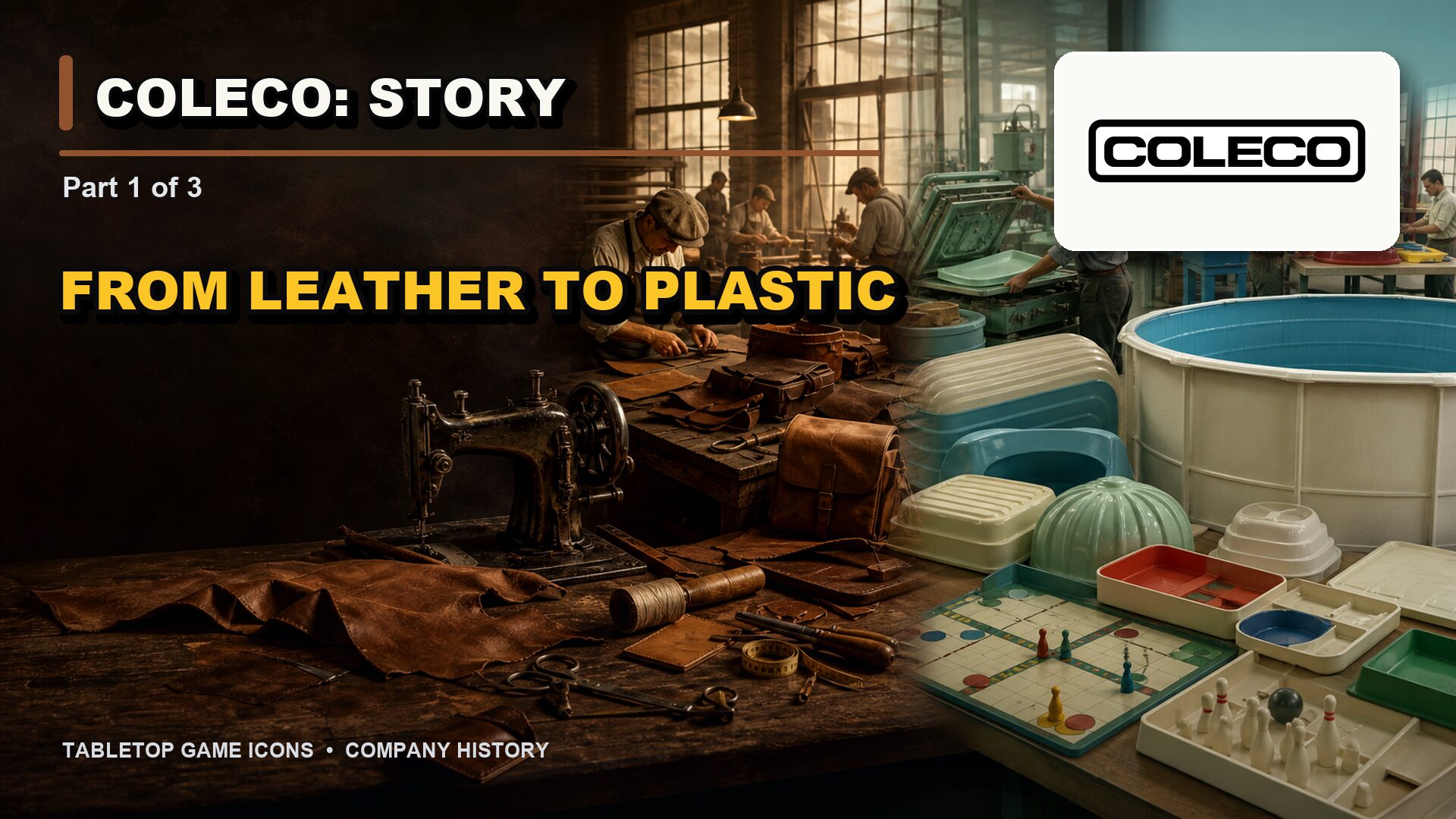
FROM LEATHER TO PLASTIC
Coleco began with shoe repair.
The name that later appeared on video-game consoles, electronic football games, swimming pools, dolls, and Scrabble boxes was originally an abbreviation for Connecticut Leather Company.
Maurice Greenberg founded the business in the Hartford area in 1932. He was a Russian-Jewish immigrant serving shoe-repair shops with leather and “shoe findings,” the materials and small components needed to restore footwear. During the Depression, repair was not a marginal service. Families needed existing shoes to last.
The company added rubber footwear in 1938 and expanded during World War II into machinery and supplies connected to shoes and cleaning. Nothing in that beginning predicted Donkey Kong or Cabbage Patch Kids.
The shift came through Maurice’s son Leonard Greenberg, an engineer. Leathercraft kits gave the company an entry into children’s products. At the 1954 New York Toy Fair, a moccasin kit received recognition as a Child Guidance Prestige Toy.
Leonard saw a larger opportunity in plastics.
Vacuum forming could turn heated plastic sheets into lightweight shapes faster and more cheaply than many traditional methods. Connecticut Leather began producing plastic toys, sandboxes, toboggans, and wading pools during the second half of the 1950s.
Pools became the breakthrough. They used the same basic skill the company had learned through leather: transforming flexible material into a durable consumer object. The materials changed, but the manufacturing instinct remained.
In 1961, the company sold the old leather and shoe-findings business and reorganized as Coleco Industries, Inc. It went public in January 1962, offering 120,000 shares at five dollars each. The corporate identity now matched the abbreviated name customers saw.
Coleco acquired Kestral Corporation in 1963 and became a leading producer of above-ground swimming pools. Playtime Products followed in 1966. Eagle Toys of Canada joined in 1968 and became Coleco Canada.
Leonard persuaded his brother Arnold Greenberg, a lawyer, to join the company. Arnold became chief legal counsel and later president and chief executive. The brothers combined engineering, manufacturing, licensing, and financial ambition.
By the end of the 1960s, Coleco operated ten plants. It listed on the New York Stock Exchange in 1971 and reported sales approaching fifty million dollars. The old leather supplier had become a diversified leisure-products manufacturer.
Not every expansion worked. Coleco entered snowmobiles as winter recreation boomed, but poor snowfall and market pressure weakened the line. It sold the Alouette snowmobile operation in 1975.
The retreat did not make the company cautious.
Home video games were beginning to attract attention. Atari’s Pong had shown that electronic play could move from arcades to television sets. Ralph Baer, whose work had helped create the first home console, alerted Coleco to General Instrument’s AY-3-8500 chip, which condensed a Pong-style game into an affordable component.
Arnold Greenberg ordered early and aggressively during a chip shortage. Coleco became General Instrument’s first major customer and received enough components to ship while rivals struggled.
The Coleco Telstar arrived in May 1976 at $49.95. It connected to a television and offered electronic table tennis. More than one million units reportedly sold, and Telstar sales transformed the company’s revenue.
The product fit Coleco’s history. It did not invent video games, just as it had not invented leather or plastic pools. It recognized a manufacturing opportunity, secured supply, licensed necessary technology, and moved quickly.
Success encouraged too many variations. Coleco released roughly fourteen Telstar models while the market shifted toward programmable cartridge systems. A dock strike disrupted imported circuit boards during the crucial 1977 holiday season. Obsolete inventory piled up. The company dumped more than a million aging units and reported a 1978 loss above twenty million dollars.
Coleco approached collapse.
Handheld electronic sports games created the next rescue. Head-to-Head Baseball, Electronic Quarterback, and related products turned red lights and simple controls into portable competition. The category produced enormous late-1970s sales and restored cash.
The company had now survived a path from leather to pools, from pools to a failed snowmobile expansion, and from a television-game boom to an electronic crash.
Coleco’s pattern was set.
It could see the next craze early.
It had not learned when to stop chasing it.
The Greenberg family’s willingness to leave leather was the source of Coleco’s strength. Leonard Greenberg recognized that postwar consumers were spending on recreation and that molded plastic could support entirely different products. Above-ground swimming pools became a major business, giving Coleco experience with seasonal demand, large retail orders, and mass production.
The company reorganized as Coleco Industries in 1961 and went public in January 1962. Public capital supported expansion, but it also increased expectations. Acquisitions and new categories promised growth faster than the mature leather trade could provide.
Not every expansion worked. Snowmobiles created losses and showed the danger of entering a capital-intensive seasonal market. Coleco recovered, then moved toward home electronics when simple television games became commercially possible.
Telstar, released in 1976, arrived during the first home-video-game boom. Its success demonstrated Coleco’s ability to source technology, package it for mass retail, and move quickly. The advantage vanished when too many similar machines entered the market. Chip shortages were followed by excess supply, and a dock strike complicated the flow of inventory. Coleco reported a severe 1978 loss.
Handheld electronic sports games offered another rescue. The company translated football and other sports into lights, buttons, and simple sounds that could be sold as self-contained toys. The products did not require a television or interchangeable software. Once again, Coleco found a growing category at the right moment.
That cycle became the company’s identity: enter quickly, manufacture aggressively, recover through the next product. Each successful turn encouraged management to believe speed could solve the risks created by the previous one.
Retail buyers rewarded that speed because a fast supplier could capture a season before competitors arrived. Bankers and shareholders saw the same momentum as growth. Inside Coleco, however, every new category demanded unfamiliar engineering, forecasts, suppliers, and service. Reinvention multiplied both opportunity and the number of ways a launch could fail.
THE ELECTRONIC BOOM
Coleco reached its height by placing the arcade, the computer, and the year’s most wanted doll inside one company.
Its tabletop Mini-Arcade games appeared in 1981 and 1982. Small cabinets reproduced the identity of Pac-Man, Galaxian, Donkey Kong, and Frogger with vacuum-fluorescent displays. They were not exact arcade conversions, but they turned familiar cabinet shapes and licensed names into toys that could sit on a desk.
The first four reportedly sold about three million units within a year. Coleco had learned that players wanted recognizable arcade experiences even when the technology reduced them to bright shapes and simplified movement.
ColecoVision made the larger promise.
Released in North America in August 1982 at about $175, the console offered graphics that looked closer to contemporary arcade games than earlier home systems. Its decisive advantage was Donkey Kong, licensed from Nintendo and included with the hardware.
Executive Eric Bromley negotiated with Nintendo president Hiroshi Yamauchi. The agreement required an advance and royalties, but it gave Coleco the game consumers used to judge the machine. The console sold hundreds of thousands of units during its first months and passed two million during its central run according to the conservative public estimate.
Coleco expanded in several directions. It sold software for rival Atari and Intellivision systems. It released the Gemini, compatible with Atari 2600 software. An expansion module let ColecoVision run Atari cartridges, leading to litigation. Every move tried to convert hardware success into a broader platform.
The Adam computer turned that ambition into disaster.
Announced in June 1983, Adam was designed as a complete family computer and as an expansion for ColecoVision. It included a keyboard, printer, storage system, and software. Executives predicted half a million units by Christmas.
The price rose between announcement and shipment. Production delays pushed release toward the holiday season. Early units suffered severe defects and high return rates. Major retailers hesitated. Coleco shipped far fewer computers than planned and discontinued Adam in January 1985.
The company exited electronics, but another craze was already carrying it.
Xavier Roberts had developed soft-sculpture “Little People” dolls through Original Appalachian Artworks. Licensing agent Roger Schlaifer helped turn the concept into Cabbage Patch Kids and arranged a mass-market agreement with Coleco in August 1982.
Coleco was the manufacturer and master toy licensee, not the creator or owner of the underlying characters. It adapted the dolls for large-scale production with vinyl heads, computer-generated names, adoption papers, and factories capable of supplying national retailers.
The 1983 launch triggered extraordinary demand. Shoppers fought over limited stock, and news reports turned scarcity into additional advertising. Coleco shipped more than three million dolls in the first year. The line earned industry awards and generated billions of dollars in retail sales across its peak.
The dolls rescued Coleco from Adam’s failure. They also encouraged the belief that one enormous hit could support any expansion.
The history behind the dolls was contested. Kentucky artist Martha Nelson Thomas had created handmade Doll Babies before Roberts commercialized a related idea. Her dispute was with Roberts and Original Appalachian Artworks, not Coleco, and it ended without a published court decision. Coleco’s role began later as licensee. Blaming or crediting Coleco for the original authorship dispute confuses the chain.
By 1985, demand was cooling. A collectible phenomenon depends on scarcity and desire, but mass manufacturing depends on volume. Making enough dolls to satisfy the craze could also destroy the shortage that helped sustain it.
Coleco searched for durable properties.
In May 1986, it bought the games business of Selchow & Righter. The deal brought Scrabble’s United States and Canadian rights, Parcheesi, and the American Trivial Pursuit relationship. The purchase was widely reported at $75 million in cash and notes, though one source gives $60 million.
On paper, the logic was strong. Scrabble and Parcheesi were evergreen games that did not depend on electronics or a seasonal doll craze. They could stabilize Coleco.
In practice, the purchase added debt while the company was still absorbing Adam losses and weakening Cabbage Patch sales. Plants and operations required integration. Trivial Pursuit itself was already coming down from a historic spike.
Coleco had produced three spectacular peaks in less than a decade: Telstar, ColecoVision, and Cabbage Patch Kids. Each demonstrated speed, licensing skill, and manufacturing reach. Each also generated inventory and expectations that became dangerous when demand shifted.
The company’s height was real. Millions of children played its electronic games and adopted its dolls. Its name became one of the most visible in American toys.
The financial structure beneath the visibility was failing.
ColecoVision succeeded because it offered a convincing version of the arcade experience. The console launched in August 1982 with Nintendo’s Donkey Kong as its central attraction. Coleco had licensed the home-console rights, giving buyers a famous game at the moment they opened the box. Strong graphics and an expanding software library made the system a serious rival to Atari and Mattel.
Adam attempted to turn that success into a home-computer business. The package combined a computer, keyboard, printer, and storage system, but delays, defects, data problems, and a high effective price damaged the launch. Coleco had committed inventory and reputation to a machine that required far more support than a console. Production ended in January 1985.
Cabbage Patch Kids provided a spectacular counterweight. Xavier Roberts had developed the dolls and adoption concept through Original Appalachian Artworks. Coleco became the master toy licensee in August 1982 and engineered the soft-sculpture idea for mass production. The 1983 demand created famous store crowds and made the dolls a cultural event. Coleco did not originate the characters, and the separate dispute involving folk artist Martha Nelson Thomas concerned Roberts and his company rather than Coleco’s invention of the line.
The boom generated enormous sales but encouraged expansion around demand that could not remain frantic forever. When doll sales cooled, Coleco had Adam losses and the cost of acquiring Selchow & Righter. A catalog containing Scrabble, Parcheesi, and Trivial Pursuit distribution rights looked like stability, yet the reported $75 million purchase added pressure before integration could deliver it.
Coleco’s products were popular. The problem was the amount of money committed before popularity could be measured accurately.
THE COMPUTER BROKE THE SPELL
Coleco’s final collapse was not caused by one bad computer.
Adam was the deepest wound, but the company had built a business that repeatedly mistook a fast boom for permanent demand.
The Telstar glut had nearly destroyed Coleco in the late 1970s. Handheld games rescued it. ColecoVision created another surge. Adam consumed the proceeds. Cabbage Patch Kids supplied a third rescue. The expensive purchase of Selchow & Righter arrived as that rescue weakened.
In 1987, Coleco reported a loss above $100 million on sales above $500 million. It defaulted on interest tied to hundreds of millions in debt. In May 1988, the company cut nearly half its staff, and Arnold Greenberg left the chief executive role.
Coleco filed for Chapter 11 protection in July 1988 in the Southern District of New York. The petition was lodged on the evening of July 11 and publicly reported July 12, which explains the two dates found in histories. Contemporary reporting placed liabilities near $540 million.
The business came apart through asset sales.
SLM Action Sports bought the swimming-pool and snow-goods divisions. Hasbro acquired children’s furniture, ride-on toys, and two New York plants for about $21 million. Those transactions reduced the company before the main sale.
In June 1989, Hasbro agreed to buy most of Coleco’s remaining assets for about $85 million in cash, with additional securities terms reported. Bankruptcy-court approval cleared the transfer that July.
Hasbro gained Cabbage Patch Kids, Scrabble, Parcheesi, and other products. It placed the board games within the Milton Bradley structure it had acquired in 1984. Cabbage Patch dolls continued under Hasbro before later licenses moved to Mattel and other manufacturers.
Trivial Pursuit requires separate wording. Selchow & Righter had been the United States distributor, not the owner. The property belonged to Horn Abbot. Hasbro later handled it through Parker Brothers and did not acquire full global ownership until paying $80 million in 2008.
The original Coleco Industries corporation did not become the modern Coleco brand.
After the bankruptcy and asset transfer, the legal shell wound down. The name lay largely dormant until River West Brands began reviving it around 2005. Coleco Holdings LLC was formed in 2014, and Dormitus Brands later became the parent.
This modern owner licenses trademarks and nostalgia. It is a separate company, not a reorganized continuation of Maurice Greenberg’s leather business.
The distinction became public during the Coleco Chameleon episode. In 2015, Coleco Holdings licensed its name to a proposed cartridge-based retro console derived from the Retro VGS project. Promoters used shells based on the Atari Jaguar and displayed supposed prototypes at events.
Technical investigators found that one display contained hardware from an older Super Nintendo, while another appeared to conceal a video capture card. Coleco Holdings demanded access to a working prototype. When the developers could not satisfy the inspection, the brand owner terminated the project in March 2016.
The Chameleon never became a consumer product. It demonstrated both the value and danger of a dormant trademark. A familiar name could give an unproven machine credibility before the hardware existed.
Coleco’s real legacy is stronger than that failed revival.
Telstar placed home video games before families during the first console wave. The Head-to-Head handhelds turned simple electronic displays into shared sports competition. The Mini-Arcades preserved the shapes and licenses of arcade cabinets on a tabletop. ColecoVision delivered an influential early home version of Donkey Kong and proved that consumers would reward arcade quality.
Adam became a warning about announcing a complex computer before manufacturing and reliability were ready. Its failure showed how quickly a successful console company could lose retailer and consumer trust.
Cabbage Patch Kids demonstrated mass licensing at extraordinary scale. Coleco turned handmade character concepts into named dolls with adoption rituals that made every unit feel personal. The craze also exposed the tension between scarcity marketing and mass production.
The company’s oldest line offers the strangest ending. Above-ground pools, not electronics, had supplied Coleco’s stable industrial base. Selling that business removed one of the last links to the plastic-forming pivot that had carried Connecticut Leather into toys.
Maurice and Leonard Greenberg built a company capable of changing materials, categories, and identities. Arnold Greenberg pushed it toward licensed electronics and mass-market phenomena. Their speed produced astonishing successes.
It also produced repeated overreach.
The original company is gone. Hasbro owns many former assets. Other companies hold Cabbage Patch licenses. Coleco Holdings owns active modern Coleco marks but not the old corporation.
The name survives because the machines and dolls mattered to people.
Leather became plastic. Plastic became electronics. Electronics became memory.
Coleco filed for Chapter 11 protection in July 1988. The proceeding followed efforts to sell assets, reduce operations, and find a path around debt. In 1989, Hasbro acquired the principal toy and game assets for about $85 million. The transaction carried former Selchow & Righter properties into Hasbro’s expanding games portfolio.
The Cabbage Patch Kids property followed its own licensing history because Coleco had been a licensee rather than the original owner. Original Appalachian Artworks and later corporate owners could appoint new manufacturers. Dolls bearing the characters therefore survived without the company that had created the 1983 mass-market boom.
The Coleco name also returned through a separate chain. Modern Coleco Holdings, associated with River West Brands and later Dormitus Brands, controls revived marks and licenses. It is a brand successor, not the original Connecticut corporation restored to life.
That distinction became especially important during the Coleco Chameleon episode. A proposed retro console appeared in 2015 and 2016 under license to the Coleco name. Public demonstrations used hardware that observers concluded did not match the promised system, including a disputed prototype shown in an Atari Jaguar shell. Coleco Holdings ended the relationship on March 8, 2016. The failure belonged to the modern licensed project, not to the engineers who built ColecoVision decades earlier.
Coleco’s genuine legacy remains substantial. Its console brought strong arcade licenses into homes. Its tabletop electronic games made digital play portable. Its Cabbage Patch manufacturing and marketing turned a handcrafted concept into a mass phenomenon. Its failures became warnings about inventory, hardware launches, and building a company around short-lived crazes.
Few businesses changed categories so often or so visibly. Coleco’s story is not one steady ascent. It is a series of reinventions, each brilliant enough to save the company until the last one could not.
Fact Check Notes
Publication notes
This site is AI-assisted and human-reviewed. We use artificial intelligence to help gather research, organize source material, and draft profile content. Human editors then read, revise, and check each article before it goes live.
Leave a Reply
You must be logged in to post a comment.