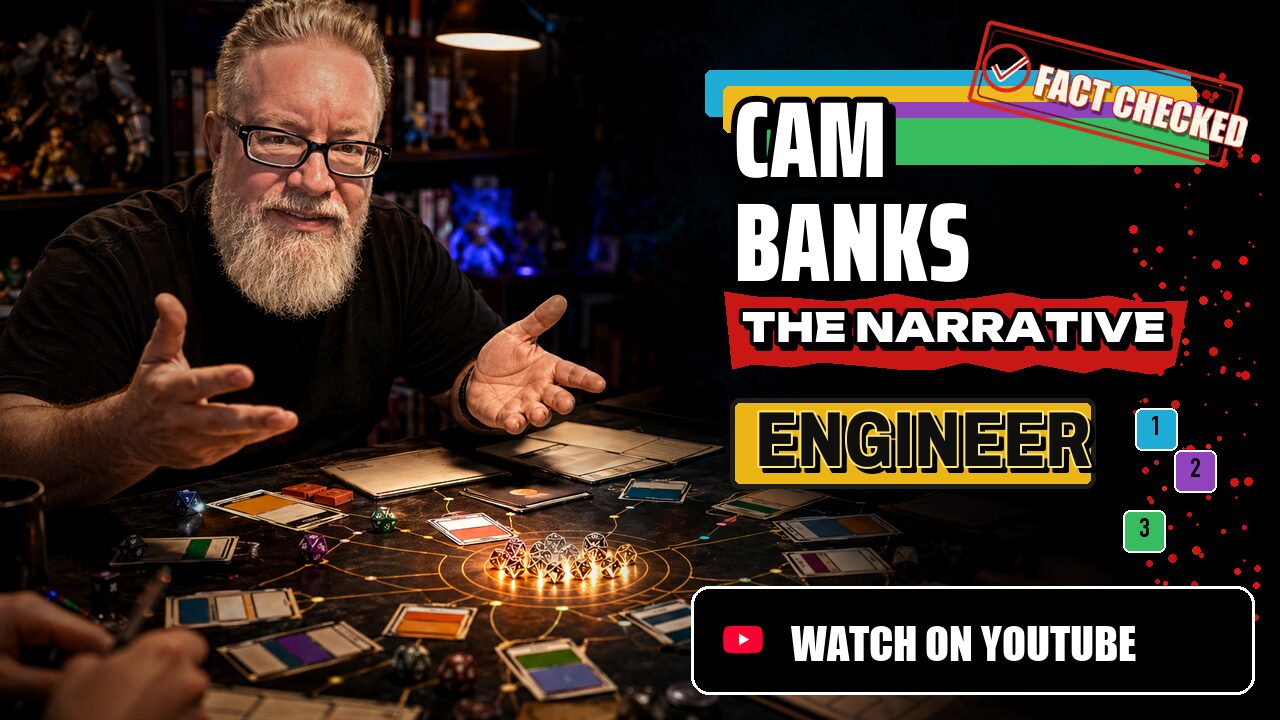
He asked a better one: what does this story care about?
That sounds abstract until you put dice in someone’s hand and the room is waiting for a number. In a traditional game, the sheet usually begins with the body: Strength, Dexterity, Constitution, Intelligence, and the familiar machinery of what a character can physically do. Banks kept returning to a different first step. Before you roll, what are you actually risking?
In a teen drama, the important question might be who you love. In a heist, it might be which role you play on the crew when the plan starts to crack. In a superhero story, it might be whether you are acting alone, with a partner, or as part of a team when the city is on fire. In a fantasy world built on moral pressure, it might be the value you are trying to live by when the scene turns against you and you have to choose.
That is Banks’s central design insight. The dice should point toward the thing the fiction is actually about.
He did not invent narrative RPG design. The indie RPG movement, the Forge, Fate, Burning Wheel, Apocalypse World, and many other designers had already pushed hard against old assumptions about simulation, authority, and story. Banks’s gift was different. He could translate those ideas into licensed games that mainstream players would buy because the cover said Smallville, Leverage, Marvel, or The Dragon Prince.
He built bridges that looked like entertainment products, and those bridges brought new priorities into familiar rooms.
From Dragonlance To Cortex
Banks was born in Auckland, New Zealand, and built his early career inside one of fantasy gaming’s most lore-heavy worlds: Dragonlance.
During the d20 years, he worked on Dragonlance material for Sovereign Press and Margaret Weis Productions, including the Age of Mortals campaign arc with Christopher Coyle: Key of Destiny, Spectre of Sorrows, and Price of Courage. He contributed to a long run of Dragonlance sourcebooks and later wrote The Sellsword, a Dragonlance novel.
That work matters because licensed and shared-world design is a discipline of restraint. You are not free to simply invent anything. You have to understand what a setting already is, where its readers expect weight, which details are load-bearing, and how to add new material without making the old material feel false.
Banks learned stewardship before he became known for system architecture.
At Margaret Weis Productions, he moved deeper into Cortex. Jamie Chambers had designed Cortex for Serenity, a step-die engine attached to a science fiction license with a devoted fan base. That earlier Cortex version was more conventional than what Banks would later build, but it had the raw material: polyhedral dice as trait ratings, Plot Points as a flexible player currency, and a structure that could bend across licensed properties.
Banks took that base and began pulling it apart. Not to show off, but because he could see a sharper question hiding in the machinery.
The Cortex Plus Break
Cortex Plus was not one game wearing different costumes. It was a family of games built around a shared philosophy: rebuild the trait sets around the genre.
Smallville Roleplaying Game was the clearest shock. Banks co-designed it with Josh Roby, and it refused to treat superhero action as the main event. A Smallville character was not primarily a pile of physical stats. The game cared about Values and Relationships. Duty, Glory, Justice, Love, Power, Truth. The people you care about. The people who can hurt you. The people whose names make the dice matter.
That is a radical move hiding inside a licensed TV RPG. The game understood that Smallville was not really about whether Clark Kent could lift a car. Of course he could. The drama was why he acted, who he protected, what he hid, and what that cost him.
Leverage, co-designed by Banks with Rob Donoghue, Clark Valentine, and others, made a different move. It cared about the crew. Grifter, Hacker, Hitter, Mastermind, Thief. The game did not need a universal skill list to feel like the show. It needed the structure of a con, the pleasure of the reveal, and the flashback logic that lets players explain how the plan was already in motion.
That is the Banks pattern at full strength. He does not begin by asking which generic attributes every human being should have. He asks what grammar the source material uses, then turns that grammar into dice.
The Doom Pool
Marvel Heroic Roleplaying was the game that made the argument loud.
Banks was the lead designer, and the game won major recognition: an ENnie Gold for Best Rules, an Origins Award for Best Roleplaying Game, and an Origins Award for the Civil War event book. It also had a short product life after the Marvel license was not renewed, which gave the whole thing the strange aura of a brilliant machine that vanished too soon.
The design did not try to simulate superhero physics in the usual way. It modeled the rhythm of comic books. Heroes were built as datafiles. Their Affiliations mattered: Solo, Buddy, Team. Distinctions could help you or complicate your life. Power Sets described what you could do, but the system kept asking what it cost.
The Doom Pool sat in the middle of the table as the story’s pressure gauge. As the players pushed harder, the pool grew. When the pool grew, the Watcher gained power. When the Watcher gained power, the next scene could climb into something worse.
That is the trick. It is not a single mechanic. It is pacing, tension, and consequence in one shared object. You can feel it in your hands as the dice pile gets heavier. You can feel it in your stomach when you realize you are the one feeding it.
You can see the same mind at work in smaller choices. Let a player take a Distinction as a d4 when they want complication in exchange for Plot Points. Let power turn into trouble. Let the fiction stay in the foreground.
Cortex Plus did not ask you to forget the joy of dice. It asked you to aim that joy at the heart of the genre.
Cortex Prime: A Toolkit Engine
Banks eventually pushed Cortex toward its most honest form: a modular rules handbook.
In 2017, Cortex Prime launched as a Kickstarter run by Banks through Magic Vacuum and raised $84,430 from 2,756 backers. The finished Cortex Prime Game Handbook arrived later under Fandom Tabletop, after Fandom acquired the Cortex rights and brought Banks on as Cortex Creative Director. Dire Wolf later acquired Fandom’s tabletop RPG business in 2022, including Cortex and Tales of Xadia, with Banks moving to Dire Wolf as Creative Director for Cortex.
Cortex Prime is not just "the generic version." Generic games often flatten genre. Cortex Prime tries to make genre selectable.
The book gives you modular trait sets and rule components. Attributes, Skills, Roles, Values, Relationships, Affiliations, Distinctions, Power Sets, Specialties. Different opposition structures. Different consequence models. Different advancement tools. You choose the parts that match the kind of story you want the game to care about.
That is why the system can handle very different designs without pretending they are the same. A teen drama can lean on Values and Relationships. A heist can lean on Roles and flashback logic. A superhero game can use Affiliations, Distinctions, Power Sets, Stress, and a Doom Pool. A fantasy adventure can make moral commitments and personal drives matter as much as sword arms.
Dire Wolf describes Cortex Prime as customizable, hackable, modular, and backwards compatible with earlier Cortex-powered games. That is marketing language, but it also captures the real architectural claim. Cortex Prime is a rules handbook for building the game under the game.
The Licensing Turn
For years, the Cortex story carried a frustration: good engine, unstable corporate ground.
Margaret Weis Productions. Magic Vacuum. Fandom. Dire Wolf. Each handoff meant the community had to wait, adjust, and wonder what the future would look like. Cortex had passionate fans and strong design bones, but it never had the open ecosystem explosion that powered Fate, Powered by the Apocalypse, or Forged in the Dark.
That kind of instability changes what people feel safe building. Designers get cautious. They keep their best ideas in private folders because they do not know where the floor will be next year.
On April 21, 2026, Dire Wolf announced that, beginning in May 2026, Cortex Prime would open to both community and commercial projects through a new licensing path with distribution through DriveThruRPG. The announcement said the licensing deal would be administered by Cam Banks through Rusty Sellsword Design, his New Zealand-based studio.
That is not a footnote. It may be the missing roadbed under the bridge Banks has been building for years.
Cortex has always invited designers to think in modules. A broader licensing path means more people can finally publish with those modules in public, not just tinker at home or inside private servers. Whether that produces a large ecosystem is still an open question, but the direction matters.
The narrative engineer now has a better workshop door.
What He Actually Built
Cam Banks built a translation layer.
He took narrative-forward design ideas and made them function inside products attached to familiar media properties. He showed that a superhero game did not have to begin with lifting capacity. A TV drama RPG could treat relationships as the main stats. A heist game could let the table reveal the plan after the fact. A modular toolkit could ask designers to choose the story’s priorities before choosing the dice.
That does not make him the inventor of narrative RPGs. It makes him one of the people who brought their logic into rooms where traditional players could meet them without feeling ambushed.
His limits are real. Much of his best-known work is licensed, and licenses expire. Cortex began before him, even if Banks rebuilt it into something much stranger and more flexible. His major games involve strong collaborators. Smallville, Leverage, and later Cortex work all sit inside networks of designers, publishers, licensors, and corporate owners.
But the pattern is still clear.
Banks is a system architect for stories that refuse to be generic. He designs engines that ask what matters here, in this genre, with these characters, under this pressure. Then he makes the dice answer that question.
Where To Find Him
Today, Banks is working from New Zealand through Rusty Sellsword Design, and Dire Wolf’s 2026 Cortex licensing announcement places him at the center of the next Cortex publishing phase. Cortex Prime remains available through Dire Wolf. Tales of Xadia remains a clear licensed example of Cortex Prime in action. Marvel Heroic, Smallville, and Leverage are out of print, but their design fingerprints are still all over conversations about what Cortex can do.
That is a strange kind of legacy: some of the most important examples are hard to buy, but easy to remember.
The Doom Pool keeps growing in designers’ heads. Values and Relationships keep challenging the old stat block. Cortex Prime keeps waiting for more builders to pick up its parts.
Cam Banks did not build one bridge.
He built a toolkit for building bridges, and he did it by insisting that the dice should care about the same things the story cares about.
Fact Check Notes
Publication notes
This site is AI-assisted and human-reviewed. We use artificial intelligence to help gather research, organize source material, and draft profile content. Human editors then read, revise, and check each profile before it goes live. Most profiles are built through deep AI research and two separate rounds of fact-checking.
Leave a Reply
You must be logged in to post a comment.