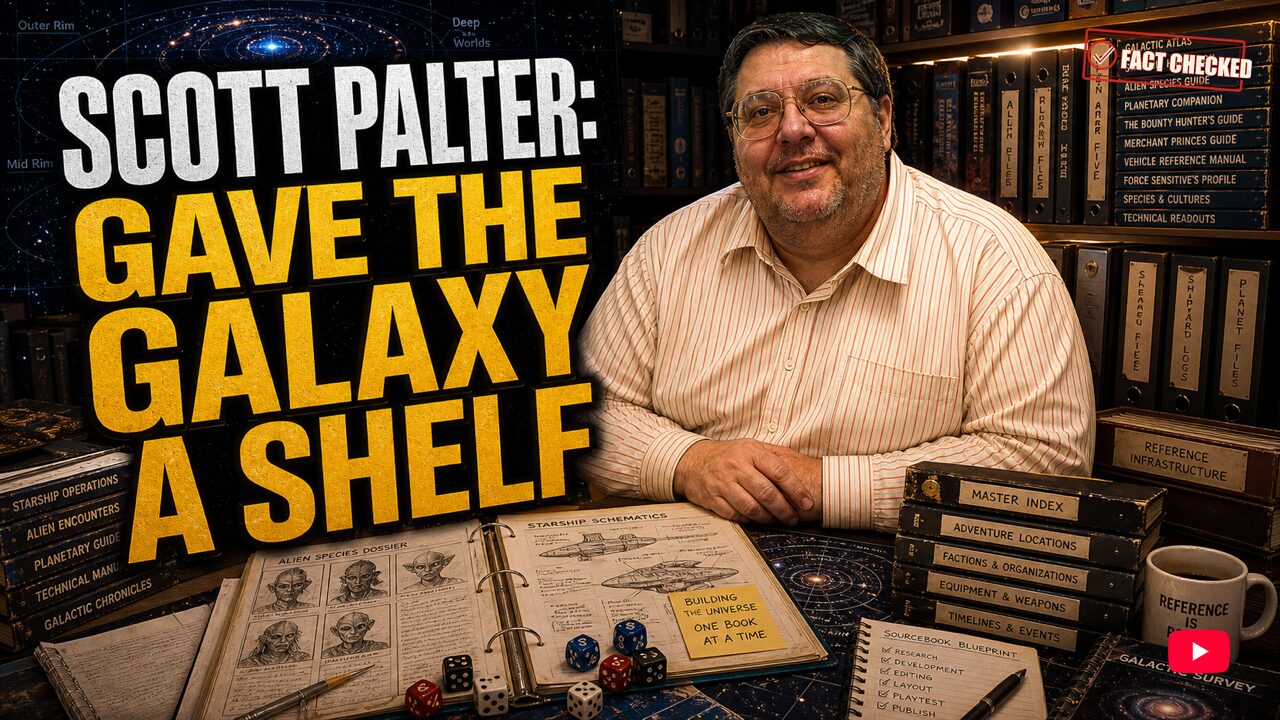
He did something quieter and, for a long stretch of the franchise’s history, strangely essential. He built the publishing house that turned Star Wars into a table-ready archive.
West End Games’ Star Wars Roleplaying Game did not just let fans play smugglers, rebels, bounty hunters, and Imperial officers. Its sourcebooks gave names to background aliens, stats to ships, ranks to the Empire, texture to planets, and everyday working details to a galaxy that had mostly existed on film. When Star Wars went quiet between Return of the Jedi and the 1990s revival, West End’s books kept the galaxy organized.
That is Palter’s strongest legacy.
He was not the sole designer of the D6 System. He was not the writer of every sourcebook. He was not the lone architect of the Expanded Universe. What he built was the company that let other people do that work at scale.
He built the shelf that held the galaxy.
The Wargamer With A Law Degree
Daniel Scott Palter came to games through analysis before he came to them through cinematic adventure.
He studied at Dartmouth, earned a law degree from Stanford in 1972, and became a member of the New York State Bar. That legal and analytical background made him unusual among the early wave of hobby publishers. Many came out of clubs, fanzines, basements, and convention rooms. Palter did too, in his way, but he also had a lawyer’s relationship with contracts, risk, and rights.
He also had wargame instincts.
Before West End Games became famous for roleplaying, Palter was connected to the world of conflict simulation. He playtested for publishers and institutions, including the wargame-heavy circles around SPI and other simulation work. His early design credits show that background clearly. Games such as Marlborough at Blenheim and Killer Angels were not cinematic improvisation engines. They were historical conflict studies, built out of maps, counters, orders of battle, and the old wargamer’s belief that history could be modeled.
West End Games began in 1974, backed through Palter’s family business connections, including Bucci Imports. The name came from the West End Bar near Columbia University, where the conversations around the company took shape.
At first, West End looked like a wargame publisher.
That was not where it would end.
The Turn Toward Weird
By the early 1980s, roleplaying games had changed the market. Dungeons & Dragons had created a category that wargames could not ignore. Players still cared about tactics, but they also wanted character, voice, setting, and absurdity.
Palter made one of the most important decisions of his career by bringing in designers and editors who could move West End beyond its wargame roots. Greg Costikyan, Eric Goldberg, Ken Rolston, and later Bill Slavicsek and many others gave the company a creative identity that was sharper, funnier, and more accessible than its early catalog.
The first great proof was Paranoia.
Paranoia began from Dan Gelber’s concept, then came through Goldberg and Costikyan and was shaped for publication at West End. Ken Rolston’s editing and development helped turn it into one of the defining RPGs of the 1980s. It was a game about a dystopian underground city ruled by an insane Computer, where player characters served a society that was broken, contradictory, and murderously bureaucratic.
It also broke one of the sacred assumptions of roleplaying.
Most RPGs treated the party as a cooperative unit. Paranoia made betrayal part of the joke. Players were encouraged to suspect one another, denounce one another, and die hilariously in service of a system that did not care whether anyone understood the rules of the world.
The game won the Origins Award for Best Roleplaying Rules of 1984. More importantly, it proved that West End could publish games with voice.
Palter had seen the market turn. He let the company turn with it.
The Cinematic Engine
Ghostbusters came next.
The 1986 Ghostbusters RPG, designed by Chaosium veterans Sandy Petersen, Lynn Willis, and Greg Stafford, gave West End a new mechanical language. It used a simple dice-pool approach built around handfuls of six-sided dice, fast resolution, and comic timing. The game cared less about simulation density and more about keeping the scene moving.
That engine became the basis for West End’s most important work.
In 1987, West End published Star Wars: The Roleplaying Game. The design and development credit belongs to the people who turned that engine into a space-opera machine: Greg Costikyan, Curtis Smith, Bill Slavicsek, and the larger WEG team. Palter’s role was publisher, license holder, and company builder.
But the decision to pursue the license changed everything.
At the time, Star Wars was not the unstoppable annual content machine it later became. Return of the Jedi was already several years old. There were no prequels, no streaming shows, no Disney era, no constant drip of official continuity. To many people, the franchise looked quiet.
West End treated the silence as room to work.
The D6 Star Wars game captured the pace of the films better than a heavier simulation engine would have. It let heroes dodge blaster fire, spend cinematic resources at dramatic moments, fly by instinct, and trust the table to move like a movie. It was fast, readable, and generous to new players.
Then the sourcebooks arrived.
The Shelf That Held The Galaxy
West End Games’ Star Wars books became more than RPG supplements.
They became reference infrastructure.
The Galaxy Guides, Imperial Sourcebook, Rebel Alliance Sourcebook, equipment books, planet books, adventures, and technical material filled in the working life of the Star Wars universe. The films showed enough to make viewers dream. West End’s books showed how the universe functioned between scenes.
What does the Empire call that unit? How does the Rebel Alliance organize itself? What are the stats for that ship in the background? What does a cantina patron belong to as a species? How do smugglers, scouts, nobles, soldiers, droids, and Force-sensitive misfits move through the same galaxy?
West End answered those questions.
That work fed back into the broader franchise. When Timothy Zahn began writing the novels that would become the Thrawn trilogy, Lucasfilm sent him West End sourcebooks as reference material. That story has become part of Star Wars publishing lore because it reveals what WEG had quietly become: the unofficial official archive of a galaxy between film eras.
The writers and editors deserve the credit for the lore itself. Palter deserves credit for the publishing platform that made the lore possible, durable, and available.
The result was a rare licensed-game achievement. West End did not simply cash in on a known brand. It helped keep the brand coherent while the films were dormant.
Torg, Masterbook, And The Licensing Machine
West End did not stop at Star Wars.
Torg, published in 1990, was a wild attempt at a multi-genre invasion game where different realities crashed into Earth. Pulp heroes, fantasy kingdoms, cyberpapacy, horror, dinosaurs, and cinematic action all existed in one conflict. Its drama deck and reality-war premise made it one of the most ambitious RPGs of its era.
Palter was drawn to systems that could handle scale. Torg’s underlying math and later Masterbook’s value-chart logic showed the same instinct visible in his wargame roots: find a structure that can compare very different kinds of power on a common scale.
That ambition produced interesting games. It also encouraged overreach.
In the 1990s, West End pursued a long list of licenses: Indiana Jones, Necroscope, Tales from the Crypt, Tank Girl, Species, Hercules & Xena, DC Universe, Metabarons, and others. Some made sense. Some were odd fits. Some arrived with more name recognition than tabletop demand.
The company still had prestige. West End products often looked substantial, with maps, boxed components, counters, and strong production values. But licensing is expensive, and not every property becomes playable just because it is recognizable.
The publisher that had made Star Wars work began chasing the logic of licensed visibility too hard.
The Collapse
West End’s fall was not simply a matter of bad games.
The company was tied to Palter’s family business network, especially Bucci Imports and related retail entities. When that broader business structure ran into financial crisis, West End was pulled into the wreckage. The exact corporate mechanics were tangled, but the effect was simple enough: the game company could not protect itself from the collapse around it.
In 1998, West End entered bankruptcy. Staff were let go abruptly. Freelancers and employees were hurt financially. Licenses became impossible to hold. Star Wars eventually moved to Wizards of the Coast.
For many people who had worked at West End, the collapse left bitterness. That deserves space in the story. A publisher can make beloved games and still fail the people who built them. A platform can create careers and still break under its own financial structure.
Palter tried to keep pieces alive. The Humanoids / D6 Legends period produced later work, including DC Universe and Metabarons, but it was not the same company. After that, Palter founded Final Sword Productions and returned to smaller-scale projects, including Psibertroopers and tactical or licensed work connected to military science fiction and alternate history.
In his later years, he also wrote fiction. The Reich Without Hitler: The Falcons of Malta, Dead Night of Space, and Deaths on the Nile showed him returning to the alternate-history and strategic speculation that had always sat close to his design instincts.
He died on February 17, 2020.
What He Actually Built
Scott Palter did not personally design every great West End game.
That boundary matters. Paranoia, Ghostbusters, Star Wars D6, Torg, and the Star Wars sourcebooks were created by teams of designers, editors, writers, developers, and artists. The names attached to those books deserve their own credit.
What Palter built was West End Games as a home for that work.
He built a company that could move from historical wargames to black comedy, from movie licenses to cinematic dice pools, from Star Wars adventures to sourcebooks that helped define one of the largest fictional universes in popular culture. He gave talented people the publishing platform to make games that did not feel like D&D clones.
His legacy has two halves.
The bright half is creative infrastructure. West End’s Star Wars line changed licensed RPGs by treating the source material seriously enough to document it, expand it, and make it playable. The D6 approach helped show that roleplaying could feel fast, cinematic, and accessible. Paranoia proved satire could be a full RPG engine, not just a joke supplement.
The dark half is business fragility. West End’s collapse shows how vulnerable independent creative companies can be when their finances are tied to outside capital, family businesses, complicated ownership structures, and licenses they cannot afford to lose.
Both halves belong to the same story.
Where To Find His Legacy
Palter is gone, but West End’s influence is still easy to see.
It is in every Star Wars fan argument that relies on a name, organization, ship detail, or background concept first stabilized by a WEG sourcebook. It is in the designers who learned that licensed games can add to a setting rather than merely borrow from it. It is in fast cinematic RPGs that care more about scene rhythm than chart density. It is in Paranoia tables where trust is a punchline and death is part of the comedy.
And it is in the cautionary memory of 1998, when a beloved publisher collapsed and reminded the industry that great books do not guarantee a stable company.
Scott Palter’s work did not end with one system or one title.
He gave the galaxy a shelf, and for a while, the whole Expanded Universe stood on it.
Fact Check Notes
Publication notes
This site is AI-assisted and human-reviewed. We use artificial intelligence to help gather research, organize source material, and draft profile content. Human editors then read, revise, and check each profile before it goes live. Most profiles are built through deep AI research and two separate rounds of fact-checking.
Leave a Reply
You must be logged in to post a comment.