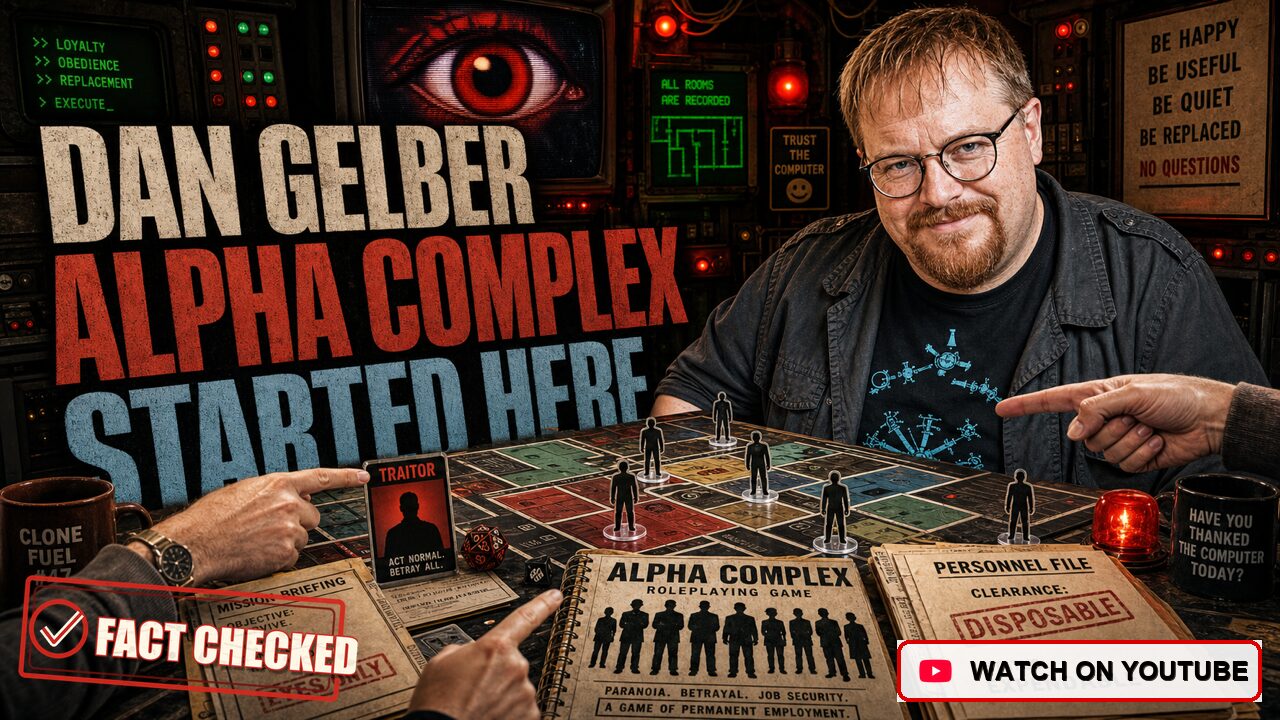
Before Paranoia was a book, it was Dan Gelber’s living room.
That origin still feels a little dangerous, even now, because it starts with a simple cruelty: what if the table can’t be a team?
Most roleplaying games of the early 1980s assumed a party. They assumed the table wanted the same thing. The players might argue, steal treasure from each other, or make terrible tactical decisions, but the basic promise was cooperation. You were a group. The monsters were elsewhere. The dungeon was the problem. The referee ran the world, and the players tried to survive it together.
Gelber imagined something nastier. Not because he hated players, but because he understood a truth about institutions: people will do terrible things to stay safe.
In Alpha Complex, the monsters were sitting at the table.
His home campaign placed players inside a sealed dystopian society ruled by an insane supercomputer called The Computer. They were Troubleshooters, loyal citizens sent to hunt traitors, mutants, secret societies, and security threats.
The joke was that every player was already guilty, and the system was built so that guilt could always be proven.
Everyone had secrets, and plenty of them were disqualifying. Some were mutants. Some were tied to secret societies. Any one of them could end up the informer, the scapegoat, the saboteur, or the victim. Trust was not merely difficult. Trust was structurally absurd. The game made that absurdity playable.
That was the idea that became Paranoia.
The Computer Is Your Friend
Alpha Complex works because it turns authority into comedy and survival into farce, and because it lets the players feel the squeeze without making the table bitter.
The Computer is always watching, always confident, always wrong, and always right by definition. The player characters are expected to obey contradictory orders, report treason, hide their own treason, and die cheerfully when the system demands it.
The clone mechanic completed the joke, and it also completed the emotional safety net.
Death did not end the session. A replacement clone arrived and carried the mission forward, often with the same terrible incentives and a fresh chance to accuse someone else first. Execution became pacing. Failure became slapstick. Catastrophe became renewable. The game gave you permission to fail loudly.
That one structural choice changed the tone of everything.
If death is permanent, betrayal is grim.
If death is bureaucratically replaceable, betrayal becomes comedy, because the punishment is no longer the end. It is paperwork.
Paranoia’s world is frightening, but it is also funny because the characters are trapped in an authoritarian machine so ridiculous that survival requires theatrical dishonesty. The players know the whole thing is doomed. The pleasure is in watching the doom develop through accusations, incompetence, and perfectly loyal treason, then realizing you are laughing at things that are genuinely scary in real life.
The Translation
Gelber did not bring Paranoia to market alone.
Greg Costikyan and Eric Goldberg, both experienced designers at West End Games, saw the potential in Gelber’s campaign material and helped turn it into a publishable roleplaying game. The 1984 game carries all three names, and the shared credit matters.
Gelber supplied the soul.
Costikyan and Goldberg supplied much of the product architecture.
That is the cleanest way to say it. Gelber’s contribution was Alpha Complex, the tone, the premise, the social dynamic, the clone-backed betrayal engine, and the sense that RPG play could be funniest when the party was structurally incapable of trusting itself.
Costikyan and Goldberg had to make that playable as a book.
Rules and missions. Character creation. Security clearances. Mutant powers. Secret societies. Equipment. Advice for the gamemaster. The transformation from living-room chaos into a published RPG required designers who knew how to package a wild campaign into something strangers could run, and how to keep the cruelty funny instead of cruel.
Paranoia needed both halves.
Without Gelber, there is no Alpha Complex.
Without Costikyan and Goldberg, there may be no Paranoia product.
The Traitor Rpg
Paranoia did something roleplaying games were not generally built to do.
It made betrayal central rather than accidental, and it did it with a grin.
Earlier games could have player-versus-player conflict. Players could duel, steal, backstab, or sabotage each other if the table allowed it. Paranoia did not merely allow that behavior. It designed for it. The mission briefing might say everyone is loyal, but the rules and setting both know better.
The result is not pure competition.
It is performative cooperation. Everyone is acting like a team because that is the only way to survive the next five minutes.
Players have to work together just long enough to make the mission, the lie, or the accusation function. They need each other and fear each other at the same time. The table becomes a pressure chamber where information, suspicion, and comic timing matter as much as stats.
That was unusual in 1984. It still feels sharp now.
It gave RPGs a new tonal possibility: a game where the group’s dysfunction was not a failure state, but the point.
The Rules Were Never The Star
Paranoia’s rules have changed again and again.
That is a clue.
The original game worked, but its lasting identity did not come from a universally admired resolution engine. It came from situation, voice, permissions, and table behavior. Later editions revised the machinery because the machinery was never the sacred part.
Alpha Complex was the sacred part. The room was the engine.
The Computer.
The secret societies.
The color-coded clearance system.
The mutant powers.
The mandatory cheerfulness.
The six-pack of clones.
The friend who is absolutely going to report you because you are absolutely going to report them first.
The system can change because the social machine is stronger than the dice engine.
That is Gelber’s kind of contribution.
The Cult That Survived
Paranoia became one of the great cult RPGs, the kind people remember even if they only played it once.
Not the biggest game. Not the central commercial engine of the hobby. Not a Dungeons & Dragons rival in scale. But it proved a different kind of table could work, and roleplaying historians keep pointing back to it because it proved something important:
An RPG could be satire.
It could turn institutional paranoia into comedy.
It could make intra-party distrust the main event and still leave everyone laughing.
The game won early recognition, including an Origins Award, and was later inducted into the Origins Awards Hall of Fame. It kept returning in new editions, including later Mongoose Publishing releases and modern reissues. Decades after Gelber’s home campaign, publishers are still selling trips back into Alpha Complex.
That longevity says the concept was not a one-night joke. It hit something real.
It had legs.
Six clones’ worth of them.
The Marvel Footnote
Gelber’s later tabletop record is thin.
Nearly twenty years after Paranoia, he was one of the credited designers on the Marvel Universe Roleplaying Game (2003), alongside Jeffrey Simons and Evan Jones among others. Published by Marvel Entertainment in 2003, it was an unusual in-house superhero RPG built around resource allocation rather than dice.
Players assigned energy stones to actions, powers, and efforts.
That was interesting.
It did not become a lasting, evergreen superhero RPG line.
The game was later overshadowed by other Marvel tabletop adaptations, including the older TSR Marvel Super Heroes game and later Marvel Heroic Roleplaying. It remains a curiosity: evidence that Gelber returned to RPG design after a long gap, but not a second pillar of his legacy.
That gap matters.
Gelber did not become a prolific designer. He did not build a catalog of original systems. He did not spend the next forty years iterating on published games. His public tabletop record is mostly Paranoia, its second edition, and the Marvel footnote.
The Current Line
The striking thing is that Paranoia kept going without needing Gelber to keep designing it.
That is how strong the setting machine was.
Later Paranoia releases keep returning to the same basic joke: the Computer is your friend, the mission is impossible, your teammates are traitors, and you are almost certainly a traitor too. Modern editions still credit Gelber, Costikyan, and Goldberg as the creators, which is exactly the right public memory. The later developers change procedures, editions, components, and presentation, but they are still visiting the place Gelber first imagined.
That is rare for a home campaign.
Most home campaigns vanish when the table breaks up.
Alpha Complex became intellectual property.
Over time, it turned into a tone.
The hobby keeps reopening that room.
The Honest Boundary
Gelber is a concept-originator more than a system-builder.
That is not a demotion.
Some games begin with math. Others start with a component. Paranoia began with a genre problem and a social nightmare funny enough to play.
Gelber imagined the world where trust is treason, loyalty is lethal, and the safest move is to accuse your friends before they accuse you. That is not a small design act. It is the act that made the rest of the design possible.
But the public product was collaborative.
Costikyan and Goldberg turned the homegame into a game line. Later developers and publishers kept it alive. Paranoia’s most famous pieces are inseparable from Gelber’s premise, but the rules as published belong to a larger team and a longer institutional history.
The boundary keeps the credit honest.
Gelber found Alpha Complex.
Other people built the roads through it.
What Remains
What remains is Alpha Complex.
The place itself.
A sealed underground society ruled by a mad Computer that insists it is your friend. Citizens divided by security clearance. Mutants hiding their powers. Secret societies hiding in plain sight. Troubleshooters sent to solve problems they do not understand, with equipment they should not trust, beside teammates who are all waiting for the right moment to denounce them.
That premise is still funny because it is still recognizable.
Bureaucracy remains absurd.
Surveillance remains frightening.
Institutions still produce contradictions and punish the people trapped inside them.
Friends still become suspects when the system rewards accusation.
Gelber’s career is small compared with the world he imagined. That mismatch is part of what makes the story feel strange and human.
That is the strange shape of it. One homegame, translated by collaborators, became a forty-year cult classic. One living-room experiment gave RPGs a new way to laugh at betrayal.
The Computer is your friend.
Dan Gelber imagined the room where that sentence became a game.
Fact Check Notes
Publication notes
This site is AI-assisted and human-reviewed. We use artificial intelligence to help gather research, organize source material, and draft profile content. Human editors then read, revise, and check each profile before it goes live. Most profiles are built through deep AI research and two separate rounds of fact-checking.
Leave a Reply
You must be logged in to post a comment.