That is the thing to understand first. He did not make war simple. He made command simple enough to enter.
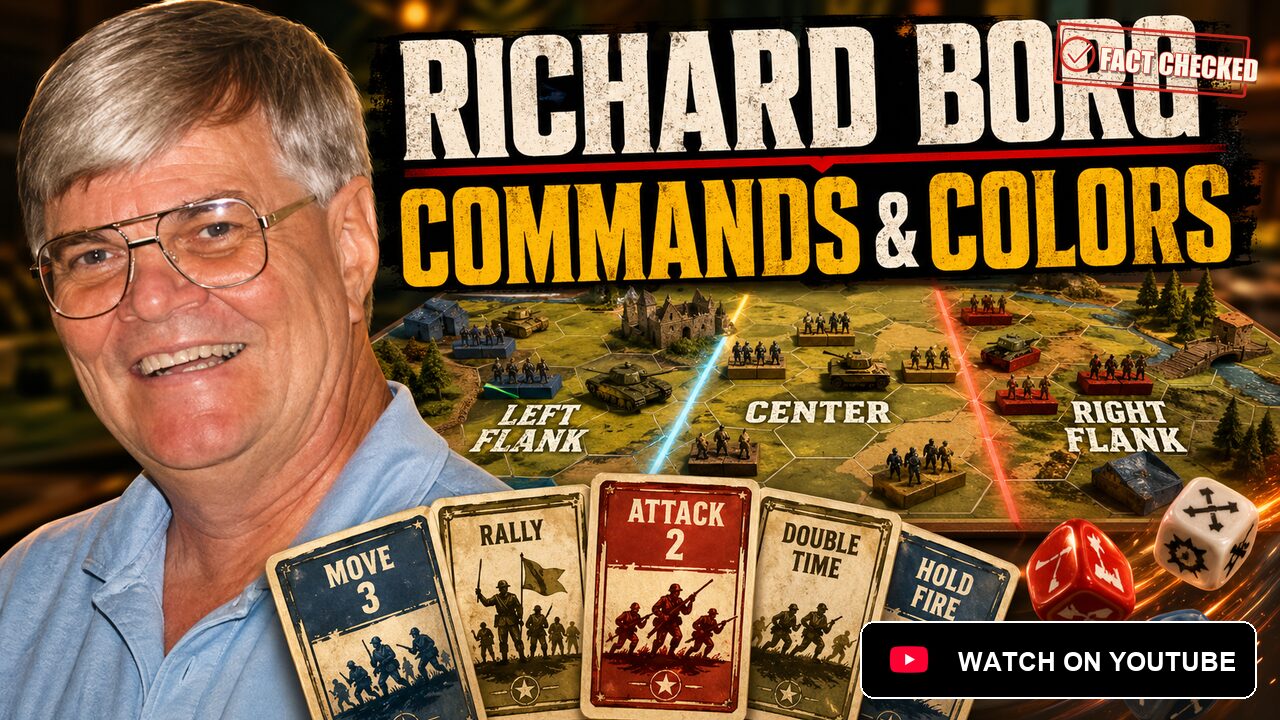
In a Borg battlefield, the map is divided into three sections: left, center, and right. You have units in all three places. You can see the whole problem. You know what should happen. Then you look at your hand of command cards and discover that the army will not obey your perfect plan.
That is the game.
You can order units on the left. Or in the center. Or on the right. Sometimes a card gives you a flexible tactical burst. Sometimes the card you need is not there. The player is not asked to memorize a hundred command rules. The player is asked to live inside one military truth:
You can never do everything at once.
That idea became the Commands & Colors system, one of the great accessibility breakthroughs in modern wargame design.
Before The Battlefield
Borg’s first major public success was not a wargame.
It was Liar’s Dice.
The design began as Doubter’s Dice and later became Bluff in Germany, where it won the 1993 Spiel des Jahres. The Spiel jury’s later retrospective describes it as a door-opener, the kind of game that could bring casual players to the table and hold them there. That phrase matters because it points to Borg’s larger instinct.
He knew how to make entry points.
Liar’s Dice is pure social pressure built from cups, dice, probability, and nerve. Players bid on hidden dice, challenge each other, and decide when a number has become a bluff. It is not a battlefield. It is not historical. It does not look like Memoir ’44 or Commands & Colors: Ancients.
But it shares a Borg signature.
The rules are light enough to teach quickly. The decision space is sharper than the rules suggest. The player feels the pressure before the system feels heavy.
That instinct carried into the wargames.
Battle Cry And The Command Problem
Battle Cry, published by Avalon Hill in 2000, was the first major expression of the system that would later define Borg’s career.
The subject was the American Civil War. The mechanism was the breakthrough. Instead of giving players total control over every unit every turn, Borg split the battlefield into sections and used command cards to determine where orders could be issued.
That one move changed the feel of the genre.
Traditional wargames often simulate command friction with detailed rules, movement allowances, supply states, morale charts, facing restrictions, and command-control subsystems. Borg found a cleaner path. Put the friction in the hand of cards.
The player sees the whole board.
The cards say no.
That "no" is the design. It creates frustration, tempo, risk, and opportunity without burying the player under procedure. You are still making tactical decisions. You still care about terrain, unit type, timing, combat odds, and scenario objectives. But the game does not ask you to become a staff officer before you can enjoy it.
That is why the system traveled.
Memoir ’44
Memoir ’44 brought the system to its widest audience.
Published by Days of Wonder in 2004, it used the Commands & Colors framework to recreate World War II scenarios tied to the D-Day campaign and beyond. The board was modular. The miniatures were inviting. The scenarios were concrete. The rules could be taught quickly.
For many players, Memoir ’44 was the first wargame that did not look like homework.
That sentence may sound dismissive to heavier wargames. It is not. Heavy wargames have their own virtues. They can model nuance, friction, logistics, and historical specificity in ways lighter systems cannot.
Borg’s achievement was different.
He built a bridge.
Memoir ’44 gave families, casual gamers, history fans, and hobby players a way to experience scenario-based tactical combat without needing to cross a rulebook desert first. Cards handled command limits. Custom dice handled combat results. Terrain created tactical texture. Scenarios gave the table immediate purpose.
The result was not a perfect simulation of World War II.
It was something more commercially and culturally powerful: a wargame people could actually get to the table.
Ancients, Napoleonics, And The Modular Engine
The Commands & Colors system did not stay in one era.
Commands & Colors: Ancients moved the framework into ancient warfare, with blocks, leaders, unit types, and battlefield behavior tuned toward the period. Napoleonics pushed the engine toward combined arms, squares, cavalry, artillery, and the distinct rhythm of Napoleonic combat. Medieval, The Great War, Samurai Battles, BattleLore, and other relatives showed how flexible the core idea could be.
The trick is that the engine remains recognizable.
Sections. Cards. Units. Dice. Scenarios. Terrain. Limited command.
Then the era changes what those pieces mean.
In Ancients, leaders and unit cohesion matter. In Napoleonics, the relationship between infantry, cavalry, artillery, and formation becomes central. In Memoir ’44, armor, ranged fire, terrain, medals, and historical objectives carry more of the weight. In BattleLore, fantasy armies and creature powers sit on top of the same structural bones.
That is architecture.
Not one game repeated lazily. One framework tuned across battlefields.
The Dice And The Lesson
Borg’s custom dice are part of the accessibility move.
Instead of asking players to calculate long tables, cross-reference modifiers, or track stacks of combat factors, the dice tell the table what happened. The results are readable. They are physical. They move quickly.
This is one reason Commands & Colors games feel so teachable.
The command cards create the question: where can I act?
The dice create the answer: did the action land?
Between those two pieces lives the decision space. When do you press? When do you wait? Do you spend a card now for a small gain, or hold it for a bigger swing? Do you attack where the card allows, or use the turn to reposition for the card you hope comes next?
The games are not deep because the rules are long.
They are deep because constraint keeps arriving at exactly the right place.
The Accessibility Trap
Accessible design is easy to misunderstand.
People sometimes treat "easy to learn" as if it means "thin." Borg’s best work argues the opposite. A short rules explanation can create a long decision if the right pressure is placed in the right spot.
Commands & Colors games do that constantly.
A new player can understand the turn structure almost immediately. Play a card. Order units. Move. Battle. Resolve dice. Check the objective.
A veteran sees a different board.
The veteran sees tempo in the card hand, pressure in the center, weakness on the flank, a unit that must retreat before it becomes a medal, and a scenario objective that will matter two turns from now. The rule has not changed. The player’s eye has changed.
That is the best version of accessibility.
The door opens quickly. The room keeps going.
What He Actually Built
Richard Borg did not invent card-driven wargaming.
He did not invent dice combat, hex maps, scenario play, or battlefield sectors. The hobby had many ancestors before Commands & Colors.
What Borg built was one of the cleanest tactical command systems in the history of board wargaming.
He took the feeling of limited orders and made it playable in a card hand. He took tactical combat and made it fast enough for weeknight play. He took historical battlefields and made them approachable without stripping away all meaningful difference between eras.
That combination is rare.
Borg also has the Liar’s Dice achievement sitting outside the wargame line. That matters because it proves he was not only the Commands & Colors designer. He could make a bluffing dice game with the same accessible pressure that later made his battle games work.
The honest limitation is range.
His legacy is dominated by one family of systems. It is a brilliant family, and it has many branches, but the center is still Commands & Colors. Unlike designers whose mastery is proven by moving constantly across unrelated forms, Borg’s mastery is proven by refining one architecture until it could carry ancient armies, Civil War brigades, World War II platoons, Napoleonic formations, fantasy creatures, and more.
Some designers build many houses.
Borg built a road that kept reaching new battlefields.
Where To Find Him
Borg’s current public presence is not built around a personal media machine.
It is built around games that remain in print, in reprint, in expansion, and in play. GMT Games still maintains a deep Richard Borg catalog, including Commands & Colors: Ancients, Commands & Colors: Medieval, Commands & Colors: Napoleonics, and expansions. Memoir ’44 remains a living Days of Wonder line, with refreshed rules and a long tail of scenarios, maps, expansions, and community play.
That is the real current-status answer.
The cards are still being played.
The system is still teaching people how battlefield command feels. Left flank. Center. Right flank. Play the card you have, not the card you wish you had. Move the units you can, fight where the opportunity opens, and learn that a general’s problem is not seeing the whole battlefield.
It is acting on only part of it.
Richard Borg took that truth and put it into a hand of cards.
That is why the design lasted.
Fact Check Notes
Publication notes
This site is AI-assisted and human-reviewed. We use artificial intelligence to help gather research, organize source material, and draft profile content. Human editors then read, revise, and check each profile before it goes live. Most profiles are built through deep AI research and two separate rounds of fact-checking.
Leave a Reply
You must be logged in to post a comment.