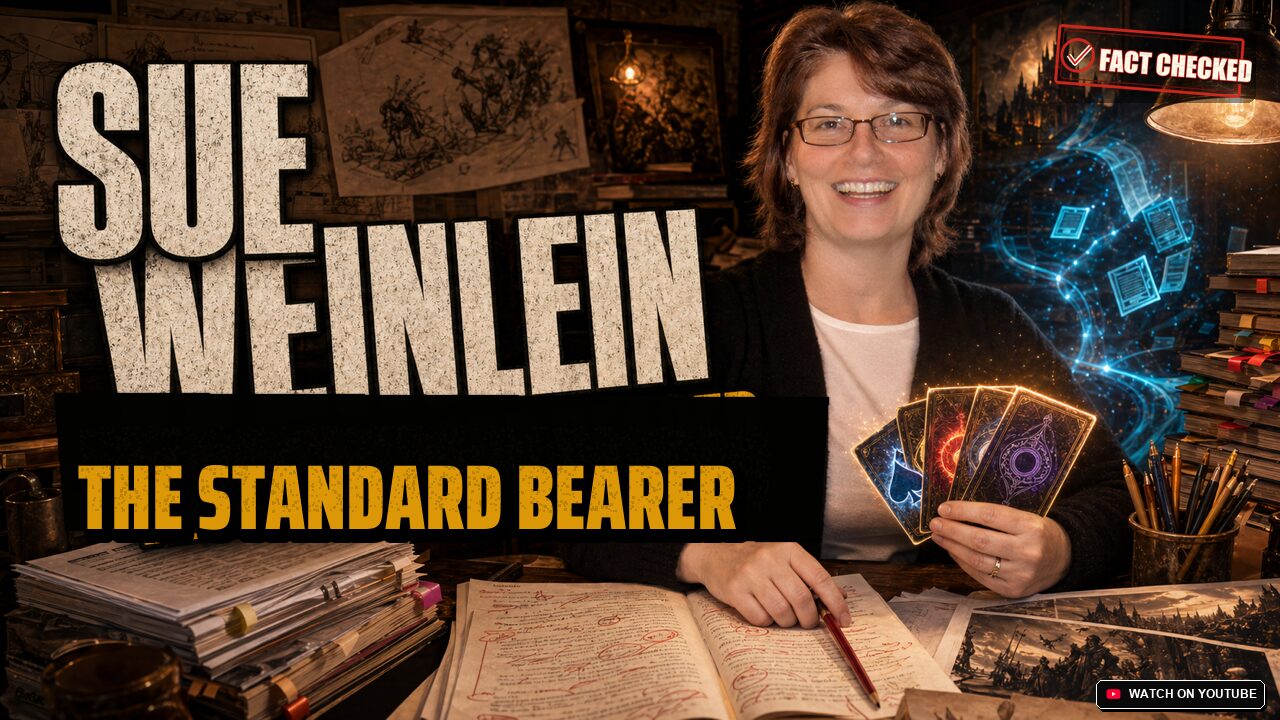
Sue Weinlein is hard to measure if you only count design credits.
That is the problem.
Her formal game-design shelf is narrow. Her impact on RPG publishing is not. She helped design one of TSR’s most unusual roleplaying systems, helped invent a digital publishing habit that spread across the industry, and then helped set an editorial standard during the d20 boom that many publishers could not match.
The visible design credit is Dragonlance: Fifth Age.
The larger career is quality infrastructure.
Weinlein was not usually the person inventing the setting, writing the main rules engine, or putting her name in the largest type on the cover. She was often the person making sure the book could actually work. Clearer text. Cleaner organization. Sharper production. Better handoff between author, editor, publisher, and reader.
That kind of labor can vanish when it succeeds.
The book simply feels professional.
The Journalist At Tsr
Weinlein came to games through words first.
She grew up in Wisconsin, studied Journalism and Spanish at Marquette University, and entered TSR in the early 1990s as an editorial assistant in the book department. That background matters because RPG publishing in that era often needed exactly what journalism trains: structure, clarity, deadlines, factual discipline, and a reader-first instinct.
Game books are strange objects.
They are fiction, reference, instruction manual, toy box, and table procedure all at once. A paragraph may need to establish tone, explain a rule, preserve canon, and stay readable under pressure. That is a harder editing problem than it looks from the outside.
Weinlein moved from book editing into game editing and Dragonlance work during one of TSR’s most unstable periods. Product lines were crowded. The company was financially stressed. The market was changing. Inside that pressure, the Dragonlance team tried something genuinely different.
They stopped rolling dice.
The Fate Deck
Dragonlance: Fifth Age arrived in 1996 using the SAGA System, credited to a team that included William W. Connors, Harold Johnson, Skip Williams, and Sue Weinlein Cook. The attribution needs to stay careful. Weinlein helped design the rules. She was not the sole designer, and Connors is often treated as the primary rules author.
But the system itself deserves attention.
SAGA replaced dice with a Fate Deck. Players held cards in hand and played them to resolve actions. The card value combined with a character trait. Matching suits could create stronger results. The hand was not only randomizer. It was also resource, timing, control, and vulnerability.
That is the clever part.
In many games, the die is external. You pick it up, roll it, and accept what happens. In SAGA, the player holds possibility. A card can be spent now or saved. A strong card can turn a desperate scene. Damage can reduce the hand, making the character’s situation worse in a way the player can feel before the math explains it.
That gives the game an organic pressure.
Hurt characters have fewer choices.
The same object that lets you act also shows how close you are to losing control.
The Story Engine That Almost Worked
SAGA was not the first card-based RPG.
Other games had already explored cards, drama decks, interpretive imagery, and poker-style genre tools. What made Dragonlance: Fifth Age distinctive was the way the hand carried several jobs at once: resolution, resource management, and the feeling of harm.
It also tried to make Dragonlance feel more like heroic fiction than tactical fantasy inventory.
Advancement leaned toward story goals. Magic was freer and more descriptive than traditional spell-list play. The person running the game was called the Narrator. The whole system was trying to move Dragonlance away from inherited AD&D procedure and toward sweeping dramatic adventure.
That was a bold move for TSR.
It was also imperfect.
The early SAGA presentation had gaps and rough explanations. The proprietary Fate Deck made the game fragile as a product. Once the cards were hard to get, the system became harder to keep alive. The Marvel Super Heroes Adventure Game later showed a cleaner version of the SAGA idea, but Weinlein’s role there was brand manager, not designer, so the credit needs to stay where it belongs.
The SAGA System remains an interesting near-miss: innovative, memorable, and trapped by the physical format that made it special.
That contradiction is part of why it still fascinates people.
The deck gave the table a different emotional rhythm. Players looked down at a hand of options instead of waiting on a die. They could see risk accumulating. They could feel when the story had given them nothing good and they would have to make a bad card matter anyway. For a Dragonlance game, that was thematically right. The heroes were always supposed to be choosing under pressure.
But an RPG system is not only an idea. It is also a product that has to survive the shelf, the table, the missing component, and the second printing that may never come.
SAGA had the idea.
The product had trouble carrying it.
The Web Enhancement
Weinlein’s most widely adopted innovation may not be a game mechanic at all.
Around 1999, while managing web content at Wizards of the Coast, she created the web enhancement concept: free downloadable bonus material tied to a print RPG product. Monte Cook has publicly credited her with inventing the idea.
That sounds ordinary now because the future swallowed it.
At the time, it was a bridge between print publishing and digital support. A publisher could release extra encounters, cut material, maps, previews, support files, or supplemental rules online. The book did not have to be the end of the product. The relationship with the reader could continue after purchase.
Wizards used the format extensively. Other publishers followed. Eventually, digital publishing became so normal that the web enhancement stopped feeling like a separate invention.
That is how infrastructure disappears.
It becomes the way things are done.
Malhavoc Press
In 2001, Weinlein and Monte Cook founded Malhavoc Press.
Cook was the primary designer and author. Weinlein was the editor, producer, quality gate, and production intelligence behind much of the line. That distinction matters. The public article should not quietly turn Monte Cook’s design credits into hers.
But Malhavoc’s identity was not only design.
It was polish.
The Book of Eldritch Might helped show that commercial PDF publishing could work for RPGs. The Malhavoc catalog helped define what high-end third-party d20 material could look like. The line included adventures, rules expansions, setting material, fiction, and major books that felt far more controlled than much of the flood around them.
That control was not accidental.
Weinlein edited and oversaw a long list of Malhavoc titles, including Ptolus: City by the Spire. Ptolus was enormous, dense, expensive, and ambitious. A book that large can collapse under its own weight if the editing does not hold. Ptolus held.
That is a real achievement.
Not flashy.
Load-bearing.
The Editor’S Standard
The ENnie awards recognized Weinlein repeatedly for editorial work.
Awards are not the whole story, but in this case they point at the right thing. She was not merely catching typos. She was setting a standard for what professional RPG editing could look like in a market where many products were rushed, muddy, or underdeveloped.
Her Gen Con editing workshops matter for the same reason.
She was not only doing the work. She was teaching the work.
RPG editing requires a particular kind of attention. The editor has to serve the reader without flattening the author. Serve the game without rewriting it into a different game. Catch continuity, clarify procedure, preserve tone, and see whether the table will understand what the page is trying to do.
That is design-adjacent craft.
Sometimes it crosses into development. Sometimes it stays editorial. The boundary is not always clean. But the responsibility is clear:
Make the book usable.
That standard mattered even more during the d20 boom.
The Open Game License let a thousand publishers move quickly. Some of the work was inspired. Some of it looked like first drafts that had found a printer. Malhavoc stood out because the books felt finished. Not perfect. Finished. They had a production intelligence behind them: what goes where, what the reader needs next, what can be cut, what needs a sidebar, what cannot be left vague.
That is not glamorous work.
It is the work that keeps ambition from turning into debris.
What She Actually Built
Sue Weinlein did not build a long catalog of original game systems.
She did not design Marvel SAGA. She did not create the d20 System. She did not write Ptolus. She did not personally invent every online bonus file or every professional editing practice in RPG publishing.
What she built was a standard.
SAGA showed her inside a genuine design experiment: a card hand that carried action, resource, and damage at the same time. The web enhancement showed her seeing how print products could live beyond the printed page. Malhavoc Press showed her applying editorial precision to a small-press catalog at a level the industry noticed.
The formal design shelf is small.
The infrastructure shelf is large.
That is the honest shape of the career.
Where To Find Her
Weinlein’s own professional credits page shows that she has returned to freelance editing and is again working on game products, including recent and forthcoming work for Wizards of the Coast, Kobold Press, and Schwalb Entertainment.
Start with Dragonlance: Fifth Age if you want the SAGA design artifact. Look at Malhavoc Press if you want the editorial standard. Look at Ptolus if you want the large-book proof. Look at the history of web enhancements if you want the publishing idea that spread so widely it became ordinary.
The lasting image is not only the Fate Deck.
It is the marked page.
The sentence made clear.
The product made usable.
The standard held.
Fact Check Notes
Publication notes
This site is AI-assisted and human-reviewed. We use artificial intelligence to help gather research, organize source material, and draft profile content. Human editors then read, revise, and check each profile before it goes live. Most profiles are built through deep AI research and two separate rounds of fact-checking.
Leave a Reply
You must be logged in to post a comment.