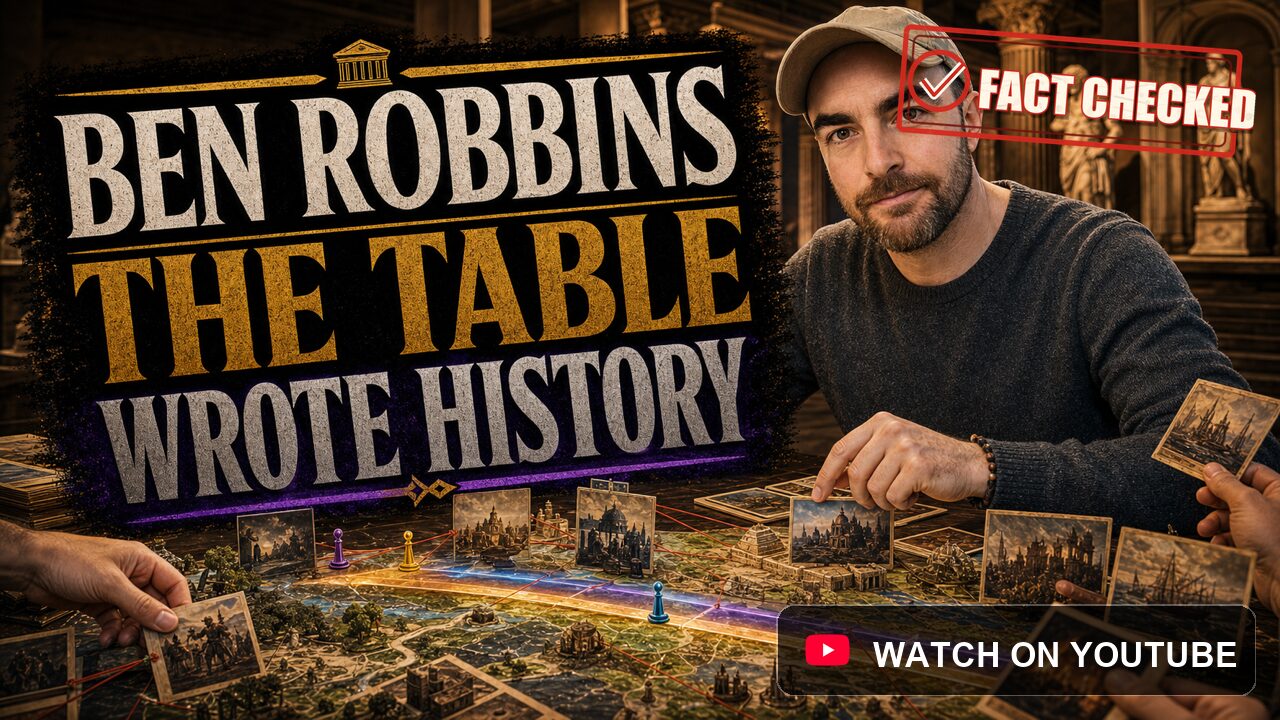
One person did the work alone. They drew the map, wrote the old wars, named the dead kings, decided which empire fell and which god lied. Then the rest of the table arrived and explored the finished product.
That model can be beautiful. It has carried entire friendships for decades.
Robbins kept asking a different question. What happens if the table makes the past together, in real time, with no game master and no preparation as a safety net?
Microscope was the clearest answer.
It did not only give players a new game. It gave them a different feeling at the table, the feeling of history becoming real because you are watching other people change it while you sit there.
The Western Edge
Robbins had changed the conversation before he sold a book.
West Marches began as a D&D campaign in the early 2000s. The structure was unusual enough that people still talk about it like a product: a large rotating cast, no fixed party, no regular scheduled session, and a wilderness stretching west from a safe home base. Players organized expeditions themselves. They chose where to go. The campaign did not wait for the same four people to show up every week.
That solved a real adult problem.
Most campaigns assume a stable group. Real life is messier than that. Jobs change. People move. Schedules collapse. West Marches stopped treating instability as a failure and built play around it. If enough players wanted to go somewhere, they made a plan and played. If someone missed a session, the world did not bend to explain the absence.
The wilderness was not a backdrop for a plot. It was the content. No quest-giver needed to point the group toward the next chapter. The players made the next chapter by deciding which rumor, ruin, or blank stretch of map was worth risking.
Robbins documented the approach on Ars Ludi, and those posts became a common reference point for later open-table, expedition-first play. “West Marches” escaped into the culture. People use it now as shorthand, even when they have never read the original writing.
That is how table craft becomes tradition. It stops belonging to one group and starts belonging to anyone who needs it.
The History On The Table
Microscope came later, and it was the bigger break.
The premise is simple enough to sound impossible: make a history together. Not a history lesson. Not a simulation of real events. A fictional history, built by the players at the table.
Players define a broad beginning and end. Between those bookends they add periods, events, and scenes. A period might be the Rise of the Empire. An event might be the assassination that ended the first dynasty. A scene might be one private conversation in a locked room before the knife comes out.
The design is fractal. You can look at centuries. You can zoom into a decade. You can zoom again into a single minute. The same history keeps opening, and each opening reveals another place where a player can make something matter.
Two constraints give the game its pressure.
On your turn, you add to the history. The other players do not get to negotiate your idea into something safer before it lands.
And once something is true, it stays true. You cannot contradict what has been established, even if it was invented a few minutes ago by the person across the table.
Those rules sound like they should make collaboration harder. They make it more alive.
By blocking easy consensus, Microscope makes room for surprise. Nobody owns the whole history. Nobody gets to guide it toward the version they secretly prefer. Each player contributes, then watches someone else reinterpret, deepen, undermine, or reframe the meaning of what they made.
The result often feels more like culture than lore. Contradictions in tone. Sudden inventions. Old consequences returning in new centuries. Tiny moments that reshape vast eras. The seams do not ruin it. The seams are the proof that more than one mind is inside the world.
The Community And The Crossroads
Kingdom asks a related question from another angle.
Instead of building a whole history, players build a community: a ship, a city, a cult, a corporation, a frontier outpost, a resistance cell, a church, a doomed school, or any other group that can face a future together. The community reaches Crossroads, decisions that will change what it becomes.
Do we open the gates to the refugees?
Do we betray the alliance?
Do we build the weapon?
The drama comes from values under pressure. The characters matter, but the real protagonist is the community. Players take different roles in the decision-making structure, and the question is not only who wins the argument. It is what kind of people this community becomes after the argument is over.
The revised edition deepened that structure and added ways to follow a community across time. That fits Robbins’s larger pattern. His games rarely ask only what happens. They ask what the thing becomes after enough people push on it.
Follow turns collaboration toward quests and fellowship. It is built for groups that want a clear shared goal and the tension of whether they hold together while pursuing it.
In This World moves back toward worldbuilding from first principles. It asks players to start with assumptions about the real world, then turn those assumptions sideways to create many possible worlds. Nations have borders. Money organizes work. Police carry badges. Dragons breathe fire. What if one of those facts worked differently?
The question keeps changing shape. The obsession stays the same.
The Blog As Design School
Ars Ludi matters because Robbins has always done more than publish games.
He writes about the craft. Campaign structure. Player agency. GM traps. Worldbuilding. Why games break. Why stories at the table behave differently from stories on a page. West Marches is the famous doorway, but the larger body of writing has been a long public workshop in tabletop thinking.
That kind of writing can be easy to undervalue because it is free, informal, and spread across years. But for many game masters and designers, an essay that changes how you run your table can matter as much as a hardcover rulebook.
Robbins’s current Lame Mage site still directs readers toward Ars Ludi, and the site itself is active with new posts, including work like Rules of Law and Summerlab experiments. His itch.io catalog is also current, listing Microscope, Kingdom, Follow, Union, In This World, Rules of Law, and playtest material such as Microscope: Chronicle.
This is not a factory. It reads like a workshop. The same designer keeps returning to the same hard questions and trying new tools.
The Shape Of The Method
Robbins does not design games about stories in the usual sense.
He designs games about making stories.
Microscope is not important because it tells one great history. It is important because it creates the experience of history being made by multiple minds that cannot fully control each other. Kingdom is not important because it tells one great community drama. It matters because it turns community decisions into play. West Marches is not only a campaign setting. It is a structure that makes adventure emerge from player initiative.
The hidden pattern is constraint.
Robbins takes away something designers often assume is necessary. No fixed party. No game master. No prepared setting. No group discussion before a history entry is added. No consensus vote to keep the world comfortable.
Then he replaces the missing piece with a rule that creates productive friction.
The games do not ask players to agree their way into creativity. They ask players to build under pressure, respect what has already been made, and keep going when someone else turns the shared creation in a direction nobody expected.
What He Actually Built
Ben Robbins did not invent collaboration. He did not invent sandbox play. He did not invent worldbuilding at the table. His catalog is small compared with designers who publish new systems every year, and his games mostly stay within the same family of GM-less collaborative story play.
What he built was a set of clear procedures for making shared creation work without turning into a meeting.
West Marches showed how a campaign could survive unstable attendance by giving players responsibility for choosing the adventure. Microscope showed that history itself could be the game. Kingdom showed how a community’s values could become a dramatic engine. Follow made collaborative quest play easier to pick up. In This World showed that assumptions about reality can be turned into worldbuilding fuel.
The influence is not only in products sold. It is in table habits. Session zero worldbuilding. Open-table campaigns. Players treating history as something they can make together. Game masters using Robbins’s tools before moving into another system entirely.
This is the quiet kind of legacy. It changes how people run their nights.
Where To Find Him
Robbins is still active through Lame Mage Productions, Ars Ludi, and his itch.io catalog. Lame Mage’s home page links to recent posts and games, including Rules of Law and In This World. The itch.io catalog remains a clean public storefront for Microscope, Kingdom, Follow, Union, In This World, Rules of Law, and playtest material like Microscope: Chronicle.
If you want the cleanest doorway, start with Microscope.
If you want to understand why West Marches kept spreading, read the original Ars Ludi posts and then look at how many later communities still use the phrase.
If you want the current edge of the work, look at In This World and Rules of Law.
The pattern is still the same.
Put the history on the table. Stop asking for permission. Let the next player make it stranger.
Fact Check Notes
Publication notes
This site is AI-assisted and human-reviewed. We use artificial intelligence to help gather research, organize source material, and draft profile content. Human editors then read, revise, and check each profile before it goes live. Most profiles are built through deep AI research and two separate rounds of fact-checking.
Leave a Reply
You must be logged in to post a comment.