Don Featherstone’s great act was not secrecy.
It was publication.
Before Featherstone, recreational miniature wargaming existed in scattered pockets. A few people had rules. A few people had figures. A few people had tables, correspondence, habits, and private procedures. But the hobby did not yet have a common front door.
Featherstone built one.
He wrote rules in plain language. He published books. He edited Wargamer’s Newsletter month after month. He organized gatherings. He answered letters. He took a pursuit that lived in rooms, clubs, and private friendships and made it reproducible for strangers.
That is why his legacy feels larger than any single mechanic.
He did not merely design games.
He made a hobby capable of explaining itself.
The Silence After Wells
H.G. Wells had published Little Wars in 1913, and it remains one of the charming ancestors of miniature wargaming. Toy soldiers. Spring-loaded cannon. Physical shots knocking figures down. A game with wit, spectacle, and the strange innocence of Edwardian play before the century turned dark.
Then came the wars.
For decades, miniature wargaming did not become a mass public hobby with shared rules and a visible publishing culture. Enthusiasts existed, especially in Britain and America, but they were hard to find unless you already knew where to look. The activity depended on letters, clubs, homemade rules, and personal networks.
Featherstone entered that world not as a distant theorist, but as a man with lived military experience and an unusually practical writing gift.
He had served in the Royal Armoured Corps during World War II, including service in North Africa and Italy. After the war, his profession was physiotherapy. He worked with athletes, treated bodies, and wrote about sports injuries as well as military history.
That combination matters.
The war gave him tactile knowledge. Physiotherapy gave him patience and clarity. Writing gave him the method for transmitting a hobby from one table to another.
War Games
War Games, published in 1962, is the hinge.
It did not make every miniature wargamer appear from nothing. It did something more useful. It gave interested readers a workable language for play.
The heart of that language was probability.
Instead of knocking toy soldiers over with physical projectiles, players could resolve fire, artillery, and close combat through dice. The basic idea was wonderfully portable: roll dice, modify for tactical circumstances, remove casualties, keep the game moving. Range, formation, charge, morale, terrain, and weapon type could all matter without requiring the table to become a mathematics examination.
This was not the first time dice and military probability had ever met. Professional military games had used probability before. Other designers were exploring miniature wargaming at the same time. But Featherstone’s achievement was access. His rules were civilian, readable, practical, and teachable.
He made the procedure feel available.
That availability changed everything.
Once a person could buy a book, read it, and play, wargaming no longer had to depend on being invited into the right private circle. The reader could start.
That is the real revolution.
The D6 Grammar
Featherstone’s rules were often simple by design.
That word, simple, can be misunderstood. In games, simplicity is not the absence of thought. It is a decision about what the player should notice.
Featherstone wanted players to notice the battle.
A handful of dice, a few modifiers, visible figures, and clear outcomes let the table breathe. Casualties came off the field. Units moved across real space. A player could see what was happening without turning the action into accounting.
This became part of the grammar of miniature wargaming.
D6 resolution with tactical modifiers. Figure removal. Period rules as practical toolkits. Historical notes that lead into play rather than burying it. Scenarios that teach by example. The idea that rules should be strong enough to support imagination but light enough to invite tinkering.
That last point is essential.
Featherstone did not write as if rules were sacred legal documents. He wrote for players who would adapt, borrow, adjust, and argue. That was not a bug in the early hobby. It was how the hobby breathed.
Later systems moved toward tighter competition, standardized basing, stricter troop types, and more elaborate simulation. Some of that work was necessary. Some of it was brilliant. Some of it also made the hobby more forbidding.
Featherstone’s voice kept pulling in the other direction.
Play the game.
Make a decision.
Roll the dice.
See what happens.
The Newsletter
If War Games gave the hobby a front door, Wargamer’s Newsletter gave it a bloodstream.
Featherstone began publishing it in 1962 and continued until 1980. FourCats’ archive describes Wargamer’s Newsletter as produced from 1962 to 1980 by Donald Featherstone, with many issues now preserved online. Wargame Developments’ history timeline likewise places Featherstone’s Newsletter at the center of the 1962 moment.
The importance of that monthly rhythm is hard to overstate without making it sound romantic.
A newsletter is humble technology. Paper, postage, deadlines, subscriptions, letters, corrections, short articles, battle reports, opinions, arguments, and news.
But for a scattered hobby, that humble technology can become infrastructure.
People who thought they were nearly alone discovered they were part of a field. Ideas moved. Rules circulated. New names appeared. Debates formed. A private pastime became a conversation.
Featherstone was not the only voice in that conversation, and he did not pretend to be. His books and newsletters often carried ideas from other wargamers. He credited contributors. He curated as much as he authored.
That transparency is part of why he mattered.
He was not building a monument to himself.
He was building a communications network.
The Doors He Opened
Featherstone kept writing.
War Game Campaigns helped players think beyond isolated battles. Armies could move on maps. Casualties could matter after the fight. Supply, attrition, and narrative continuity could turn a tabletop engagement into one chapter of a longer war.
Solo Wargaming gave serious attention to the player without an opponent. That was not a side issue. For many hobbyists, geography and schedule are the true enemies. Featherstone treated solo play as a real mode with fog of war, programmed opposition, chance, and uncertainty.
Skirmish Wargaming moved the focus down toward individual figures and named characters. That door would matter enormously for later gaming, where small-unit action, scenario design, and character-driven combat became central pleasures.
Advanced War Games and the many other books kept broadening the field. Naval games, air games, tanks, colonial wars, campaigns, battles, and historical periods arrived not as sealed products but as invitations to experiment.
Each book said, in effect: you can do this too.
That is the Featherstone sentence.
Not "behold my perfect system."
"You can do this too."
The Philosophy Of Enough
Featherstone’s limitations are real.
His rules can feel dated to modern eyes. They often lack the precision, balance machinery, and period-specific detail that later players came to expect. Competitive wargamers found other systems better suited to tournaments and standardized play. Some of his treatments were broad where later designers would be granular. Some historical problems were handled by judgment rather than solved by mechanism.
But the older one-size-fits-many approach survived because it was not trying to be everything.
Featherstone’s rules were not blueprints for a closed machine. They were working plans for a table. They trusted the player. They assumed the group would exercise taste, common sense, and adaptation. They valued speed, visibility, and the ability to start.
That philosophy has aged better than some of the systems that replaced it.
Every few years, the hobby remembers that playable simplicity has a power of its own. The old-school wargaming revival, the continued republication of Featherstone’s work through the History of Wargaming Project, and the affection that still surrounds his books all point toward the same truth.
The field still needs doors that open easily.
Featherstone built many of them.
The Node
Featherstone’s influence is not only mechanical.
It is network influence.
The Newsletter carried ideas. The books credited peers. The conventions and gatherings brought people into the same physical space. Designers who later built their own systems moved through a hobby culture that Featherstone had helped make legible.
That makes him less like a single destination and more like a junction.
Ideas passed through him. People found each other through him. A language of play became available because he kept printing, explaining, and mailing it.
This is sometimes harder to honor than a famous rules engine. A rules engine can be quoted. A network becomes invisible once it succeeds. Later generations inherit the connections and forget that someone had to tie the wires together.
Featherstone tied the wires.
The Man At The Table
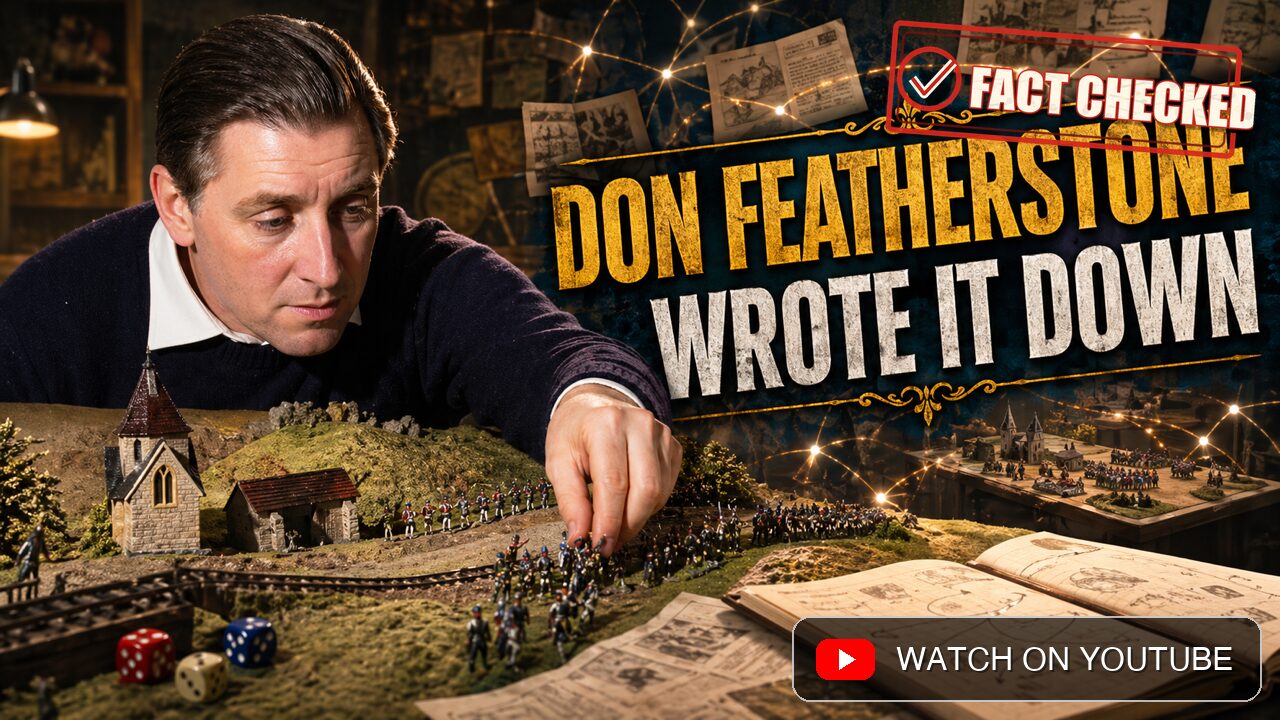
The supplied image catches the right thing.
Featherstone leans over a miniature battlefield, hand extended toward a cluster of figures. The table is not an abstract diagram. It is hills, a church, soldiers, roads, formations, and the physical pleasure of moving through a tiny world.
That is where his writing always returns.
The table.
Not simulation for its own sake. Not rules for their own beauty. Not history as frozen information. History as something you can arrange, test, dramatize, misunderstand, replay, and discuss.
He made wargaming communicable because he made it tangible.
A reader could see the figures. Understand the dice. Imagine the next turn. Write a letter. Try a rule. Send in an article. Start a club. Build a campaign. Play alone. Invite someone over.
That chain is the hobby.
What Remains
Don Featherstone died on September 3, 2013, after a life that stretched from World War I’s final year into the age of online wargaming archives.
What remains is War Games, the 1962 book that gave modern recreational miniature wargaming one of its defining public languages.
What remains is Wargamer’s Newsletter, preserved in scans and memory as the monthly conversation that helped scattered players become a community.
What remains is the Don Featherstone Tribute Weekend at the Wargames Holiday Centre, where his name is still attached to people gathering around tables to play.
What remains is the History of Wargaming Project’s continued republication of his work, keeping the books available to players who were born long after the first editions vanished from shop shelves.
And what remains is the simplest possible summary of his achievement.
He wrote it down.
Everything else could follow because of that.
Fact Check Notes
Publication notes
This site is AI-assisted and human-reviewed. We use artificial intelligence to help gather research, organize source material, and draft profile content. Human editors then read, revise, and check each profile before it goes live. Most profiles are built through deep AI research and two separate rounds of fact-checking.
Leave a Reply
You must be logged in to post a comment.